Rates and Differentiation (HSC SSCE Mathematics Advanced): Revision Notes
📚Revision Notes
Rates and Differentiation
Introduction
When analysing how quantities change over time, we use differentiation as a powerful tool. The first derivative tells us the rate at which something is changing, whilst the second derivative tells us the rate at which that rate is changing.
Previously, we defined functions at specific points as increasing when and decreasing when . Similarly, we said functions were concave up when and concave down when . These were all pointwise definitions - they described behaviour at individual points.
Now we extend these ideas to describe function behaviour over entire intervals, providing a more complete picture of how functions behave.
Increasing and decreasing over an interval
Consider a share price that varies with time days after a company launches. We want to describe whether the price is rising or falling over a period of time, not just at isolated moments.
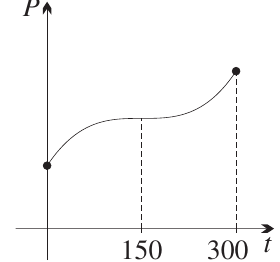
We say a function is increasing over an interval when every chord connecting two points on the curve slopes upward. In mathematical terms, for any two values and where , we must have .
Note
Notice something important: even if the tangent is horizontal at isolated points (like when in the graph above), the function can still be increasing over the interval. As long as every other tangent slopes upward, then every chord will slope upward without exception.
Important
Formal definition - Increasing and decreasing in an interval
For a function defined over an interval :
-
The function is increasing in the interval when every chord slopes upward:
-
The function is decreasing in the interval when every chord slopes downward:
The interval can be bounded or unbounded, and may be open, closed, or neither.
Connection to derivatives: If is differentiable over an interval and increasing at every point (except perhaps some isolated points where the tangent is horizontal), then it is increasing in the interval.
Concavity over an interval
Concavity describes the "shape" of the curve and provides insight into whether rates are accelerating or decelerating.
Using the share price example again, we observe two distinct behaviours:
In the interval [0, 150]: The graph is concave down because every chord lies under the curve. The significance here is that whilst the share price is increasing, it is increasing at a decreasing rate - the growth is slowing down.
In the interval [150, 300]: The graph is concave up because every chord lies above the curve. Here, the share price is increasing at an increasing rate - the growth is accelerating.
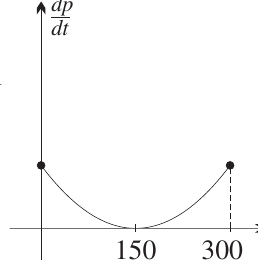
The gradient function shown above reveals this behaviour clearly. In the interval [0, 150], the gradient function is decreasing (corresponding to concave down in the original function). In the interval [150, 300], the gradient function is increasing (corresponding to concave up in the original function).
Important
Formal definition - Concave up and down in an interval
For a function defined and continuous over an interval :
-
The function is concave up in the interval when every chord within the interval lies above the curve
-
The function is concave down in the interval when every chord within the interval lies below the curve
Note
Helpful connections:
- If is differentiable in the interval and is increasing, then is concave up
- If is twice differentiable and at every point (except perhaps isolated points where ), then is concave up in the interval
Worked example: describing function behaviour
Example
Worked Example: River height during drought
Drought struck Kookaburra Valley, causing the height of the Everyflow River to drop. The graph below shows the river height at Emu Bridge days after 1st January.
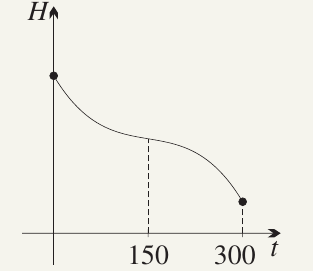
Question: Use the features of the graph to describe the behaviour of the river height. What happened around day 150?
Solution:
The river height is decreasing throughout the entire 300-day period.
Interval [0, 150]: The graph is concave up, so the height is decreasing at a decreasing rate. This means the river level is falling, but the rate of fall is slowing down.
Interval [150, 300]: The graph is concave down, so the height is decreasing at an increasing rate. The river level is falling faster and faster.
Around day 150: Since the rate of decrease changed from slowing down to speeding up, it probably rained a little just before , temporarily slowing the rate of decline.
Important
Important note about language: When we say the height is "decreasing at a decreasing rate", we mean is negative and is decreasing. Similarly, "decreasing at an increasing rate" means is negative and is increasing. This language is intuitive, but be careful with the mathematics behind it.
Combining increasing/decreasing with rate changes
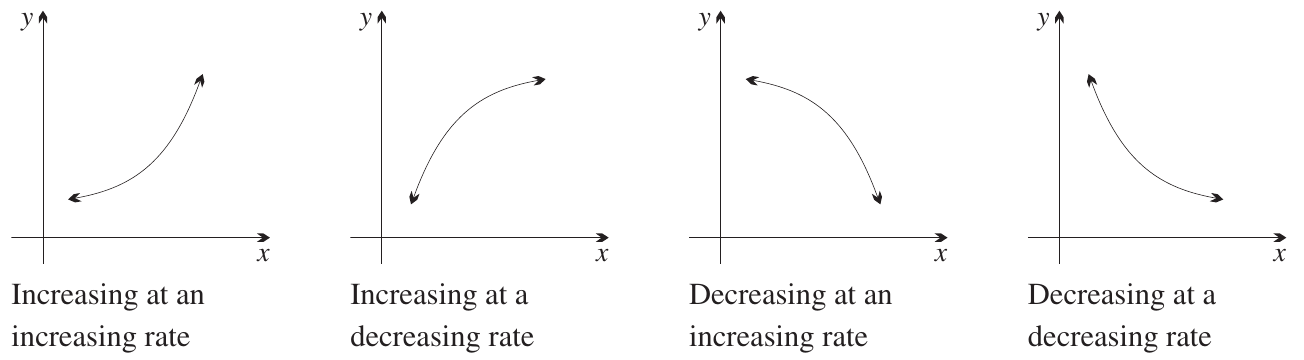
By combining whether a function is increasing or decreasing with whether it is concave up or down, we can precisely describe four distinct patterns of behaviour:
Note
Rate terminology - Four key patterns
For a function defined and continuous over an interval :
-
Increasing at an increasing rate: The function is increasing AND concave up in
- The function rises and the rate of rise accelerates
- Example: exponential growth
-
Increasing at a decreasing rate: The function is increasing AND concave down in
- The function rises but the rate of rise decelerates
- Example: logarithmic growth
-
Decreasing at an increasing rate: The function is decreasing AND concave down in
- The function falls and the rate of fall accelerates
- Example: steep decline after a peak
-
Decreasing at a decreasing rate: The function is decreasing AND concave up in
- The function falls but the rate of fall decelerates
- Example: exponential decay
Example
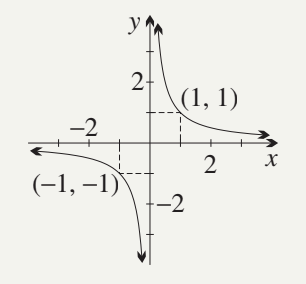
Worked Example: The reciprocal function
Question: Describe the branches of using rate terminology.
Solution:
In the interval : The curve is decreasing at an increasing rate and concave down. As moves leftward from just below zero, becomes increasingly negative at an accelerating rate.
In the interval : The curve is decreasing at a decreasing rate and concave up. As increases from just above zero, decreases toward zero but the rate of decrease slows down.
Average rates versus instantaneous rates
When analysing change, we distinguish between two types of rates:
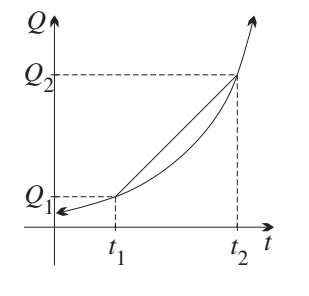
Average rate of change corresponds to a chord. It measures the overall change between two points:
Instantaneous rate of change corresponds to a tangent. It measures the rate at one specific moment:
Note
Unless otherwise stated, "rate of change" always means the instantaneous rate of change, which equals the gradient of the tangent at that point.
Comprehensive worked example
Example
Worked Example: Share price analysis
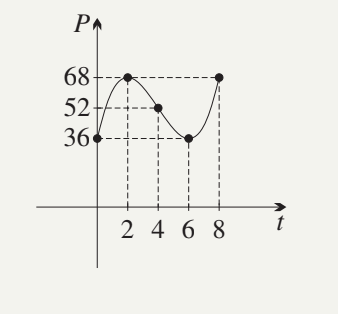
For the first 8 months after listing, the share price (in cents) of Avocado Marketing followed:
where is the time in months after listing.
a) Initial and final share prices
When :
When :
b) Rates of change
First derivative (rate of change of price):
Second derivative (rate of change of the rate):
c) Local maximum and minimum
Setting :
When :
When :
Summary: Local maximum of 68 cents after 2 months; local minimum of 36 cents after 6 months.
d) Points of inflection
Setting :
When :
Testing for sign change:
| 2 | 4 | 6 | |
|---|---|---|---|
| Shape | ⌢ | · | ⌣ |
Since changes sign around , the point is an inflection point.
e) Describing behaviour using rate terminology
- Interval [0, 2]: Price is increasing at a decreasing rate (increasing and concave down)
- Interval [2, 4]: Price is decreasing at an increasing rate (decreasing and concave down)
- Interval [4, 6]: Price is decreasing at a decreasing rate (decreasing and concave up)
- Interval [6, 8]: Price is increasing at an increasing rate (increasing and concave up)
f) Average rate of increase
The price changed from 36 cents at to 68 cents at .
Summary
Key Points to Remember:
-
A function is increasing in an interval when all chords slope upward: for all
-
A function is concave up when all chords lie above the curve; concave down when all chords lie below the curve
-
Increasing at an increasing rate means the function is both increasing AND concave up (think: accelerating growth)
-
Average rate uses chord gradient: ; instantaneous rate uses tangent gradient:
-
The second derivative tells us about concavity: positive means concave up, negative means concave down