Rates and Integration (HSC SSCE Mathematics Advanced): Revision Notes
📚Revision Notes
Rates and Integration
Understanding rates and integration
When we know how quickly a quantity is changing over time (called the rate of change), we can work backwards to find the original quantity itself. This process uses integration, which is the reverse of differentiation.
If we know the rate at which a quantity is changing with respect to time , we can find by integrating the rate function. This is similar to how we worked with motion - if we know velocity (rate of change of displacement), we can find displacement by integrating.
Note
Integration and differentiation are inverse operations - just like addition and subtraction, or multiplication and division. When you differentiate a function and then integrate the result, you return to the original function (plus a constant).
There are two crucial points to remember:
- Always include the constant of integration (usually written as ) when you integrate
- Use an initial condition or boundary condition (information about the value of the quantity at a specific time) to work out what equals
Finding the quantity from the rate
When the rate of change of a quantity is known as a function of time , follow these steps:
Important
Three-Step Process for Finding Quantities from Rates:
Step 1: Integrate the rate to find as a function of time
Step 2: Always include the constant of integration in your answer
Step 3: Use an initial or boundary condition to calculate the value of the constant of integration
This three-step process ensures you find the complete function, not just the general form.
Worked example: Tank drainage
Let's look at a practical problem involving water draining from a tank.
Example
Worked Example: Tank Drainage Problem
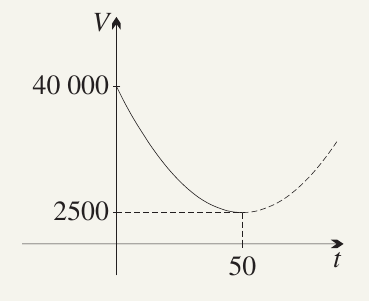
Problem: A tank contains 40,000 litres of water. When the draining valve is opened, the volume in litres decreases at a variable rate given by , where is the time in seconds after opening the valve. The valve shuts off once water stops flowing.
Part a: When does the water stop flowing?
Water stops flowing when the rate becomes zero. Setting the rate equal to zero:
The water stops flowing after 50 seconds.
Part b: Why is the rate negative?
During the first 50 seconds, water is flowing out of the tank. This means the volume in the tank is decreasing. When a quantity decreases over time, its rate of change (derivative) is negative. This is why is negative up to seconds.
Part c: Finding the volume function
To find the volume at any time, we integrate the rate:
Now we use the initial condition to find . We're told that when , the tank contains litres.
Substituting these values:
Therefore, the volume at any time is:
Part d: How much water has flowed out?
When seconds:
The tank still contains 2,500 litres when the valve closes. Since it started with 40,000 litres:
Amount that flowed out litres
Answer: 37,500 litres of water flowed out
Working with graphs instead of equations
Sometimes we're given a graph of a rate function but not its equation. In these situations, we need to carefully analyse the features of the rate graph to understand the behaviour of the original quantity.
Note
Key Features to Look For in Rate Graphs:
- Where the rate equals zero → these are stationary points of the original function
- Where the rate is positive → original function is increasing
- Where the rate is negative → original function is decreasing
- Where the rate reaches a minimum or maximum → these are inflection points of the original function
Worked example: Population dynamics
Example
Worked Example: Analyzing Population from Rate Graph
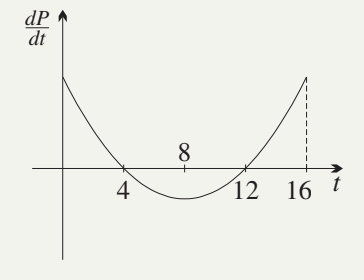
Problem: Frog numbers in the Ranavilla district were increasing, but during a drought, the rate of increase fell and became negative for several years. The graph below shows the rate of population growth as a function of time years after observations began.
Part a: When was the population neither increasing nor decreasing?
Looking at the graph, at two times:
- When years
- When years
These are the times when the population was stationary (neither increasing nor decreasing).
Part b: When was the population decreasing and increasing?
The population decreases when its rate of change is negative. From the graph:
- (negative) when
- Therefore, the population was decreasing during years 4 to 12
The population increases when its rate of change is positive. From the graph:
- (positive) when and when
- Therefore, the population was increasing during years 0 to 4, and again during years 12 to 16
Part c: When was the population decreasing most rapidly?
The population decreases most rapidly when the rate is at its most negative value (the minimum point on the graph). This occurs at t = 8 years.
Part d: When was the population at a maximum?
From parts a and b, we know that:
- Before , the population was increasing
- After , the population was decreasing
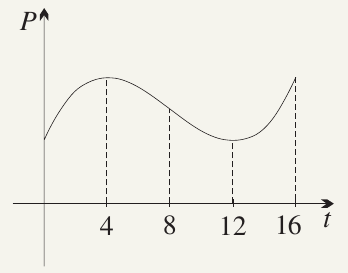
Therefore, the population reached its maximum at t = 4 years.
Part e: When was the population at a minimum?
Similarly, we can see that:
- Before , the population was decreasing
- After , the population was increasing
Therefore, the population reached its minimum at t = 12 years.
Part f: Sketching the population graph
We need to draw a graph of versus that matches the behaviour we identified. The key features are:
- The gradient of must match the values shown in the graph
- Maximum at years
- Minimum at years
- Increasing before and after
- Decreasing between and
- The population cannot fall below zero
Rates involving exponential functions
Many natural processes involve quantities that change exponentially. When integrating exponential functions, we use the standard formula:
Important
Integration of Exponential Functions:
Remember to divide by the coefficient of the variable in the exponent.
For example, to integrate :
Notice how we handle the negative coefficient in the exponent carefully - this is a common source of errors.
Worked example: Exponential decay
Example
Worked Example: Water Flow with Exponential Decay
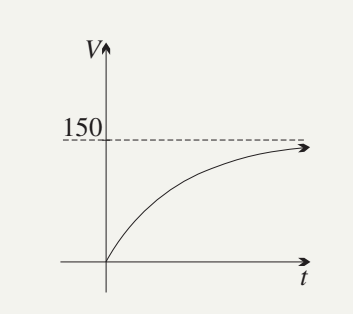
Problem: During a drought, the flow rate of water from Welcome Well gradually diminishes according to , where is the volume in megalitres that has flowed out during the first days after time zero.
Part a: Is the rate always positive?
Since for all values of , we know that for all values of .
Therefore, is always positive.
Physical significance: The volume represents the total amount of water that has flowed out of the well. This quantity can only increase (water flows out, not back in), so its rate of change must always be positive. The water continues to flow, just at an ever-decreasing rate.
Part b: Finding the volume function
Integrating the rate:
When , no water has yet flowed out, so .
Substituting:
Therefore:
Part c: Water flow during first 100 days
When days:
Part d: Long-term behaviour and percentage analysis
As , the exponential term
Therefore, megalitres
This means the well will eventually produce a total of 150 megalitres of water, but it approaches this limit asymptotically (never quite reaching it in finite time).
To find what percentage flows in the first 100 days:
Answer: Approximately 86.5% of the total water flow occurs in the first 100 days, even though water continues to flow indefinitely at an ever-decreasing rate.
Summary
Key Points to Remember:
- When you know a rate of change , integrate to find the original quantity
- Always include the constant of integration - this is essential and must never be omitted!
- Use an initial or boundary condition to find the value of
- When analysing rate graphs:
- Zero rate means stationary point
- Positive rate means increasing
- Negative rate means decreasing
- For exponential rates of the form , remember to divide by the coefficient of the variable when integrating
- Physical context matters: think about whether the quantity can be negative, and what the rate's sign tells you about behaviour