Velocity and Acceleration as Derivatives (HSC SSCE Mathematics Advanced): Revision Notes
📚Revision Notes
Velocity and Acceleration as Derivatives
Introduction to instantaneous velocity
When travelling, your average velocity might be quite different from your instantaneous velocity at any given moment. For example, if you drive 160 km from Sydney to Newcastle in 2 hours, your average velocity is 80 km per hour. However, your instantaneous velocity during the journey varies constantly - it might be zero at traffic lights or 110 km per hour on expressways.
Note
The key connection is this: average velocity corresponds to the gradient of a chord on a displacement-time graph, while instantaneous velocity corresponds to the gradient of a tangent.
Instantaneous velocity and speed
From now on, when we use the words "velocity" and "speed" alone, we mean instantaneous velocity and instantaneous speed.
Instantaneous velocity is the gradient of the tangent on the displacement-time graph:
This can also be written using Newton's dot notation as:
The dot over any symbol means differentiation with respect to time .
Instantaneous speed is the absolute value of the velocity:
Understanding dot notation
Important
Newton introduced the dot notation as a shorthand for derivatives with respect to time:
- means (velocity)
- means (acceleration)
- means (acceleration)
All the symbols , , and represent velocity.
Worked example: Ball trajectory
Example
Worked Example: Ball Trajectory Analysis
A ball moves with displacement equation , where is in metres and is in seconds.
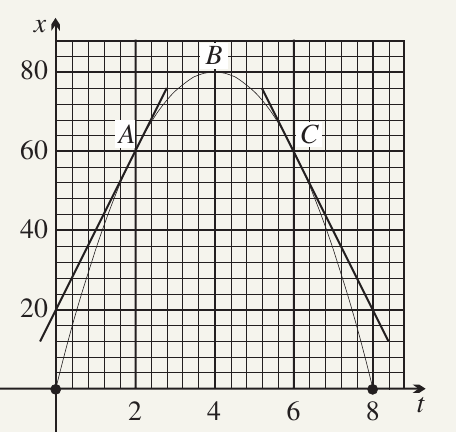
Step 1: Finding the velocity function
First, expand the displacement equation:
Differentiate to find velocity:
This is a linear function with -intercept 40 and gradient .
Step 2: Creating a table of values
| 0 | 2 | 4 | 6 | 8 | |
|---|---|---|---|---|---|
| 40 | 20 | 0 | -20 | -40 |
The velocity graph is a straight line sloping downward.
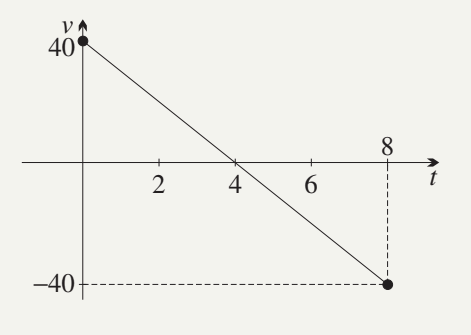
Step 3: Checking against tangent gradients
If you measure the gradients of the tangents at points A (), B (), and C () on the displacement graph, they match the velocity values: 20, 0, and -20 respectively.
Step 4: Determining initial velocity
When ,
The ball was originally hit upwards at 40 m/s.
Step 5: Finding impact speed
When ,
The ball hits the ground at 40 m/s (the negative sign indicates downward direction).
Worked example: Cubic motion
Example
Worked Example: Cubic Motion Analysis
A particle moves with displacement (in metres and seconds).
Step 1: Finding velocity
Step 2: Analysis at
Distance from origin: 2 metres
Speed: 6 m/s
Step 3: Analysis at
Distance from origin: 7 metres
Speed: 21 m/s
Vector and scalar quantities
Understanding the difference between vectors and scalars is crucial in motion problems.
Important
Vector quantities have direction built into them:
- Displacement (can be positive or negative)
- Velocity (can be positive or negative)
A negative velocity means the particle is moving in the negative direction (for example, downwards or to the left). A negative displacement means the particle is on the negative side of the origin.
Scalar quantities are magnitudes only:
- Distance (always positive or zero)
- Speed (always positive or zero)
Distance is the magnitude of displacement, and speed is the magnitude of velocity. Neither can be negative.
Finding when a particle is stationary
A particle is stationary when its velocity equals zero. This occurs at turning points in the motion.
Note
Method: To find when a particle is stationary, set and solve for .
This connects to the concept of stationary points on graphs - these are points where the derivative (gradient) is zero.
Worked example: Finding stationary times
Example
Worked Example: Finding When a Particle is Stationary
A particle moves with displacement (in metres and seconds).
Step 1: Finding when stationary
First, find the velocity function:
Factor the quadratic:
Set :
The particle is stationary after 3 seconds and after 9 seconds.
Step 2: Finding distance from origin
When :
When :
The particle is 18 metres from the origin on both occasions (once at +18, once at -18).
Acceleration as the second derivative
A particle is accelerating if its velocity is changing. Acceleration is defined as the rate at which velocity changes.
Acceleration as first derivative of velocity:
Acceleration as second derivative of displacement:
Since velocity is the derivative of displacement, acceleration is the second derivative of displacement:
Important
Summary of notation:
All these symbols mean acceleration:
Important note: In motion problems, represents the acceleration function, not a constant (unlike in other mathematical contexts where often represents a constant).
Worked example: Constant acceleration
Example
Worked Example: Constant Acceleration Analysis
Consider the ball from earlier with displacement .
Step 1: Finding velocity and acceleration
The acceleration is constant at -10 m/s².
Step 2: Analysis at
Step 3: Understanding the motion
During the first 4 seconds:
- The ball has positive velocity (rising)
- The ball is slowing down by 10 m/s every second
During the last 4 seconds:
- The ball has negative velocity (falling)
- The ball is speeding up by 10 m/s every second
This shows how constant negative acceleration can cause a particle to both slow down (when moving upward) and speed up (when moving downward).
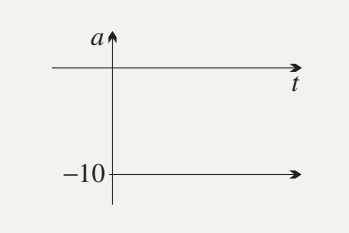
Units of acceleration
In the previous example, the particle's velocity decreased by 10 m/s every second. This is expressed as:
-10 metres per second, per second
In symbols: or
Note
The units of acceleration correspond with the indices in the second derivative .
Acceleration is normally a vector quantity - it has direction built into it. This is why we write the acceleration as with the negative sign. Alternatively, we can omit the minus sign and specify the direction: "10 m/s² in the downward direction".
Worked example: Finding zero acceleration
Example
Worked Example: Finding When Acceleration is Zero
For the particle with displacement :
Step 1: Finding acceleration function
Step 2: When is acceleration zero?
Step 3: State of particle at
At , the particle is at the origin, moving with velocity -9 m/s (moving in the negative direction).
Trigonometric equations of motion
When a particle's motion is described by sine or cosine functions, it oscillates backwards and forwards, becoming stationary repeatedly.
Note
The wavy graphs of displacement (), velocity (), and acceleration () help visualize the particle's motion. These graphs show the periodic nature of trigonometric motion.
Worked example: Sinusoidal motion
Example
Worked Example: Sinusoidal Motion Analysis
A particle has displacement function .
Step 1: Finding velocity and acceleration
This has amplitude 2 and period .
This has amplitude and period 2.
This has amplitude and period 2.
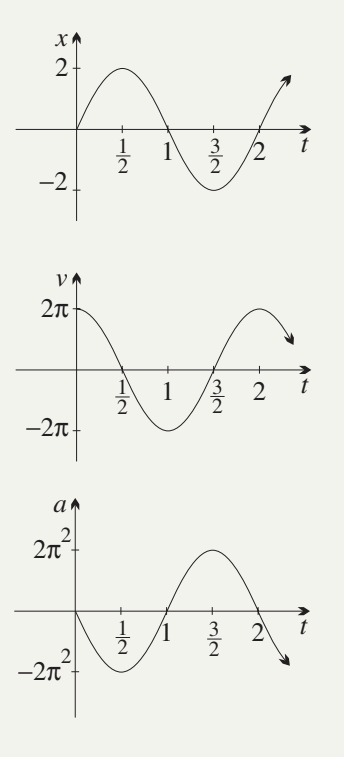
Step 2: Finding when at the origin (in interval )
From the displacement graph, when:
At these times:
- When : speed = m/s, acceleration = 0
- When : speed = m/s, acceleration = 0
- When : speed = m/s, acceleration = 0
Step 3: Finding when stationary (in interval )
The particle is stationary when .
From the velocity graph: or
At these times:
- When : metres, m/s²
- When : metres, m/s²
Step 4: Description of motion
The particle oscillates forever between and , with period 2. It begins at the origin and moves first toward .
Motion with exponential functions
When motion is described by exponential functions, we often examine limiting values - what happens to the particle "eventually" or "as time goes on". This means taking the limit as .
Important
Key fact for exponential motion:
This is essential for finding limiting values in exponential motion problems.
Worked example: Exponential motion
Example
Worked Example: Exponential Motion with Limiting Values
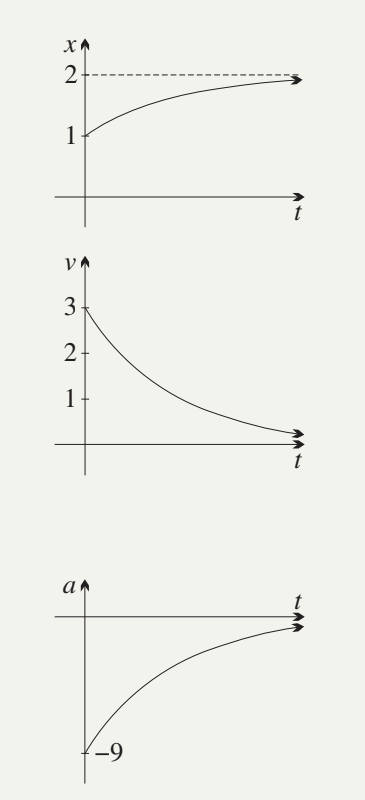
A particle has height metres above ground at time seconds.
Step 1: Finding velocity and acceleration
Step 2: Initial values ()
Using :
Step 3: Limiting values (as )
As increases,
Therefore:
- metres
- m/s
- m/s²
Step 4: Description of motion
The particle starts 1 metre above the ground with initial velocity of 3 m/s upwards. It constantly slows down and moves toward a limiting position at height 2 metres, which it approaches but never quite reaches.
Extension: Newton's second law of motion
Newton's second law states that when a force is applied to a body that is free to move, the body accelerates with an acceleration proportional to the force and inversely proportional to the mass:
where:
- is the mass of the body
- is the sum of all forces applied
- is the resulting acceleration
Note
The units of force are chosen to make the constant of proportionality equal to 1. In SI units (kilograms, metres, seconds), the units of force are called newtons.
This law means that acceleration is felt in our bodies as a force - we experience this when a car accelerates away from traffic lights or brakes suddenly. The second derivative (acceleration) becomes directly observable to our senses as a force, just as the first derivative (velocity) is observable to our sight.
Remember!
Summary
Key Points to Remember:
-
Velocity is the first derivative of displacement:
-
Speed is the magnitude of velocity: Speed =
-
A particle is stationary when - solve this equation to find when it occurs
-
Acceleration is the second derivative of displacement:
-
Vector quantities (displacement, velocity, acceleration) have direction and can be negative; scalar quantities (distance, speed) are magnitudes only and are always positive or zero
-
Units of acceleration are m/s² or ms⁻², representing metres per second, per second
-
For exponential motion, remember that as when finding limiting values