The Exponential and Logarithmic Functions (HSC SSCE Mathematics Advanced): Revision Notes
📚Revision Notes
Integration of the Reciprocal Function
Why we need a special rule for integrating 1/x
The reciprocal function is important in mathematics because it describes relationships where two quantities are inversely proportional to each other. Until now, we haven't been able to integrate this function using our standard techniques.
The standard power rule for integration states that:
However, when we try to apply this rule with , we encounter a problem:
Important
This result is undefined because we cannot divide by zero. The standard power rule completely breaks down at , requiring us to find a different approach.
Despite this algebraic problem, we can see from the graph of that there should be no issue with definite integrals involving , as long as we don't try to integrate across the discontinuity at .
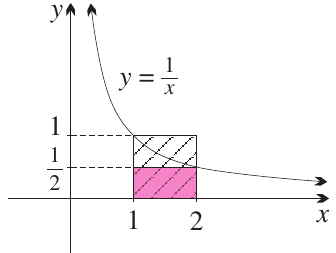
The diagram shows the area under the curve from to . Using rectangles to approximate the area, we can estimate that this integral has a value between and .
The basic standard form
Since we know that the derivative of the natural logarithm is:
we can work backwards to find the integral. Reversing this differentiation gives us:
This is our new standard form for integrating the reciprocal function, where is the constant of integration.
Note
There is one important restriction: this result only applies when , because is undefined for negative values and zero.
Standard form (for positive x):
Example
Worked Example: Evaluating a definite integral
Let's find the exact value of , which is the shaded area shown in the diagram above.
Using our standard form:
This is because .
To verify our earlier estimate, we can approximate this value:
This is indeed between and , confirming what the rectangles in the diagram suggested.
A characterisation of e
When we integrate the reciprocal function from to , we get a remarkably simple result. This property is so important that it can be used to define the number itself.
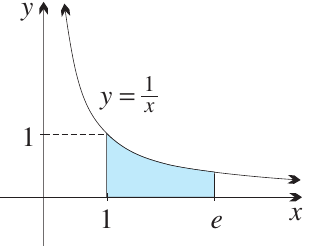
Working through the calculation:
Note
This tells us that the area under the curve from to is exactly 1. Some mathematicians use this property as the definition of : it is the unique positive number such that .
Extending to both sides of the origin
So far, our formula only works for positive values of . However, the graph of is a hyperbola with two separate branches, one for positive and one for negative . We should be able to integrate on either branch, as long as we don't cross the asymptote at .
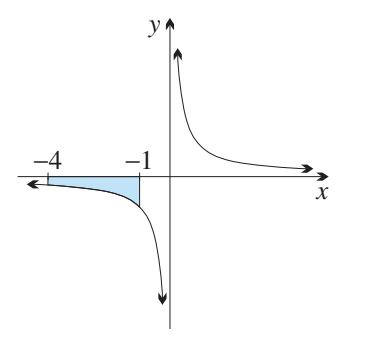
For negative values of , we can find a primitive by considering . When is negative, is positive, so is well-defined. Using the chain rule:
Reversing this gives us:
Important
The absolute value function helps us combine both cases into a single formula:
This unified form works for both positive and negative values of .
Important note: separate constants for each branch
Note
Technically, because the two branches of are disconnected, each branch can have its own constant of integration. The complete general primitive is:
where and may be different constants.
In practice, most problems involve only one branch at a time, so the simpler unified form is usually sufficient and is the standard notation used.
Three standard forms for integration
By extending the basic result and using the chain rule in reverse, we obtain three key standard forms:
Important
Standard forms for integrating reciprocal functions:
Critical warning: No calculation involving these integrals may cross an asymptote. If a definite integral would cross a point where the function is undefined, the integral is meaningless.
Worked examples: using the first two standard forms
Let's evaluate some definite integrals using the first two standard forms.
Example
Worked Example 1: Find
Example
Worked Example 2: Find
Here and , so:
Example
Worked Example 3: Why is meaningless?
This definite integral crosses the asymptote at , which lies between the limits of integration. The function is undefined at , so this integral cannot be evaluated.
Using the third standard form
The third standard form is particularly powerful:
Important
The key to using this form is recognising that the numerator must be the derivative of the denominator. You can use whichever notation you prefer: and , or and .
Worked examples with the third standard form
Example
Worked Example 1: Evaluate
First, identify the function and its derivative:
- Let
- Then
The numerator is exactly the derivative of the denominator , so we can apply the third standard form:
Note: We don't need absolute value signs here because is always positive.
Example
Worked Example 2: Evaluate
Let , so .
The numerator is , but we need to match the derivative. We can manipulate the integral:
Now the numerator is the derivative of the denominator:
Example
Worked Example 3: Why is meaningless?
This integral crosses the asymptote at (where ), so it cannot be evaluated.
Finding a function from its derivative
When we're given the derivative of a function and asked to find the original function, we integrate and then use a boundary condition (initial value) to find the constant of integration.
Example
Worked Example: Find if and the graph passes through the origin. Then find .
Solution:
Part (a): Finding
Given:
To find , we integrate:
Now we use the boundary condition. Since the graph passes through the origin, :
Therefore:
Part (b): Finding
Substituting :
Note: In this example, the asymptote is at , and both the given point and the evaluation point are on the same side of the asymptote, so there are no issues with the constant of integration.
A primitive of ln x
Finding a primitive (antiderivative) of requires a clever application of the product rule for differentiation. This result is important and worth understanding, though you don't need to memorise the derivation.
Derivation using the product rule
If we differentiate using the product rule with and :
Now, if we consider the function :
This shows that is a primitive of . Reversing this result:
Note
This elegant formula allows us to integrate the natural logarithm function, which appears frequently in calculus and its applications. While you should know the result, the derivation demonstrates how the product rule can be used in reverse to find integrals.
Application: evaluating an integral
We can use this result to evaluate :
This elegant result tells us that the area under the curve from to is also equal to 1.
Summary
Key Points to Remember:
-
The power rule fails at , so we need a special standard form:
-
Three key standard forms:
-
Never cross an asymptote when evaluating definite integrals. If the limits of integration include a point where the function is undefined, the integral is meaningless.
-
The area under from 1 to equals 1, which provides a fundamental characterisation of the number .
-
For the form, the crucial requirement is that the numerator must be exactly the derivative of the denominator. Sometimes you need to manipulate the integral to achieve this.
-
The integral of is given by: