Calculus with Other Bases (HSC SSCE Mathematics Advanced): Revision Notes
📚Revision Notes
Calculus with Other Bases
Introduction
When working with exponential functions in calculus, we typically use base . However, sometimes you'll encounter functions with different bases, such as or . The change-of-base formula allows us to differentiate and integrate exponential and logarithmic functions of any base without converting to base first.
Note
Understanding how to work with different bases is essential because many real-world applications use bases other than . For example, population growth models often use base 2, and pH calculations use base 10.
In this note, we develop three standard formulas that make working with other bases straightforward. Throughout, the base must be positive and not equal to 1.
Logarithmic functions to other bases
The change-of-base formula
Any logarithmic function can be expressed in terms of using the change-of-base formula. This is important because it shows that every logarithmic function is just a constant multiple of the natural logarithm.
Important
Change-of-base formula:
This can also be written as:
This relationship tells us that is simply multiplied by the constant . This means we can treat as a constant when differentiating, making the process straightforward.
Example
Worked Example: Using the change-of-base formula
Question:
a) Express in terms of
b) Use the calculator's ln function to approximate these values to four decimal places:
c) Check the results using the power function
Solution:
Part a:
Using the change-of-base formula:
Part b:
For :
For :
For :
Part c:
We can verify these results by checking that raised to each power gives the original number:
Differentiating logarithmic functions with other bases
Understanding the differentiation process
Once we've expressed a logarithmic function as a multiple of , we can differentiate it using the standard rules we already know. Because is a constant, we can apply the constant multiple rule.
Two approaches to differentiation
There are two equally valid ways to differentiate logarithmic functions with bases other than :
Method 1: Use the change-of-base formula to convert to base , then differentiate
Method 2: Use the standard form directly:
Note
Both methods give the same result, but Method 2 is often faster once you're familiar with the formula. Method 1 is useful for understanding where the formula comes from.
Deriving the standard form
Example
Worked Example: Deriving the differentiation formula
Question: Use the change-of-base formula to differentiate .
Solution:
Starting with
Using the change-of-base formula:
Since is a constant:
This gives us the general formula for differentiating logarithms with any base.
Important
Standard form for differentiating logarithms:
Notice that when , we have , so this reduces to , which is the familiar formula we already know.
Worked examples of differentiation
Example
Worked Example: Differentiating with different bases
Question: Differentiate:
a)
b)
Solution:
Part a:
Part b:
Characterisation of the logarithmic function
The gradient at the x-intercept
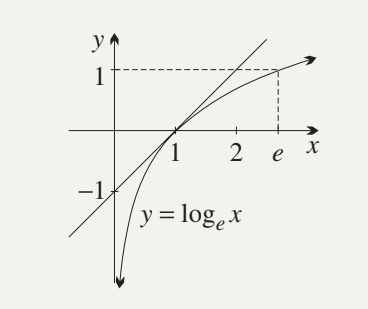
An interesting property distinguishes the natural logarithm from all other logarithmic functions: it's the only one whose gradient at the x-intercept equals exactly 1.
This special property helps explain why base is so fundamental to calculus. While other bases work perfectly well mathematically, base gives the simplest and most elegant formulas.
Proving the special property of base e
Example
Worked Example: The special gradient property
Question:
a) Show that the tangent to at the x-intercept has gradient
b) Show that is the only logarithmic function whose gradient at the x-intercept is exactly
Solution:
Part a:
Starting with
When :
So the x-intercept is at .
Differentiating:
When :
as required.
Part b:
The gradient at the x-intercept is if and only if:
Therefore, the gradient equals only when the base equals .
Important
Key characterisation of the natural logarithm:
The function is the only logarithmic function whose gradient at the x-intercept is exactly . This special property is one reason why base is fundamental to calculus.
Exponential functions with other bases
Converting to base e
Before we can apply calculus to an exponential function with base different from , we must convert it to base . We use the important identity:
This identity expresses the fact that and are inverse functions. Just as , we also have for any positive number .
The conversion process
We can write in terms of base as follows:
Using the index law :
Now has been expressed in the form where is a constant. This form is ready for differentiation and integration using our standard rules for exponential functions.
Important
Key formulas for converting to base e:
Every positive real number can be written as a power of :
Every exponential function can be written with base :
These conversions are essential because all our differentiation and integration rules for exponential functions are based on .
Example
Worked Example: Converting to powers of e
Question: Express these numbers and functions as powers of :
a)
b)
c)
Solution:
Part a:
Part b:
Part c:
Differentiating and integrating exponential functions with other bases
Deriving the standard forms
Once we've written the function as a power of , we can differentiate and integrate using our standard rules. The key is recognizing that is just a constant multiplier.
Starting with
For differentiation:
For integration:
Important
Standard forms for exponential functions with base a:
Two approaches for working with base a:
-
Convert all powers to base before differentiating or integrating
-
Use the standard forms directly:
Key observation: Both formulas involve the constant . When differentiating, you multiply by . When integrating, you divide by .
Note
Why base e gives the simplest formulas:
Notice that both formulas involve the constant . This constant equals when , which is why the formulas are simplest with base :
This confirms that is the most natural base for calculus with exponential functions.
Example
Worked Example: Differentiating and finding gradient
Question: Differentiate . Hence find the gradient of at the y-intercept, correct to three significant figures.
Solution:
Starting with
Using the standard form:
When (the y-intercept):
Example
Worked Example: Area between curves
Question:
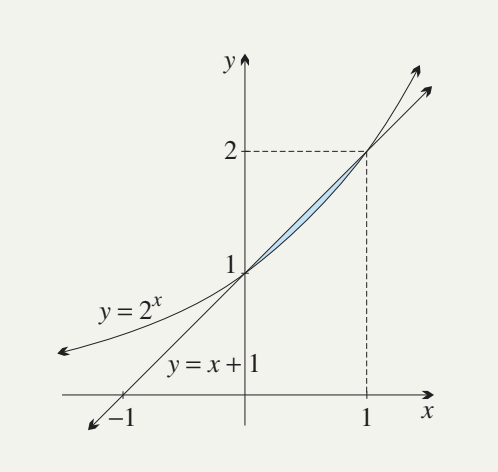
a) Show that the line meets the curve at and
b) Sketch the two curves and shade the region between them
c) Find the area of this shaded region, correct to four significant figures
Solution:
Part a:
For point :
When : and ✓
For point :
When : and ✓
Part b:
The graph shows the line intersecting the exponential curve at the two points. The shaded region lies between them from to .
Part c:
The area is found by integrating the difference between the upper and lower curves:
Evaluating at the limits:
At :
At :
Therefore:
Summary
Key Points to Remember:
-
Change-of-base formula: Any logarithmic function can be written as , making it a constant multiple of
-
Differentiating logarithms: Use , or convert to base first
-
Converting exponentials: Any exponential function can be written as before applying calculus
-
Differentiating exponentials: Use — remember to multiply by
-
Integrating exponentials: Use — remember to divide by
-
Special property of base e: The function is the only logarithmic function with gradient exactly at its x-intercept, which is why base is fundamental to calculus
-
Memory aid: "To differentiate , multiply by ; to integrate , divide by "