Further Applications of Differentiation (HSC SSCE Mathematics Advanced): Revision Notes
📚Revision Notes
Further Applications of Differentiation
Introduction
We can use differentiation to analyze and sketch graphs of functions that include . The derivative provides valuable information about tangents, normals, turning points, and the overall shape of logarithmic curves.
Finding tangents and normals to logarithmic curves
The derivative helps us find the equations of tangents and normals to curves involving logarithms. We use the key derivative:
Important
The derivative of the natural logarithm is:
This derivative gives us the gradient of the tangent at any point on the curve .
Example
Worked Example: Tangent and normal to at
Let's find the tangent and normal to at the point .
Finding the tangent:
Differentiating gives us
At point , the gradient is
Using the point-gradient form:
This can also be written as
Notice that this tangent passes through the origin and has gradient .
Finding the normal:
Since the tangent has gradient , the normal has gradient (negative reciprocal).
Using the point-gradient form:
Finding the area of the triangle:
Substituting into the normal equation, we find the y-intercept is .
The triangle has:
- Base (along the y-axis)
- Altitude (height) (horizontal distance from y-axis to point )
Area square units
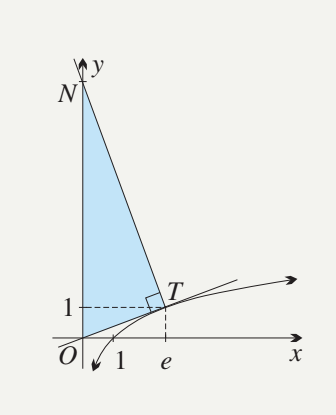
Curve sketching with logarithmic functions
When sketching curves involving logarithmic functions, we follow a systematic approach to ensure we capture all important features of the graph.
Note
Six-Step Curve Sketching Process:
- Write down the domain
- Test whether the function is even, odd, or neither
- Find any zeroes and examine the sign of the function
- Examine the function's behaviour as and as
- Find any stationary points and examine their nature
- Find any points of inflection and examine the concavity
Following this systematic approach ensures you don't miss any important features when sketching logarithmic curves.
Example
Worked Example: Sketching
Let's sketch the graph of following this systematic approach.
Step 1: Domain
The function is only defined for , so the domain is .
Step 2: Even or odd?
The function is undefined when is negative, so it is neither even nor odd.
Step 3: Zeroes and sign
The only zero occurs when . Since in the domain, we need , which gives .
To determine the sign of the function, we test values on either side of :
When :
(positive)
When :
(negative)
| * | ||||
| sign | * |
Therefore, is negative for and positive for .
Step 4: Behaviour at limits
As given in the hint, as (we'll explain this limit behavior later).
Also, as because both and grow without bound.
Step 5: Stationary points
Using the product rule with and :
and
For the second derivative:
Setting :
To determine the nature of this stationary point:
(positive, so it's a minimum)
Therefore, is a minimum turning point.
An important observation: as , which means the curve becomes vertical (very steep) near the origin.
Step 6: Inflection points and concavity
Since is always positive for , there are no inflection points.
The curve is always concave up throughout its domain.
The complete sketch:
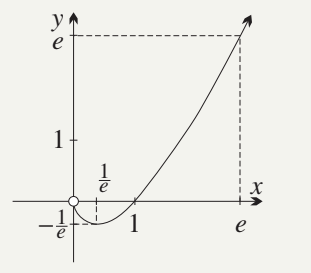
The graph shows a curve that:
- Approaches the origin from below as
- Has a minimum turning point at
- Crosses the x-axis at
- Increases without bound as
- Is concave up throughout
Understanding limits involving logarithms
The limit of as
When examining the curve near the origin, we face an interesting question. When is a small positive number, is a large negative number. So what happens to their product?
The answer is that as . We say that dominates .
Note
This table demonstrates the behaviour as approaches zero from the right:
| approx. |
As we can see, despite becoming more negative, the product approaches zero because is shrinking faster.
The limit of as
A similar issue arises when examining for large values of . Both the numerator and denominator grow without bound, so the behaviour is not immediately obvious.
Again, dominates , meaning that as .
Note
This table illustrates the behaviour as grows without bound:
| approx. |
The table shows that although both numerator and denominator increase, the quotient approaches zero because the denominator grows faster.
The concept of domination
In both cases above, we say dominates . This is similar to how dominates (covered in earlier sections).
Important
Understanding Domination:
This domination means:
- In products where one term approaches zero and the other approaches infinity, the term approaching zero "wins"
- In quotients where both terms approach infinity, the faster-growing term dominates
Key Limits:
Exam tip: These limits are typically given in exam questions where needed. However, understanding the concept of domination helps you appreciate the behaviour of logarithmic functions.
Summary
Key Points to Remember:
- The derivative of is , which we use to find tangents and normals
- When sketching logarithmic curves, follow the six-step process systematically: domain, symmetry, zeroes, behaviour at limits, stationary points, and concavity
- Use the product rule when differentiating : the result is
- dominates : this means as and as
- Always check the second derivative to determine whether stationary points are maxima or minima, and to identify concavity