Further Applications of Integration (HSC SSCE Mathematics Advanced): Revision Notes
📚Revision Notes
Further Applications of Integration
Introduction to integrating reciprocal functions
Now that we have discovered the primitive of the reciprocal function , we can apply standard integration techniques to a wider range of problems. Previously, we couldn't find the antiderivative of , but now we know that:
Note
This breakthrough in finding the primitive of is fundamental because it allows us to solve practical problems involving areas under curves, particularly when working with hyperbolas and other functions that include reciprocal terms. The natural logarithm becomes an essential tool in our integration toolkit.
Finding areas between curves
When calculating the area enclosed between two curves, we use a fundamental integration principle. The key is to integrate the difference between the functions over the interval where they overlap.
The general method
Important
The area between two curves is found using the formula:
where:
- and are the -coordinates of the intersection points
- The top curve is the function with larger -values in the region of interest
- The bottom curve is the function with smaller -values in the region of interest
Remember: Always subtract the bottom curve from the top curve to ensure a positive area value.
Steps for solving area problems
Follow these steps systematically to find areas between curves:
- Find intersection points: Solve the equations simultaneously to find where the curves meet
- Sketch the situation: Draw both curves to visualise which is on top
- Set up the integral: Write the integral with the correct limits and functions
- Evaluate: Use integration techniques including the logarithmic rule for reciprocal terms
- Simplify: Express the answer in exact form and as a decimal approximation
Note
Why sketching matters: Drawing the curves helps you avoid the common mistake of subtracting the functions in the wrong order. Visual confirmation ensures you identify which curve is above the other in your region of interest.
Worked example: Area between a hyperbola and a line
Example
Worked Example: Finding the Area Between a Hyperbola and a Line
Let's work through a complete example involving a rectangular hyperbola and a linear function.
Part a: Verifying intersection points
Consider the hyperbola and the line . We need to verify that these curves intersect at points and .
Testing point A(1, 2):
For the hyperbola :
✓
For the line :
✓
Therefore, A(1, 2) lies on both curves.
Testing point B(2, 1):
Similarly, we can verify that:
- For the hyperbola: ✓
- For the line: ✓
Therefore, B(2, 1) also lies on both curves.
Part b: Sketching the curves
Before calculating the area, we need to understand the shape and position of each curve.
The hyperbola :
- This is a rectangular hyperbola
- Both coordinate axes are asymptotes
- The curve lies in the first and third quadrants
- We can rewrite it as
The line :
- This can be rewritten as
- x-intercept: when , we get , giving point
- y-intercept: when , we get , giving point
- The line has a negative gradient of
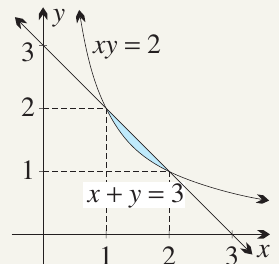
Part c: Calculating the area
Now we can find the exact area between the two curves in the region bounded by the intersection points.
From to , the line is above the hyperbola .
Setting up the integral:
Integrating term by term:
Evaluating at the upper limit :
Evaluating at the lower limit :
Note that log₁ = 0
Subtracting the lower limit from the upper limit:
Converting to decimal form:
Key integration techniques used
When working with problems involving reciprocal functions, remember these important techniques:
Note
For the reciprocal term:
- Always include the absolute value to ensure the function is defined for all non-zero values
- The constant multiple rule applies:
For polynomial terms:
- Use the standard power rule:
- Integrate constants to get linear terms:
Special logarithm values:
- log₁ = 0 (since )
- This often simplifies calculations at lower limits
Important
Common Mistake to Avoid:
When setting up the integral for the area between curves, make sure you subtract in the correct order. Always verify through your sketch which curve is on top in your region of interest. Subtracting in the wrong order will give you a negative area, which doesn't make sense geometrically!
Summary
Key Points to Remember:
- The primitive of 1/x is , which opens up many new integration applications
- To find the area between curves, use the formula:
- Always sketch the curves first to identify which function is on top in the region of interest
- When integrating reciprocal functions, the natural logarithm will appear in your answer
- Express your final answer in both exact form (with logarithms) and as a decimal approximation to the required accuracy
- Remember that log₁ = 0, which often helps simplify your calculations when evaluating definite integrals