Review of Logarithmic Functions (HSC SSCE Mathematics Advanced): Revision Notes
📚Revision Notes
Review of Logarithmic Functions
This section reviews logarithmic functions with base , focusing on properties, transformations, and solving techniques. Two new topics are introduced: dilations of logarithmic functions and exponential and logarithmic equations reducible to quadratics.
The function
Definition and inverse relationship
A logarithmic function is the inverse of an exponential function. Since exponential functions are one-to-one, they have inverse functions.
Important
The Key Relationship:
means
This can be understood with the phrase: "The log is the index, when the number is written as a power of the base."
For example:
- because
- means
The inverse relationship algebraically
Since is the inverse function of , composing these two functions in either order gives the identity function:
Important
These identities are fundamental for simplifying expressions and solving equations. You will use them frequently when working with logarithmic and exponential expressions.
Graphical properties
When both functions are graphed together, they appear as reflections of each other in the diagonal line .
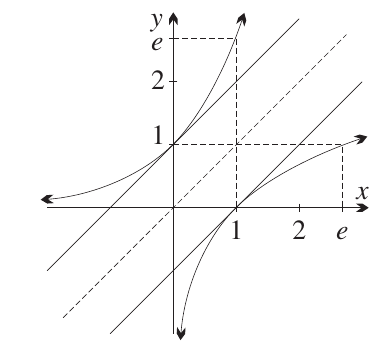
Note
Key Features of the Graphs:
Domain and range:
- For : domain is and range is
- For : domain is and range is
Notice that the domain and range are swapped between the two functions.
Asymptotes:
- has a horizontal asymptote at
- has a vertical asymptote at
Intercepts:
- crosses the -axis at
- crosses the -axis at
- Both curves have gradient at their intercepts
Rate of change:
- Both functions are increasing throughout their domains
- increases at an increasing rate (concave up)
- increases at a decreasing rate (concave down)
One-to-one property: Both functions are one-to-one, meaning each output value corresponds to exactly one input value.
Notation and calculator usage
Standard notation
The function can be written in two equivalent ways:
- (emphasises that the base is )
- (pronounced "logs naperian" or "logs natural")
Both notations mean exactly the same thing.
Calculator usage
Important
Calculator Warning:
Be careful when using your calculator!
- The button means (natural logarithm)
- The button means (common logarithm)
In mathematics, when you see "" without a base specified, it usually means . However, this is not true on calculators or in other fields.
Transformations of
Logarithmic functions can be transformed using reflections, shifts, and dilations, just like other functions.
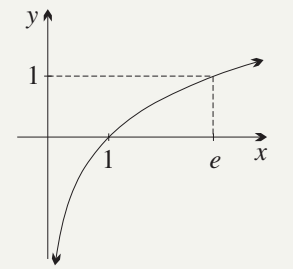
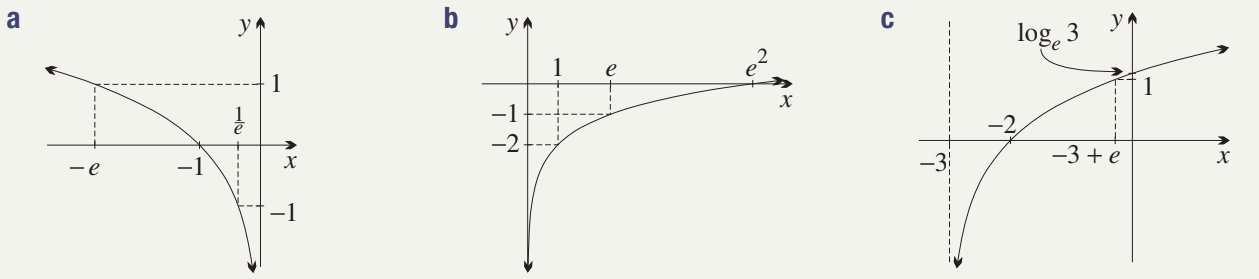
Example: Reflections and shifts
Example
Worked Example: Reflection in the -axis
a) For :
- This reflects the graph across the -axis
- Domain becomes
- -intercept is at
- Vertical asymptote remains at
Example
Worked Example: Vertical shift down
b) For :
- This shifts the entire graph down by units
- Domain remains
- -intercept moves to
- Vertical asymptote remains at
Example
Worked Example: Horizontal shift left
c) For :
- This shifts the entire graph left by units
- Domain becomes
- -intercept is at
- Vertical asymptote moves to
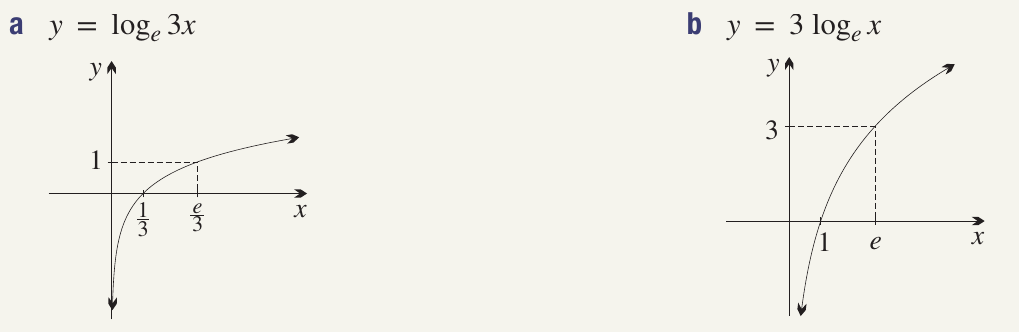
Dilations
Some transformations can be achieved using either dilations or shifts, due to logarithm properties.
Example
Worked Example: Horizontal dilation
a) For :
To graph this function, apply a horizontal dilation to with factor (the graph is compressed horizontally).
Key features:
- The point moves to
- The point moves to
Alternatively, using logarithm laws: , which is a vertical shift up by .
Example
Worked Example: Vertical dilation
b) For :
To graph this function, apply a vertical dilation to with factor (the graph is stretched vertically).
Key features:
- The -intercept remains at
- The point moves to
Note
The vertical shift down by can also be written as , which represents a horizontal dilation with factor .
Using the inverse identities
The inverse identities allow us to simplify many expressions involving logarithms and exponentials.
Simplification examples
Example
Worked Example: Using
Using :
These identities are particularly useful for solving equations.
Converting between exponential and logarithmic forms
Being able to convert between exponential and logarithmic statements is essential.
The key relationship
Important
Remember: " means "
The base of the exponential becomes the base of the logarithm, and the logarithm is the power (index).
Conversion examples
Example
Worked Example: Converting between forms
From exponential to logarithmic form:
- If , then
- If , then
From logarithmic to exponential form:
- If , then
- If , then
- If , then
The change-of-base formula
Sometimes we need to work with logarithms in different bases. The change-of-base formula allows us to convert any logarithm to base .
Formula
Important
Change-of-Base Formula:
For any positive base :
This can be remembered as: "The log of the number over the log of the base."
Using the formula
Example
Worked Example: Solving
Solve correct to three decimal places.
Step 1: Recognise that and , so the answer is between and .
Step 2: Convert to logarithmic form:
Step 3: Use the change-of-base formula:
Alternative method: Take logarithms base of both sides of the original equation:
Solving equations reducible to quadratics
Some exponential and logarithmic equations can be transformed into quadratic equations using substitution.
Exponential equations
Example
Worked Example: Solving
Step 1: Notice that . The equation becomes:
Step 2: Let :
Step 3: Factorise:
Step 4: Return to :
Example
Worked Example: Solving
Step 1: Notice that . The equation becomes:
Step 2: Let :
Step 3: Factorise using sum = , product = :
Step 4: Return to :
Since is always positive, has no solution.
Therefore: , so
Logarithmic equations
Example
Worked Example: Solving
Method 1 (with substitution):
Step 1: Let :
Step 2: Multiply both sides by :
Step 3: Factorise:
Step 4: Return to :
Method 2 (without substitution):
Step 1: Multiply both sides by :
Step 2: Solve for :
Step 3: Convert to exponential form:
Remember!
Summary
Key Points to Remember:
-
The function is the inverse of , meaning their graphs are reflections of each other in the line .
-
The key inverse identities are (for all real ) and (for all ).
-
On your calculator, means (natural logarithm), while means (common logarithm).
-
To convert between bases, use the change-of-base formula: .
-
Complex exponential and logarithmic equations can often be solved by recognising quadratic patterns and using substitution methods.