Applications of Integration (HSC SSCE Mathematics Advanced): Revision Notes
📚Revision Notes
Applications of Integration
Integration is a powerful tool for finding areas under curves and between curves. When working with trigonometric functions, we can use the integrals we've learned to calculate these areas precisely.
Finding areas by integration
When calculating areas using definite integrals, always remember that areas below the x-axis are represented as negative numbers. This is why sketching the curve first is essential.
Important
Key principle: Evaluate separate integrals for regions above and below the -axis, then combine them to find the total area.
Example
Worked Example: Area under
Let's find the area between and the -axis for .
Step 1: Sketch the curve
First, we identify the properties of the function:
- Amplitude =
- Period =
- The x-intercepts in the interval occur at and
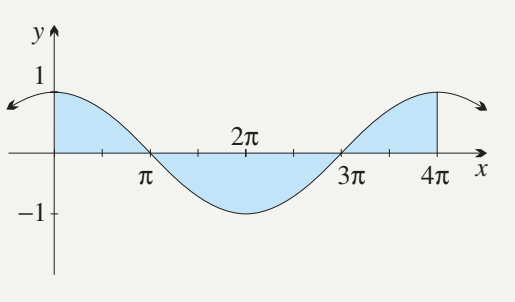
Step 2: Identify the intervals
The curve crosses the -axis at and , dividing our region into three parts:
- - curve is above the x-axis
- - curve is below the -axis
- - curve is above the x-axis
Step 3: Integrate over each interval
For the first interval :
This is positive because the curve is above the -axis.
For the second interval :
This is negative because the curve is below the -axis.
For the third interval :
This is positive because the curve is above the -axis.
Step 4: Calculate total area
Total area = square units
Note
We use the absolute value of the negative integral () when calculating the total area. This ensures all regions contribute positively to the total.
Finding areas between curves
When one curve lies above another throughout an interval, we can find the area between them using a single integral. This method is more efficient than calculating separate areas and subtracting them.
Important
Formula: If is above throughout the interval , then:
Remember: always subtract the lower function from the upper function.
Example
Worked Example: Area between and
Let's find the area between these curves in the interval .
Step 1: Verify the intersection point
The curves intersect at because:
Step 2: Sketch the curves
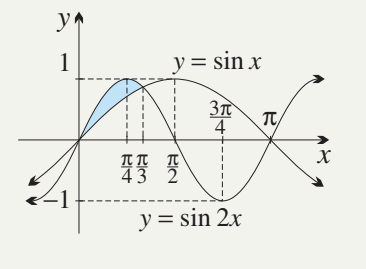
In the interval , the curve is always above .
Step 3: Set up and evaluate the integral
Using , , and :
Example
Worked Example: Area between and
Let's find the area between these curves in the interval .
Step 1: Find intersection points
Setting :
The curves intersect at and .
Step 2: Sketch the curves
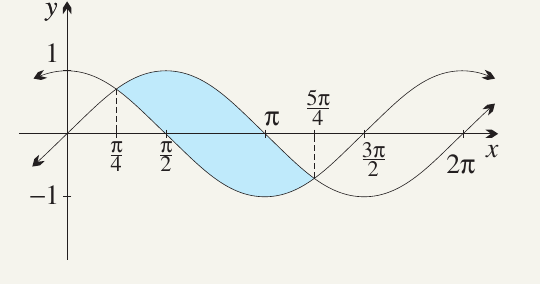
Between and , the curve is above .
Step 3: Calculate the area
Summary
Exam Tips
- Always sketch the curve before attempting to integrate
- Mark all x-intercepts clearly on your sketch
- Identify which regions are above and which are below the -axis
- When finding total area, add the absolute values of all integrals
- For areas between curves, ensure you subtract the lower function from the upper function
- Check which curve is on top by testing a value in the interval
Summary
Key Points to Remember:
- Always sketch first - a diagram helps identify where the curve is above or below the -axis
- Areas below the -axis give negative integrals - take the absolute value when calculating total area
- Separate your intervals - integrate separately over each interval where the curve doesn't cross the -axis
- Area between curves formula: where
- Find intersection points by setting the two functions equal to each other