Car Purchase, Insurance, and Stamp Duty (HSC SSCE Mathematics Standard): Revision Notes
📚Revision Notes
Car Purchase, Insurance, and Stamp Duty
When you buy a car, there are several important costs to consider beyond just the purchase price. Understanding how vehicle depreciation works, the true cost of finance, insurance requirements, and government fees will help you budget accurately for car ownership.
Vehicle depreciation
A motor vehicle is not an investment. Unlike property or shares, cars decrease in value from the moment you drive them off the lot. This loss of value is called depreciation.
New cars depreciate rapidly in their early years. In the first year of ownership, a new car can lose up to 20% of its original value. By the fifth year, your car will typically have decreased in price by over 65% of what you paid for it.
Note
The rapid depreciation of new cars is why many financial advisors recommend buying a car that is 2-3 years old. The previous owner has already absorbed the steepest depreciation, but the car is still relatively new with modern features and reliability.
Calculating percentage decrease
To work out how much value your car has lost as a percentage, you need to follow this process:
The percentage decrease formula is:
Example
Worked Example: Calculating Vehicle Depreciation
A new vehicle is bought for $25,000 and sold one year later for $19,000. Calculate the percentage decrease in the value of the vehicle.
Solution:
- Subtract $19,000 from $25,000 to find the price decrease: $6,000
- Divide the price decrease by the purchase price:
- The vehicle lost 24% of its value in one year.
Buying a car on finance
When you purchase a car using dealer finance, you pay an initial deposit and then make regular repayments over several years. While this makes the car more affordable upfront, the total cost using finance is always greater than paying cash.
Important
The difference between the cash price and the total cost with finance represents the interest you pay for the convenience of spreading payments over time. This can add tens of thousands of dollars to the purchase price.
Finance formulas
You need to know these three key formulas:
Example
Worked Example: Calculating Finance Costs
A four-wheel-drive vehicle is for sale at $45,000. Finance is available with a $5,000 deposit and monthly repayments of $1,470 for 5 years.
a) What is the total of the repayments?
b) What is the total cost of the finance?
c) What is the interest paid?
Solution:
a) Total repayments:
- Multiply the monthly repayment by the number of repayments (12 months × 5 years = 60 payments):
b) Total cost:
- Add the deposit to the total repayments:
c) Interest paid:
- Subtract the original sale price from the total cost:
Notice that the buyer pays $48,200 in interest charges, which is more than the original deposit!
Car insurance
Insurance is a major ongoing cost of keeping a motor vehicle on the road. Understanding the different types of insurance and how premiums are calculated is essential for budgeting.
Types of car insurance
There are three main types of car insurance in Australia, each providing different levels of cover:
Green slip or Compulsory Third Party (CTP) insurance protects vehicle owners and drivers who are legally liable for personal injury to any other party. If you injure someone in an accident, this insurance covers their medical costs and compensation claims. This insurance is compulsory in all Australian states and territories.
Third Party Property insurance covers you for damage caused by your car to property owned by a third party in the event of an accident. This means if you damage someone else's car, fence, or building, the insurance will pay for their repairs, but not for damage to your own vehicle.
Comprehensive insurance provides the most complete coverage. It covers you for damage to your own vehicle as well as damage your car may cause to another person's vehicle or property. This is the most expensive option but provides the best protection.
Insurance premiums
An insurance premium is the cost of taking out insurance cover. The premium you pay depends on many factors including the make and model of your car, your age, driving history, whether the car is financed, any modifications or accessories, and your location.
Note
Many insurance companies offer online calculators to estimate your vehicle insurance premium based on these factors. These tools can help you compare quotes and understand how different factors affect your premium.
No-claim bonus
A no-claim bonus is a discount on your insurance premium that rewards you for not making claims. This discount increases each year you don't make a claim, until it reaches the maximum discount level (often 60% or 65%). This provides a strong incentive to drive carefully and only claim for significant damage.
When calculating your premium with a no-claim bonus, you pay the remaining percentage. For example, a 40% no-claim bonus means you pay 60% of the quoted premium.
Excess
Excess is the amount you must pay when you make a claim on your insurance policy. The standard excess can be adjusted when you take out the policy – choosing a higher excess will reduce your premium. There are also additional excesses that apply to younger or inexperienced drivers.
Example
Worked Example: Calculating Insurance Premium with No-Claim Bonus
Elle has been quoted $960 for comprehensive car insurance. She has a no-claim bonus of 40%. How much is Elle required to pay?
Solution:
- A no-claim discount of 40% means Elle pays 60% of the quoted premium
- Calculate 60% of $960:
Elle is required to pay $576 for her insurance.
Stamp duty
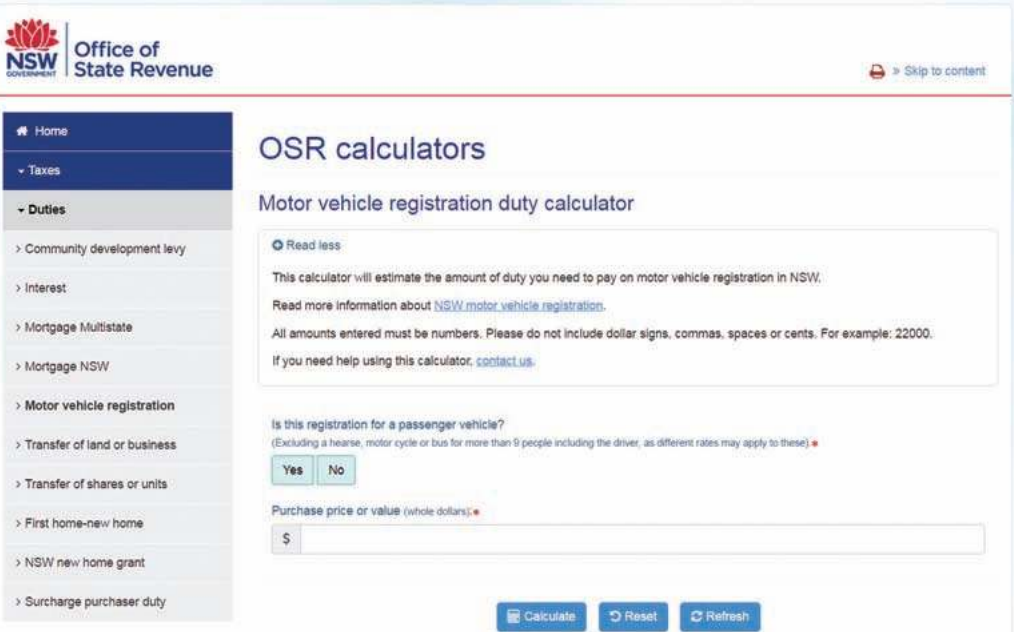
Stamp duty is a government tax you pay when registering or transferring a motor vehicle. The amount payable is based on the price of the vehicle.
How stamp duty works
The stamp duty rate is typically $3 per $100 of the vehicle's value, which equals a 3% tax. For example, a new passenger car purchased for $40,000 would require stamp duty of:
Calculating stamp duty
To calculate stamp duty accurately, follow these steps:
- Round up the cost of the vehicle to the nearest $100 (if charged per $100), $200 (if charged per $200), etc.
- Express the stamp duty rate as a fraction or decimal ($3 per $100 is or )
- Multiply the rounded value by this fraction or decimal
Important
Always round UP to the next $100, even if the actual price is only slightly over a hundred-dollar mark. This is a common mistake – failing to round up will result in an incorrect calculation.
Example
Worked Example: Calculating Stamp Duty
A used car is bought for $17,730. Calculate the stamp duty payable if the charge is $3 per $100 or part $100.
Solution:
- Round $17,730 up to the nearest $100:
- Express the stamp duty as a fraction:
- Multiply the rounded value by the fraction:
The stamp duty payable is $534.
Summary
Key Points to Remember:
-
Cars depreciate rapidly: A new car can lose 20% of its value in the first year and over 65% by the fifth year.
-
Finance costs more: When buying on finance, always calculate the total cost (deposit plus all repayments) and the interest paid (total cost minus sale price) to understand the true cost.
-
Three insurance levels: Green slip (CTP) for injuries, Third Party Property for others' property damage, and Comprehensive for complete coverage including your own vehicle.
-
No-claim bonus saves money: Each year without a claim increases your discount, reducing your premium. A 40% bonus means you pay 60% of the quoted price.
-
Stamp duty rounds up: Always round the vehicle price up to the nearest $100 before calculating stamp duty at $3 per $100 (3% of the value).