Piecework, Royalties, and Income from Government (HSC SSCE Mathematics Standard): Revision Notes
📚Revision Notes
Piecework, Royalties, and Income from Government
There are several ways people can earn income beyond traditional wages and salaries. This note explores three important income types: piecework, royalties, and government payments. Each has unique characteristics, advantages, and disadvantages that affect how people earn and manage their money.
Note
Unlike traditional employment where you receive a regular wage or salary, these three income types offer alternative payment structures that can provide flexibility but may lack the security and benefits of permanent employment.
Piecework
Piecework is a payment system where you receive a set amount for each task or unit of work you complete. Instead of being paid by the hour, you are paid based on what you produce or accomplish. For example, an electrician might charge a fixed rate for installing each light fixture, or a tiler might charge per square metre of tiles laid.
Advantages of piecework
- Motivation to work productively: The more tasks you complete, the more you earn, which encourages efficiency and hard work.
- Flexibility: You often have control over when and where you work, allowing you to manage your own schedule.
Disadvantages of piecework
- No job security: You do not have permanent employment, which means your work can be irregular and unpredictable.
- No paid leave: You do not receive sick leave or holiday pay, so any time off work means no income.
- Limited benefits: Piecework may not include superannuation contributions, affecting your retirement savings.
Calculating piecework payments
Important
Piecework Formula
This is the fundamental formula for calculating earnings from piecework. Make sure you identify both the number of units completed and the rate per unit before calculating.
Example
Worked Example: Calculating Piecework Payment
Noah is a tiler and charges $47 per square metre to lay tiles. How much will he earn for laying tiles in a room with an area of 14 square metres?
Step 1: Write the formula for earnings
Step 2: Substitute the known values
Step 3: Calculate the result
Answer: Noah earns $658 for laying tiles in the 14 square metre room.
Royalties
Royalties are payments received when your creative work, such as a book, song, or invention, is used or sold. The payment is calculated as a percentage of the revenue or profit generated from the work. Authors, musicians, and other creative professionals typically receive royalties for their intellectual property.
Note
Intellectual property refers to creative works like books, music, inventions, and designs that are owned by their creator and protected by law.
Advantages of royalties
- Quality incentive: Your income increases when you create a better product that sells more, motivating you to produce high-quality work.
- Flexibility: You can often work on your own schedule and choose your workplace.
Disadvantages of royalties
- Unpredictable income: Your earnings depend on sales performance, which can vary significantly from month to month or year to year.
- No employment benefits: Like piecework, royalties do not include superannuation, sick leave, or holiday pay.
Calculating royalties
Important
Royalty Formula
Remember to convert percentages to decimals when calculating (e.g., 12% becomes 0.12).
Example
Worked Example: Calculating a Royalty Payment
Hiroshi is an author and receives a royalty of 12% on books sold. Find his royalties if 2480 books were sold at $67.50 each.
Step 1: Write the formula for royalty
Step 2: Calculate total sales first
Step 3: Calculate the royalty as 12% of total sales
Step 4: Convert the percentage to a decimal
Step 5: Calculate the result
Answer: Hiroshi earns $20,088 in royalties.
Income from government
The government provides financial support to eligible individuals through various programs including pensions, allowances, and benefits. These payments help people in different circumstances, such as retirees, students, or people seeking employment.

For example, the age pension supports people who have reached retirement age, while Youth Allowance helps young people who are studying, undertaking training, or completing an apprenticeship. The eligibility requirements and payment amounts for these programs can change based on government policy.
Note
Government income eligibility and payment amounts are subject to change based on policy decisions. Requirements typically include factors such as age, living situation, income, and assets. Always check current government guidelines for the most up-to-date information.
Worked example: calculating government income
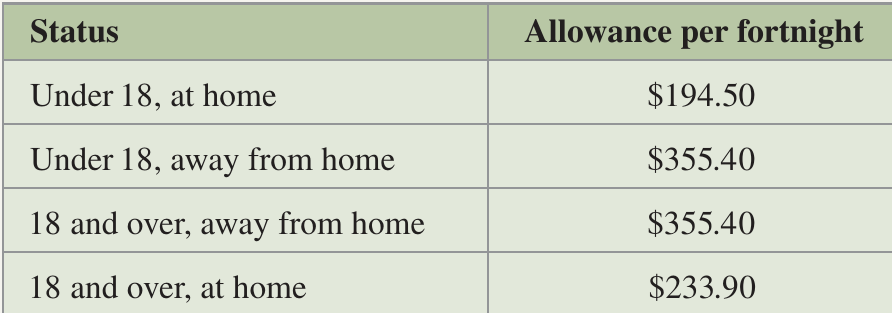
Youth Allowance is a government payment that supports young people in education or training. The amount you receive depends on your age and living situation.
Example
Worked Example: Calculating Annual Government Income
How much Youth Allowance does Ryan receive in a year if he is over 18 and living at home while studying?
Step 1: From the table, find Ryan's fortnightly allowance
Step 2: Calculate the annual amount by multiplying by the number of fortnights in a year (26)
Step 3: Calculate the result
Answer: Ryan receives $6081.40 in Youth Allowance per year.
Important
Exam tip: Remember there are 26 fortnights in a year (52 weeks ÷ 2 = 26 fortnights). This is essential for converting fortnightly government payments to annual amounts.
Remember!
Summary
Key Points to Remember:
-
Piecework pays a fixed amount for each task or unit completed. It offers flexibility but lacks job security and employment benefits.
-
Royalties are calculated as a percentage of sales or profit from your creative work. Income varies with sales performance.
-
Government income includes pensions, allowances, and benefits for eligible people. Payment amounts depend on specific criteria like age and living situation.
-
Use the correct formula for each income type: multiply units by rate for piecework, calculate percentage of sales for royalties, and multiply fortnightly payments by 26 for annual government income.
-
All three income types typically do not include superannuation, sick leave, or holiday pay, unlike traditional employment.