Gradient and Intercept (HSC SSCE Mathematics Standard): Revision Notes
📚Revision Notes
Gradient and Intercept
What is gradient?
The gradient tells us how steep a line is. You might also hear it called the slope of the line. We represent gradient with the letter m.
The gradient shows us how much a line rises vertically for every unit it moves horizontally. A larger gradient value means a steeper line.
To calculate the gradient, we use this formula:
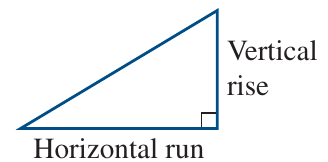
The vertical rise is how far the line goes up or down, and the horizontal run is how far the line moves across.
Note
Think of gradient like walking up a hill - the steeper the hill, the larger the gradient value. A flat path has a gradient of zero, while a steep mountain path has a large gradient.

Positive and negative gradients
Gradients can be positive or negative:
- Positive gradients: Lines that slope upward as they move to the right. These represent increasing relationships.
- Negative gradients: Lines that slope downward as they move to the right. These represent decreasing relationships.
Important
Remember the direction:
- Positive gradient = line goes up to the right (increasing)
- Negative gradient = line goes down to the right (decreasing)
The sign of the gradient tells you the direction of the line!
Worked example: Finding the gradient of a line
Example
Worked Example: Finding the Gradient of a Line
Let's find the gradient of a line passing through the points and .
Step 1: Draw a coordinate plane with the -axis horizontal and the -axis vertical.
Step 2: Plot the two points and .
Step 3: Draw a straight line connecting these points.
Step 4: Create a right-angled triangle by drawing a vertical line and a horizontal line between the two points.
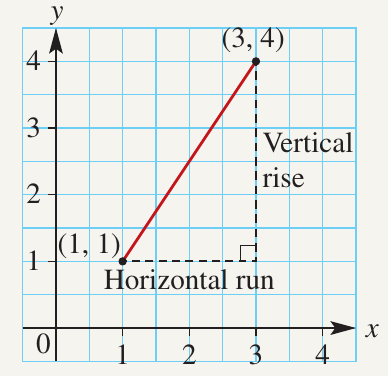
Step 6: Calculate the vertical rise:
Step 7: Calculate the horizontal run:
Step 8: Substitute these values into the formula:
Therefore, the gradient is .
What is intercept?
An intercept is the point where a line crosses an axis.
- The y-intercept is where the line crosses the vertical axis (the -axis). We denote this with the letter b.
- The x-intercept is where the line crosses the horizontal axis (the -axis). We denote this with the letter a.
The y-intercept is particularly useful because it tells us the starting value of when .
Note
The y-intercept is often easier to identify than the x-intercept because it's simply the constant term in the equation . This makes it a convenient starting point when sketching graphs.
Worked example: Finding gradient and vertical intercept
Example
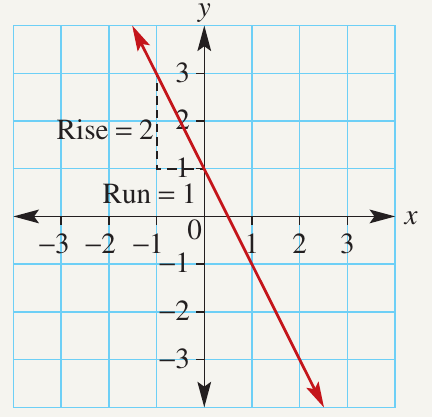
Worked Example: Finding Gradient and Vertical Intercept
Let's find the gradient and vertical intercept for the line .
Step 1: Create a table of values for and .
Step 2: Choose convenient values for (let's use ) and calculate the corresponding values using the equation :
Step 3: Draw a coordinate plane and plot the points , , and .
Step 4: Draw a line through these points.
Step 5: Construct a right-angled triangle using vertical and horizontal lines.
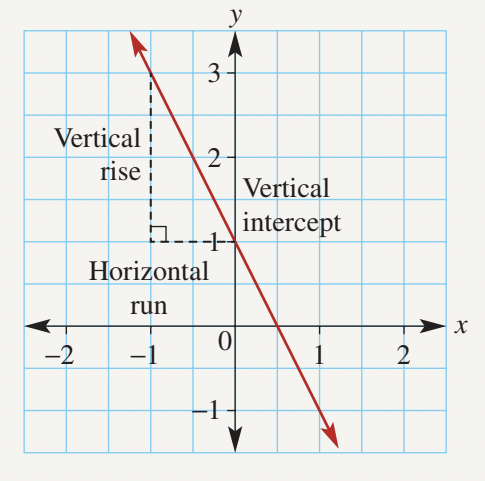
Step 6: This line slopes downward to the right, so it has a negative gradient.
Step 7: Calculate the vertical rise:
Step 8: Calculate the horizontal run:
Step 9: Substitute these values into the gradient formula:
Step 10: The line crosses the vertical axis at the point .
Therefore, the gradient is and the vertical intercept is .
The gradient-intercept formula
When we write a straight line's equation in the form , we call this the gradient-intercept formula. This format is extremely useful because we can immediately identify:
- m is the gradient (the coefficient of )
- b is the y-intercept (the constant term)
The gradient-intercept formula is:
where:
- = slope or gradient of the line (vertical rise divided by horizontal run)
- = y-intercept where the line crosses the y-axis
In this formula, is the independent variable and is the dependent variable. This means that the value of depends on the value of .
Important
The Power of
This is one of the most important formulas in mathematics! Once you can recognize this form, you can instantly identify:
- How steep the line is (the m value)
- Where it crosses the y-axis (the b value)
If an equation isn't in this form, your first step should be to rearrange it to .
Worked example: Identifying gradient and y-intercept from equations
Example
Worked Example: Identifying Gradient and y-Intercept from Equations
Let's identify the gradient and y-intercept for each of these equations:
a)
First, rearrange the equation to gradient-intercept form:
The gradient is the coefficient of :
The y-intercept is the constant term:
b)
Rearrange to gradient-intercept form:
The gradient is:
The y-intercept is:
c)
Write in gradient-intercept form:
The gradient is:
The y-intercept is:
d)
Rearrange to gradient-intercept form:
The gradient is:
The y-intercept is:
Sketching graphs using gradient-intercept form
To sketch a straight-line graph, we need at least two points. When an equation is in gradient-intercept form, we already know one point: the y-intercept. We can find a second point using the gradient.
Here's the process:
- Identify the gradient () and y-intercept ()
- Mark the y-intercept on the y-axis at the point
- Use the gradient to find a second point (rise over run from the y-intercept)
- Draw a straight line through the two points
Note
Tip for Success: Always start by marking the y-intercept - it's your anchor point. Then, think of the gradient as instructions: "From the y-intercept, rise this many units, run this many units."
Worked example: Sketching with positive gradient
Example
Worked Example: Sketching a Graph with Positive Gradient
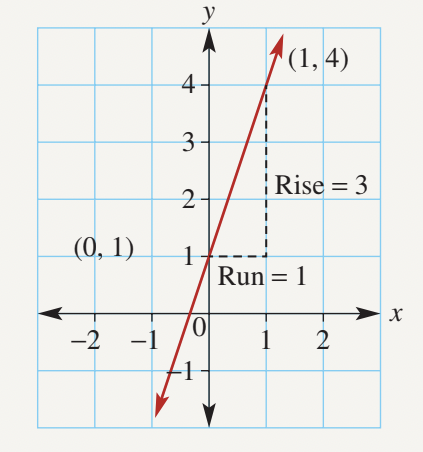
Let's sketch the graph of .
Step 1: The equation is already in gradient-intercept form:
Step 2: The gradient is (the coefficient of )
Step 3: The y-intercept is (the constant term)
Step 4: Mark the y-intercept at the point on the y-axis.
Step 5: The gradient of can be written as , which means a vertical rise of 3 and a horizontal run of 1.
Step 6: Starting from the y-intercept , move unit horizontally to the right, then move units vertically upward.
Step 7: This gives us the point .
Step 8: Draw a straight line through the points and .
Worked example: Sketching with negative gradient
Example
Worked Example: Sketching a Graph with Negative Gradient
Let's sketch the graph of .
Step 1: The equation is already in gradient-intercept form:
Step 2: The gradient is (the coefficient of )
Step 3: The y-intercept is (the constant term)
Step 4: Mark the y-intercept at the point on the y-axis.
Step 5: The gradient of can be written as or . This means a vertical rise of and a horizontal run of to the left (or alternatively, down and right ).
Step 6: Starting from the y-intercept , move unit horizontally to the left, then move units vertically upward.
Step 7: This gives us the point .
Step 8: Draw a straight line through the points and .
Summary
Key Points to Remember:
- Gradient measures the steepness of a line and is calculated as
- Positive gradients slope upward to the right; negative gradients slope downward to the right
- Intercepts are where a line crosses an axis: the y-intercept () is on the vertical axis, the x-intercept () is on the horizontal axis
- The gradient-intercept formula is , where is the gradient and is the y-intercept
- To sketch a line from its equation, mark the y-intercept first, then use the gradient (rise over run) to find a second point