Measurement and Energy (HSC SSCE Mathematics Standard): Revision Notes
📚Revision Notes
Food and Nutrition
What is food energy?
Our bodies obtain energy and essential nutrients from the food we eat. These nutrients support growth processes and help repair body tissues. The energy in food is a form of chemical energy, which we measure in kilojoules.
Note
The energy we get from food isn't immediately available - it's stored as chemical energy in the molecular bonds of nutrients. When our bodies need energy, they break down these molecules and release the stored energy for use.
Understanding kilojoules
A kilojoule (kJ) is a unit of energy measurement. One kilojoule equals 1000 joules.
Previously, food energy was measured in calories (Cal), but the SI unit kilojoule is now used internationally as the standard measurement.
Important
Conversion factor:
This means that for every calorie, you have approximately 4 kilojoules. When reading older nutrition information, you'll need to convert calories to kilojoules using this factor.
Energy balance and storage
When you consume food with high kilojoule content, you might be taking in more energy than your body actually needs. Your body stores this surplus energy as body fat. Maintaining a balance between energy intake and energy use is important for healthy weight management.
Note
Think of your body like a bank account for energy. If you deposit more energy (through food) than you withdraw (through daily activities and exercise), the excess gets stored as fat reserves. This is why balancing what you eat with how active you are is crucial for maintaining a healthy weight.
The healthy eating pyramid
The healthy eating pyramid provides a visual guide for balanced nutrition. It organises food into different groups and shows the recommended proportions for daily consumption.
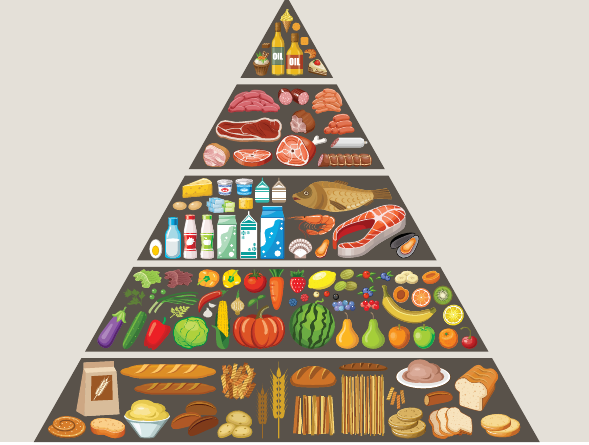
How to use the pyramid:
- Eat more of the foods shown at the bottom of the pyramid
- Eat less of the foods shown at the top of the pyramid
- The pyramid illustrates which food groups should form the largest and smallest parts of your daily diet
Note
The healthy eating pyramid is designed to help you visualize a balanced diet at a glance. The wider sections at the bottom represent foods you should eat most frequently, while the narrow tip contains foods to consume sparingly. For detailed guidance on serving sizes and specific food recommendations, visit eatforhealth.gov.au.
Daily energy requirements
The amount of energy your body needs each day depends on several factors:
- Age: Younger adults typically need more energy than older adults
- Gender: Men generally require more energy than women
- Lifestyle: Physical activity increases energy needs
Energy requirements by age and gender
| Age | Men kJ per day | Women kJ per day |
|---|---|---|
| 18–35 | 12 500 | 9000 |
| 36–70 | 10 000 | 8000 |
Key observations:
- Men aged 18–35 need the highest energy intake at 12 500 kJ per day
- Women aged 18–35 need 9000 kJ per day
- Energy requirements decrease with age for both men and women
- The reduction is about 2000 kJ per day for men and 1000 kJ per day for women after age 35
Important
These values represent base requirements for typical daily activities. If you're physically active, play sports, or have a demanding job, you'll need to add the energy used during those activities to these base values. Athletes and people with physically demanding jobs can require significantly more energy than shown in this table.
Adjusting for activity levels
Physical activity significantly increases your daily energy requirements. You need to add the energy used during exercise to your base daily requirement.
Example
Worked Example: Calculating Daily Energy Needs with Exercise
Jenny is 18 years old. How many kilojoules does she need each day?
Solution:
Using the table for women aged 18–35:
Jenny needs per day
Mitchell is 25 years old and works out at the gym for 2 hours. A gym workout uses 2500 kJ per hour. How many kilojoules does he need each day?
Solution:
Step 1: Calculate energy used during gym workout
Step 2: Find base daily requirement for a man aged 18–35
Step 3: Add exercise energy to base requirement
Mitchell needs per day
Understanding food labels
Food manufacturers are legally required to display nutritional information on their products. This helps consumers make informed choices and control their energy intake.
What appears on food labels
The energy content is typically shown for:
- 100 g of the product (standardised comparison)
- One typical serving size
- The entire package contents (sometimes)
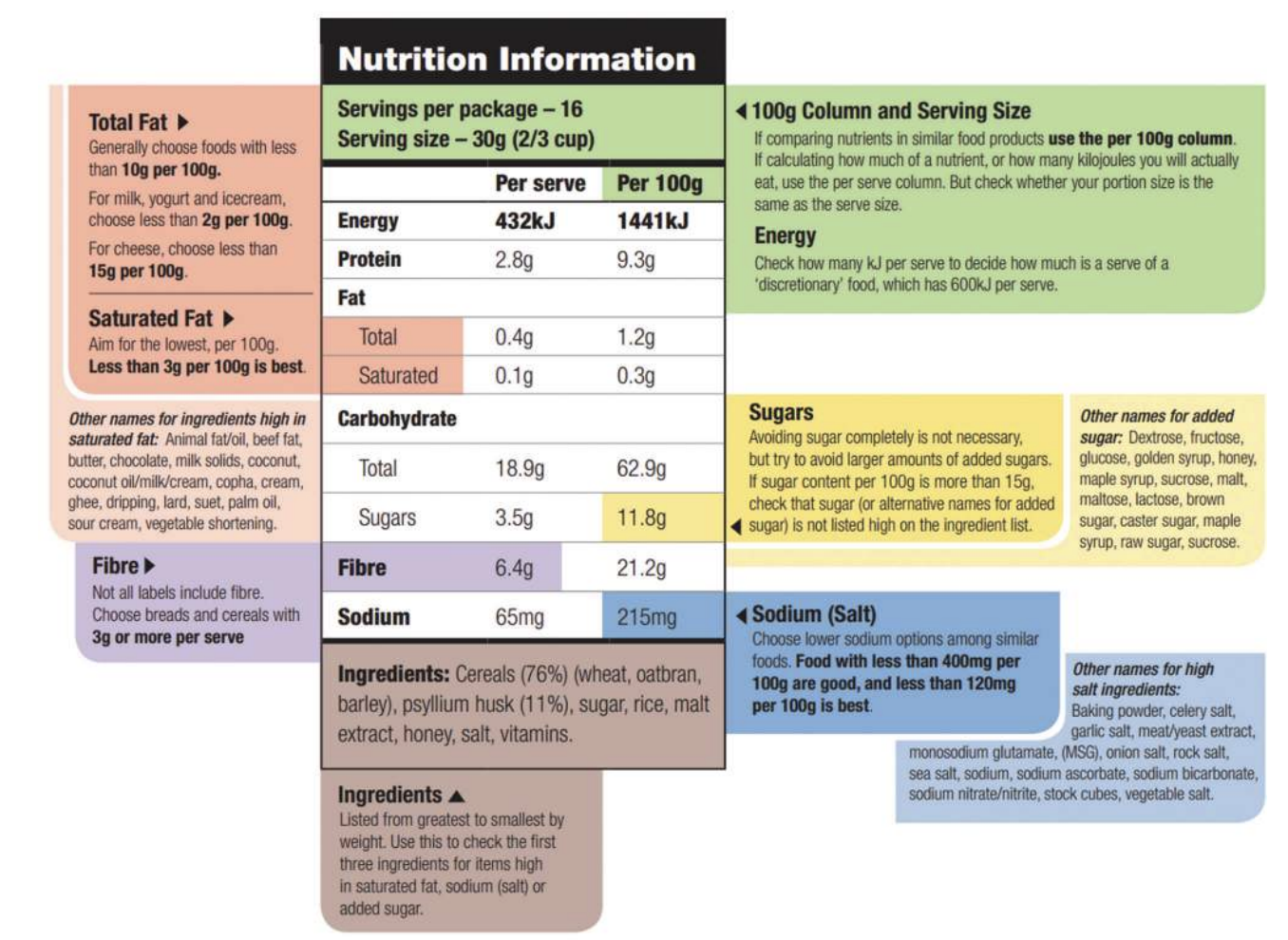
Key components of nutrition information panels
Serving information:
- Servings per package: Total number of serves in the container
- Serving size: The amount in grams that counts as one serve
Energy content:
- Shown in kilojoules (kJ)
- Given per serve and per 100 g
- Use the per 100 g column when comparing similar products
Macronutrients:
- Protein: Essential for growth and repair
- Fat: Includes total fat and saturated fat (limit saturated fat)
- Carbohydrate: Includes total carbohydrates and sugars
- Fibre: Important for digestive health (choose foods with 3 g or more per serve)
Sodium (salt):
- Choose foods with less than 400 mg per 100 g
- Best choice: less than 120 mg per 100 g
Ingredients list:
- Listed from greatest to smallest by weight
- Check the first three ingredients for items high in saturated fat, sodium, or added sugar
Note
Understanding serving sizes:
The serving size shown on a label might not match how much you actually eat. For example, a box of cereal might list 30 g as a serving, but you might pour yourself 60 g. To calculate the nutrients you're actually consuming, you'll need to adjust the values accordingly. If you eat double the serving size, you consume double the nutrients shown in the "per serve" column.
Tips for reading labels
Comparing products:
- Use the per 100 g column to compare similar foods
- Calculate how much of a nutrient you'll actually consume based on your portion size
Note
Understanding sugars:
Avoiding sugar completely isn't necessary. Natural sugars found in fruit, milk, and vegetables are part of a healthy diet. However, be aware of added sugars versus natural sugars. If sugar content per 100 g is more than 15 g, check whether added sugar is listed high on the ingredients list.
Alternative names for sugar: dextrose, fructose, glucose, golden syrup, honey, maple syrup, maltose, lactose, brown sugar, caster sugar, icing sugar, raw sugar, sucrose
Checking fats:
- Choose foods with less than 10 g total fat per 100 g
- For dairy products like yoghurt and icecream, choose less than 2 g per 100 g
- For cheese, choose less than 15 g per 100 g
- Aim for the lowest saturated fat per 100 g
Important
Why focus on saturated fat?
Not all fats are equal. While your body needs some fat for proper function, saturated fat can contribute to increased cholesterol levels and heart disease risk when consumed in excess. That's why food labels separate saturated fat from total fat - to help you make healthier choices.
Example
Worked Example: Reading a Food Label
Use the nutrition information panel shown above to answer the following questions:
a) What is the serving size?
b) How many kilojoules per 100 g?
c) What is the amount of fibre per serve?
d) How much saturated fat per serve?
Solution:
a) Find serving size information at the top of the label
Serving size is
b) Look at the Energy row in the Per 100 g column
per
c) Find Fibre in the Per serve column
Fibre per serve is
d) Find Saturated fat in the Per serve column
Saturated fat per serve is
Summary
Key Points to Remember:
- Food energy is measured in kilojoules (kJ), where 1 kJ = 1000 joules
- The conversion factor is: 1 calorie = 4.184 kilojoules
- Daily energy requirements vary by age, gender, and activity level - younger people and men typically need more energy
- The healthy eating pyramid shows recommended food proportions: eat more from the bottom levels, less from the top
- Food labels show nutritional information per serve and per 100 g - use the per 100 g column when comparing products
- When calculating total daily energy needs, add energy used during exercise to your base requirement
- Excess energy is stored as body fat, making energy balance crucial for healthy weight management