Energy Consumption (HSC SSCE Mathematics Standard): Revision Notes
📚Revision Notes
Energy Consumption
Introduction to energy
Energy represents the ability to perform work or cause change. It exists in many different forms, including heat, light, sound, and electrical energy. Understanding energy and how we measure it is essential for managing household electricity consumption and costs.
The joule (symbol ) is the standard unit of energy in the International System of Units (SI). For larger amounts of energy, we often use megajoules (symbol ), where one megajoule equals one million joules. Heat energy, such as that produced when burning natural gas in homes, is commonly measured in megajoules.
Note
Energy exists in many forms around us - when you turn on a light, electrical energy converts to light and heat energy. When you boil water, electrical energy converts to heat energy. Understanding these conversions is fundamental to understanding energy consumption.
Power
Power measures how quickly energy is produced or used over time. While energy tells us the total amount of work that can be done, power tells us the rate at which this work happens.
The watt is the SI unit of power, with the symbol . One watt equals one joule of energy transferred per second:
Just like with joules, we use standard SI prefixes (milli, kilo, mega, giga, tera) to measure power at different scales. The table below shows the common power units you'll encounter:
| Name | Symbol | Meaning | Value | Example |
|---|---|---|---|---|
| Milliwatt | One thousandth of a watt | W | Small laser pointer | |
| Watt | One watt | W | Smartphone making a call | |
| Kilowatt | Thousand watts | W | Electric heater | |
| Megawatt | Million watts | W | Large diesel generator | |
| Gigawatt | Billion watts | W | Very large power station | |
| Terawatt | Trillion watts | W | Worldwide nuclear power |
Note
Notice the vast range of power scales! A smartphone uses just a few watts, while a large power station generates billions of watts. This is why we need these different units - trying to express a power station's output in milliwatts would give us an impossibly large number!
Electrical energy
While the joule is the standard scientific unit for energy, it's not very practical for measuring household electricity consumption. Instead, we think about electrical energy in terms of the power rating of a device and how long it runs for.
For example, when you turn on a device with a power rating of W for one hour, it uses watt-hours () of energy. This is the same amount of energy that a W device would use in hours.
Kilowatt-hours
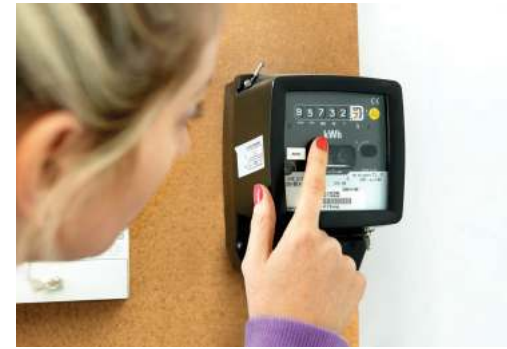
The kilowatt-hour (symbol ) is the standard unit used to measure electrical energy on household electricity meters. It represents the amount of energy consumed when a W power load operates for one hour.
To calculate energy in kilowatt-hours, we multiply the power (in kilowatts) by the time (in hours):
Important
Important conversion to remember:
This conversion is frequently needed when working with different energy units, so make sure you memorize it!
Energy consumption
Energy consumption refers to the amount of energy used per unit of time. For electrical energy, this is typically expressed in kilowatt-hours per year (), megawatt-hours per year (), or megajoules per year ().
In Australia, the average household uses approximately 11 MWh of energy per year (which can also be written as MJ per year). This level of energy consumption is equivalent to producing about eight tonnes of carbon dioxide () emissions annually.
Note
Understanding your household's energy consumption helps you identify opportunities to save money and reduce environmental impact. By monitoring your electricity meter regularly, you can track your usage patterns and make informed decisions about energy efficiency.
Energy rating of appliances
In Australia, many household appliances come with an energy rating label. These labels help consumers compare the energy efficiency of similar products before making a purchase.
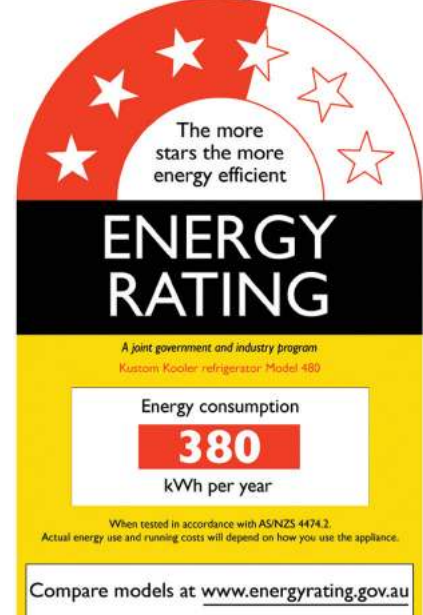
Understanding the label
Energy rating labels have two key features:
1. Star rating system
The label displays a star rating on a scale. More stars indicate that the appliance is more energy efficient. When comparing similar appliances, choose the one with more stars to save energy and money.
2. Energy consumption figure
This is the number shown in the red box on the label. It indicates the amount of electricity (in ) that the appliance typically uses in one year. The lower this number, the less the appliance will cost to run.
Calculating running costs
To work out how much an appliance will cost to operate, multiply the energy consumption figure by the electricity price rate. Electricity suppliers typically charge in dollars per kilowatt-hour ($/kWh).
Important
When comparing appliances in the store, don't just look at the purchase price! An appliance with a higher star rating might cost more upfront but can save you hundreds of dollars in electricity costs over its lifetime. Always consider both the purchase price and the running costs shown on the energy label.
Worked example: Calculating the cost of running appliances
Example
Worked Example: Calculating the Cost of Running Appliances
Question: Determine the cost of running the following appliances given the average rate for electricity is $0.17 per kWh.
a) A dishwasher with an energy consumption of kWh per year
b) A kW fan heater for five hours
c) A W LED light bulb for a year
Solution
Part a: Dishwasher
When the annual energy consumption is already given, we can calculate the cost directly.
Multiply the energy consumption by the electricity price rate:
The dishwasher costs $113.90 to run for a year.
Part b: Fan heater
First, we need to calculate the energy used. The heater has a power rating of kW and runs for hours.
Calculate the energy by multiplying power by time:
Now calculate the cost:
The fan heater costs $2.04 to run for five hours.
Part c: LED light bulb
First, convert the power to kilowatts: W kW
For a full year, the bulb runs for hours per day for days.
Calculate the energy:
Now calculate the cost:
The LED bulb costs $29.78 to run for a year.
Exam tip: Always check whether power is given in watts or kilowatts. Remember to convert watts to kilowatts by dividing by 1000 before using the energy formula.
Summary
Key Points to Remember:
-
Energy is the capacity to do work, measured in joules (J) or megajoules (MJ).
-
Power is the rate at which energy is generated or consumed, measured in watts (W). Remember: W J/s.
-
For household electricity, we use kilowatt-hours (kWh) rather than joules. The formula is: Energy (kWh) = Power (kW) × Time (hours).
-
Energy rating labels in Australia use stars to show efficiency (more stars = more efficient) and display annual energy consumption in kWh (lower number = cheaper to run).
-
To calculate running costs: Cost = Energy consumption (kWh) × Electricity price rate ($/kWh).