Units of Measurement (HSC SSCE Mathematics Standard): Revision Notes
📚Revision Notes
Units of Measurement
What is measurement?
When we need to find out how big something is or how much of something we have, we use measurement. This process involves determining the size or amount of a quantity. To measure accurately, we typically need a measuring instrument. Different tools are used for measuring different things. For example, when measuring length or distance, you might use a ruler, tape measure, or even GPS technology depending on what you're measuring and how precise you need to be.
Note
Common measuring instruments include rulers, tape measures, calipers, micrometers, GPS devices, and laser range finders. Each tool is designed for specific types of measurements and levels of precision.
There are several different measurement systems used around the world, but in Australia we use the SI metric system. This system makes calculations and conversions much easier because it's based on powers of ten.
The SI metric system
The letters 'SI' stand for Système International, which is French for International System of Units. This system is used by most countries worldwide and is the standard for scientific work. The key advantage of the SI system is that it's based on multiples of , which makes converting between units straightforward. You can easily multiply or divide to change from one unit to another.
Note
The SI system's base-10 structure means you only need to move decimal places when converting between units. This is much simpler than systems that use irregular conversion factors, like converting between inches, feet, yards, and miles.
In the SI system, some units are official SI units (the standard units), while others are non-SI units that are approved for everyday use alongside the official units. Understanding which is which helps you know when you're working with the formal scientific standard.
SI units for different quantities
The SI system has base units for measuring different types of quantities. A base unit is the fundamental unit from which other units are derived. Let's look at the main quantities you'll work with:
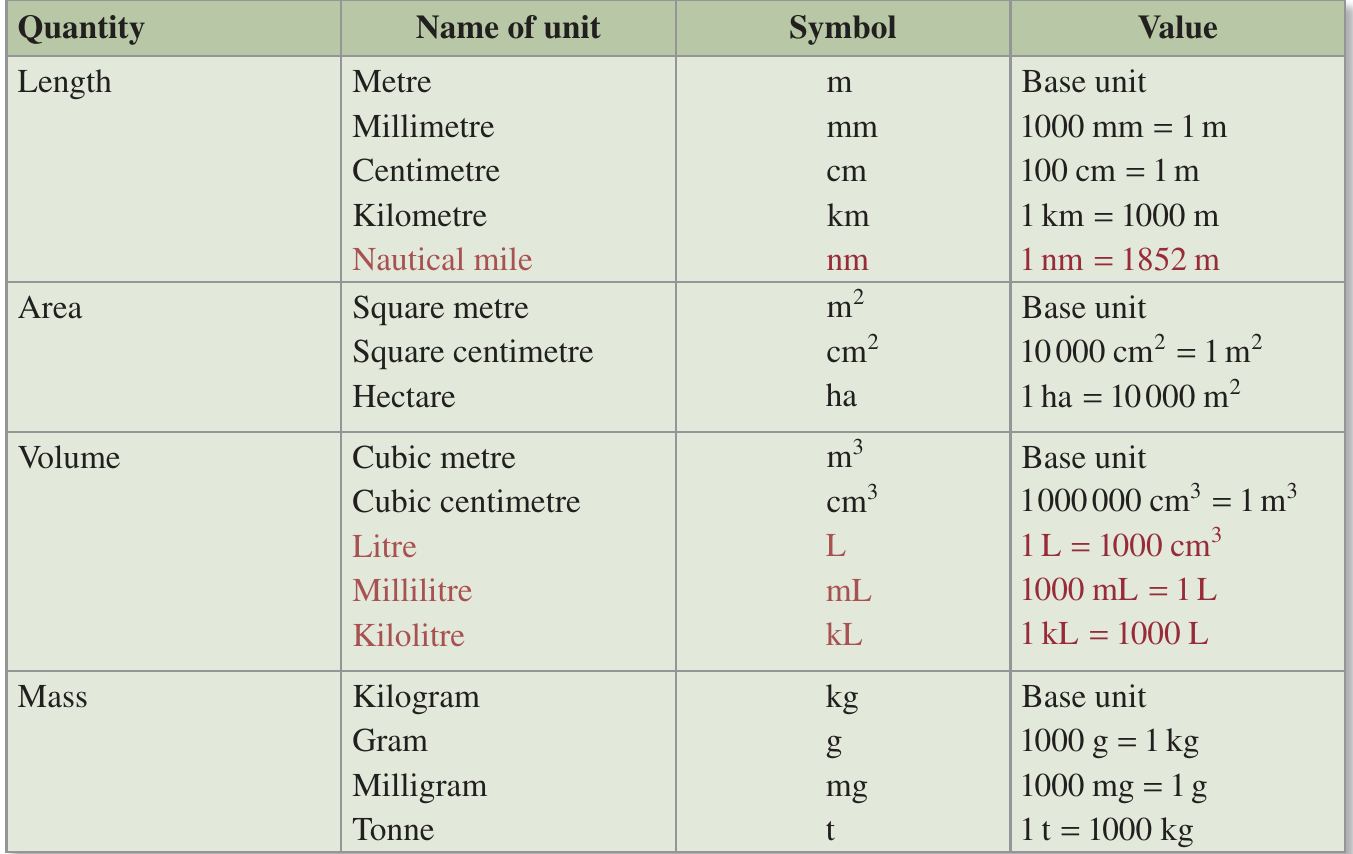
This table shows you the base units and the most commonly used derived units for length, area, volume, and mass. Notice how each quantity has one base unit, and then several other units that relate to it through powers of ten.
Length units
The base unit for length is the metre (symbol: ). Other length units include:
- Millimetre ():
- Centimetre ():
- Kilometre ():
Area units
The base unit for area is the square metre (symbol: ). This measures two-dimensional space. Other area units include:
- Square centimetre ():
- Hectare ():
Volume units
The base unit for volume is the cubic metre (symbol: ). This measures three-dimensional space. Other volume units include:
- Cubic centimetre ():
- Litre ():
- Millilitre ():
- Kilolitre ():
Mass units
The base unit for mass is the kilogram (symbol: ). Other mass units include:
- Gram ():
- Milligram ():
- Tonne ():
Understanding mass
It's important to understand what mass actually measures. Mass is the amount of matter (stuff) that makes up an object or body. This is different from weight, even though we often use these words interchangeably in everyday life.
Weight is actually the force that gravity exerts on a mass. Here's the key difference: if you travel to a different location where gravity is stronger or weaker (like the Moon or Jupiter), your mass stays exactly the same, but your weight changes. This is because you still have the same amount of matter in your body, but the gravitational force acting on that matter is different.
Important
Mass vs Weight - A Critical Distinction:
Mass = amount of matter in a body (always constant)
Weight = gravitational force acting on that mass (varies with location)
Your mass on the Moon is the same as on Earth, but your weight is about one-sixth of what it is on Earth because the Moon's gravity is weaker.
However, when you're on Earth's surface and not moving, mass and weight are considered equivalent for everyday purposes. This is why we can use scales to "weigh" objects and report the result in kilograms, which is technically a unit of mass.
Converting between SI units of the same type
One of the most useful features of the SI system is how easy it is to convert between units. The prefix attached to a unit tells you exactly how that unit relates to the base unit. This prefix indicates multiplication by a power of .
The most common prefixes you'll encounter are:
- Mega: means multiply by (or )
- Kilo: means multiply by (or )
- Centi: means divide by (or multiply by or )
- Milli: means divide by (or multiply by or )
Note
Conversion Principle:
To convert from one unit to another, you multiply or divide by the appropriate power of .
- Larger to smaller unit (e.g., metres to centimetres) → multiply
- Smaller to larger unit (e.g., millimetres to metres) → divide
This makes sense because there are more of the smaller units needed to make up the same measurement.
The diagram below shows you how this works:
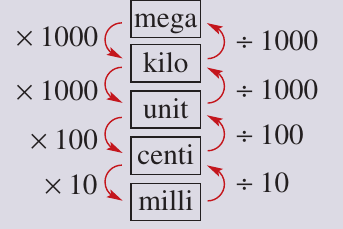
Converting length units
Let's see how this works with length conversions.
Example
Worked Example: Converting centimetres to millimetres
To convert to millimetres:
Step 1: Identify the conversion factor
- Since , we multiply by
Step 2: Perform the conversion
Step 3: Calculate the result
Therefore, 35 cm = 350 mm
Example
Worked Example: Converting metres to kilometres
To convert to kilometres:
Step 1: Identify the conversion factor
- Since , we divide by
Step 2: Perform the conversion
Step 3: Calculate the result
Therefore, 4500 m = 4.5 km
Converting mass units
The same principles apply when converting mass units.
Example
Worked Example: Converting kilograms to grams
To convert to grams:
Step 1: Identify the conversion factor
- Since , we multiply by
Step 2: Perform the conversion
Step 3: Calculate the result
Therefore, 5.2 kg = 5200 g
Example
Worked Example: Converting kilograms to tonnes
To convert to tonnes:
Step 1: Identify the conversion factor
- Since , we divide by
Step 2: Perform the conversion
Step 3: Calculate the result
Therefore, 3850 kg = 3.85 t
Converting area units
Converting area units is slightly different from converting length units. This is because area is two-dimensional, so the conversion factor must be squared.
Important
Critical Concept for Area Conversions:
When converting area units, you must square the length conversion factor.
If (factor of ), then: (factor of )
To understand this, let's look at converting square metres to square centimetres. We start by converting the side lengths:
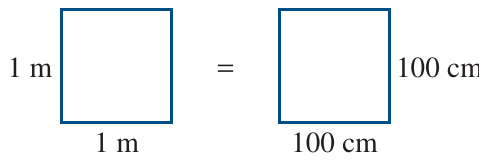
This diagram shows that a square with sides of is equal to a square with sides of .
Now let's calculate the areas:
For the square in metres:
For the square in centimetres:
Therefore:
Or equivalently:
Notice that even though (a factor of ), we have (a factor of ). This is because we're multiplying both the length and the width by .
Converting volume units
Converting volume units requires even more care because volume is three-dimensional, so the conversion factor must be cubed.
Important
Critical Concept for Volume Conversions:
When converting volume units, you must cube the length conversion factor.
If (factor of ), then: (factor of )
Let's look at converting cubic metres to cubic centimetres:
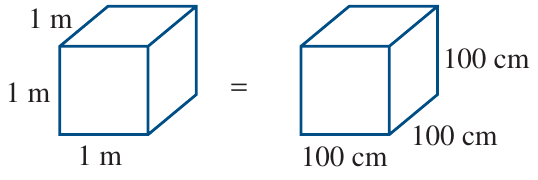
This diagram shows that a cube with edges of is equal to a cube with edges of .
Now let's calculate the volumes:
For the cube in metres:
For the cube in centimetres:
Therefore:
Or equivalently:
Even though (a factor of ), we have (a factor of ). This is because we're multiplying the length, width, and height each by .
Summary
Key Points to Remember:
-
The SI metric system is based on powers of , making conversions straightforward through multiplication or division.
-
Mass (the amount of matter) stays constant regardless of location, while weight (gravitational force on mass) changes with different gravitational fields.
-
When converting area units, you must square the length conversion factor (e.g., because ).
-
When converting volume units, you must cube the length conversion factor (e.g., because ).
-
Common prefixes make conversions easier: kilo means , centi means , and milli means .