Area of Circles and Sectors (HSC SSCE Mathematics Standard): Revision Notes
📚Revision Notes
Area of Circles and Sectors
Introduction
When working with circular shapes, we often need to calculate how much space they occupy. This is called finding the area. In this topic, we'll explore how to find the area of complete circles as well as portions of circles, including ring shapes and slice-shaped sections.
Circle area
A circle is a perfectly round shape where every point on the edge is the same distance from the center. This distance is called the radius (represented by ).
To find the area of a circle, we use the formula:
Where:
- is the area
- (pi) is approximately
- is the radius
Note
Understanding the formula: Square the radius (multiply it by itself), then multiply by pi. For example, if the radius is 5 cm, you calculate , then multiply by to get approximately cm².
Annulus area
An annulus is a ring-shaped region formed when you have two circles that share the same center point (called concentric circles), with one circle positioned inside the other. Think of it like a doughnut shape – the area between the outer edge and the inner hole.
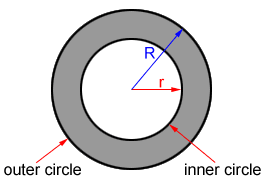
To find the area of an annulus, we use the formula:
Where:
- is the radius of the larger (outer) circle
- is the radius of the smaller (inner) circle
Note
Understanding the formula: We calculate the area of the large circle and subtract the area of the small circle. The result is the area of the ring between them. Remember: capital R for the larger radius, lowercase r for the smaller radius.
Example
Worked Example: Finding the area of an annulus
Question: Thomas draws two concentric circles whose radii are cm and cm. What is the area of the annulus formed, to the nearest square centimeter?
Solution:
Step 1: Identify the given information
- Inner radius: cm
- Outer radius: cm
Step 2: Choose the appropriate formula
- Since we have a ring shape (annulus), use
Step 3: Substitute the values
Step 4: Calculate
Step 5: Round to the nearest whole number
Answer: The area of the annulus is 63 square centimeters.
Sector area
A sector is like a slice of pizza – it's the portion of a circle bounded by two straight lines extending from the center (called radii) and the curved edge (called an arc) connecting them.
To find the area of a sector, we use the formula:
Where:
- (theta) is the central angle in degrees – the angle formed at the center of the circle
- is the radius
Note
Understanding the formula: The fraction tells us what portion of the full circle we have. We multiply this fraction by the total circle area . For example, if the angle is , then , meaning we have one-quarter of the circle.
Special cases of sectors
Semicircle: When the central angle is exactly 180°, we have a semicircle (half a circle). The formula becomes:
Quadrant: When the central angle is exactly 90°, we have a quadrant (quarter of a circle). The formula becomes:
Both of these are just special applications of the general sector formula.
Example
Worked Example: Finding the area of a sector
Question: Find the area of a sector with an angle at the center of and radius cm. Write your answer correct to one decimal place.
Solution:
Step 1: Identify the given information
- Central angle:
- Radius: cm
Step 2: Choose the appropriate formula
- Since we have a sector, use
Step 3: Substitute the values
Step 4: Calculate
Step 5: Round to one decimal place
Answer: The area of the sector is 1.9 square centimeters.
Summary of area formulas
The table below shows all the key formulas you need to know:
| Shape | Formula | Key Features |
|---|---|---|
| Circle | Complete round shape | |
| Annulus | Ring with outer radius and inner radius | |
| Sector | Slice with central angle | |
| Semicircle | Half circle ( sector) | |
| Quadrant | Quarter circle ( sector) |
Important
Master these formulas! All area calculations for circular shapes build on the fundamental circle formula . Understanding how each formula relates to this basic formula will help you remember them more easily and choose the right one for different problems.
Exam tips
Note
Strategies for success:
- Always identify which shape you're working with before choosing a formula
- For annulus problems, remember that R (capital) is the larger radius and r (lowercase) is the smaller radius
- Check whether angles are given in degrees – the sector formula uses degrees, not radians
- Don't forget to include units (cm², m², etc.) in your final answer
- Round your answer according to the question's instructions (nearest whole number, one decimal place, etc.)
Summary
Key Points to Remember:
- The area of a circle depends on the square of its radius:
- An annulus is a ring shape – subtract the small circle's area from the large circle's area:
- A sector's area is a fraction of the full circle, determined by the central angle:
- Semicircles () and quadrants () are special types of sectors with their own simplified formulas
- Always check your units and round to the required decimal places in your final answer