Area of Composite Shapes (HSC SSCE Mathematics Standard): Revision Notes
📚Revision Notes
Area of Composite Shapes
What is a composite shape?
A composite shape is a figure made from two or more basic plane shapes joined together. These basic shapes might include squares, rectangles, triangles, circles, or semicircles. To work out the area of a composite shape, we need to break it down into its simpler parts, calculate each area separately, and then combine them.
Note
The key skill is recognising which basic shapes make up the composite shape. Look for familiar geometric forms like rectangles, triangles, and circles within the larger figure. Sometimes you'll need to imagine dividing lines to see these shapes clearly.
Sometimes you'll need to add the areas together, while other times you'll need to subtract one area from another. This depends on whether the shapes are joined together or whether one shape has been removed from another.
In some problems, you may need to find missing measurements before you can calculate the areas. Pythagoras' theorem is particularly useful when working with shapes that contain right-angled triangles.
Steps for finding areas of composite shapes
Follow these four steps to successfully calculate the area of any composite shape:
Step 1: Divide the shape
Break down the composite shape into two or more basic plane shapes that you recognise. Look for squares, rectangles, triangles, circles, or semicircles within the larger shape.
Step 2: Calculate each area
Work out the area of each individual plane shape using the appropriate formula. You may need to find missing measurements first.
Step 3: Combine the areas
Add the areas together if the shapes are joined side by side. Subtract one area from another if a shape has been cut out or removed.
Step 4: Write your answer
Express your final answer with the correct units (such as cm² or m²) and to the specified level of accuracy (for example, to one decimal place).
Important
Common Mistake to Avoid:
Students often forget to check whether they should add or subtract areas. Ask yourself: "Are these shapes placed next to each other (add) or is one shape cut out from another (subtract)?" This simple question will help you choose the correct operation.
Key formulas you'll need
For squares: where is the side length.
For triangles: where is the base and is the perpendicular height.
For semicircles: where is the radius.
Pythagoras' theorem: where is the hypotenuse (longest side) and and are the other two sides of a right-angled triangle.
Note
Remember that the base and height of a triangle must be perpendicular to each other. The height is the vertical distance from the base to the opposite vertex, forming a right angle with the base.
Worked example 1: Adding areas together
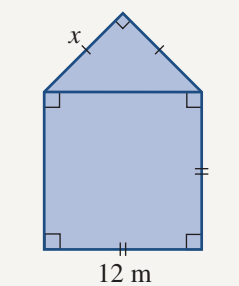
A concrete area in a shopping centre is made from a square joined to an isosceles triangle. The square has a side length of metres. The triangle sits on top of the square.
Example
Worked Example: Finding Combined Areas Using Pythagoras' Theorem
Part a: Use Pythagoras' theorem to find the value of .
The isosceles triangle has two equal sides, both of length . The base of the triangle sits on top of the square, so it has length m. If we draw a vertical line from the apex (top point) of the triangle down to the middle of the base, it creates two right-angled triangles.
In each right-angled triangle:
- The hypotenuse is
- One side is m (the full base of the square)
- The other side is also (the equal slant side)
Starting with Pythagoras' theorem:
Since both legs of the right triangle are equal in this case:
Simplify the left side:
Divide both sides by :
Take the square root of both sides:
Part b: Calculate the area of the shaded region.
First, find the area of the square using :
Next, find the area of the triangle using . The base is and the height is also :
Now add the two areas together (since the shapes are joined):
Final Answer: The area of the shaded region is 180 m².
Worked example 2: Subtracting one area from another
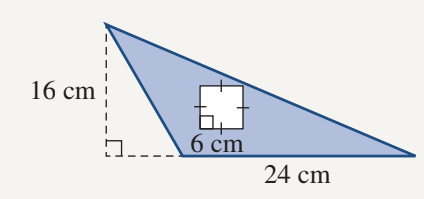
A square with side length cm is cut from a triangle. The triangle has a base of cm and a height of cm. Find the shaded area.
Example
Worked Example: Finding Areas by Subtraction
First, calculate the area of the triangle using :
Next, calculate the area of the square using :
Since the square has been removed from the triangle, we subtract:
Final Answer: The shaded area is 156 cm².
Worked example 3: Working with semicircles
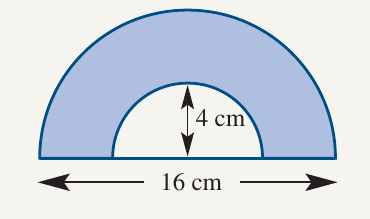
The diagram shows a smaller semicircle cut out of a larger semicircle. The larger semicircle has a diameter of cm, while the smaller semicircle has a radius of cm.
Example
Worked Example: Composite Shapes with Curved Boundaries
Part a: What is the area of the smaller semicircle?
The radius is cm. Using the semicircle formula:
Part b: What is the area of the larger semicircle?
The diameter is cm, so the radius is half of this: cm. Using the semicircle formula:
Part c: What is the shaded area correct to one decimal place?
Subtract the smaller semicircle from the larger:
Calculate the decimal value:
Final Answer: The shaded area is approximately 75.4 cm².
Important
Exam Tip: Exact vs Approximate Answers
Unless told otherwise, leave answers involving in exact form (like ) rather than calculating a decimal approximation. Only round to the requested number of decimal places when specifically asked to do so. Exact answers are more accurate and often required in examinations.
Remember!
Summary
Key Points to Remember:
- A composite shape is formed from two or more basic shapes joined together or with one shape removed from another.
- Break the composite shape into recognisable parts (triangles, squares, circles, etc.) before calculating areas.
- Add areas when shapes are placed side by side; subtract areas when one shape is cut out from another.
- You may need to find missing measurements using Pythagoras' theorem () before calculating areas.
- Always include the correct units in your final answer (such as m² or cm²) and round to the specified level of accuracy.