Volume of Right Prisms (HSC SSCE Mathematics Standard): Revision Notes
📚Revision Notes
Volume of Right Prisms
Understanding volume
Volume measures the amount of space a three-dimensional object occupies. Think of it as counting how many unit cubes can fit inside a solid shape. When you calculate volume, your answer will always be expressed in cubic units.
Note
Imagine filling a box with small cubes - the number of cubes that fit inside represents the volume. This is why volume is measured in cubic units like cm³ or m³.
Converting volume units
It's important to know how different cubic units relate to each other:
Note
Notice that volume conversions involve cubing the linear conversion factor. For example, since , we have cubic centimetres in one cubic metre.
What are prisms?
A prism is a special type of three-dimensional object. The key feature of a prism is that it has a uniform cross-section along its entire length. This means if you were to slice through the prism parallel to its ends, every slice would have exactly the same shape and size.
The volume of any prism can be calculated using the cross-sectional area. This area is often called the base area of the prism.
Note
Think of a prism as a shape that has been "stretched" or "extended" in one direction. The cross-section is the shape you see when you look at the end of the prism. Because this cross-section stays the same along the entire length, calculating volume becomes straightforward.
Volume formulas for right prisms
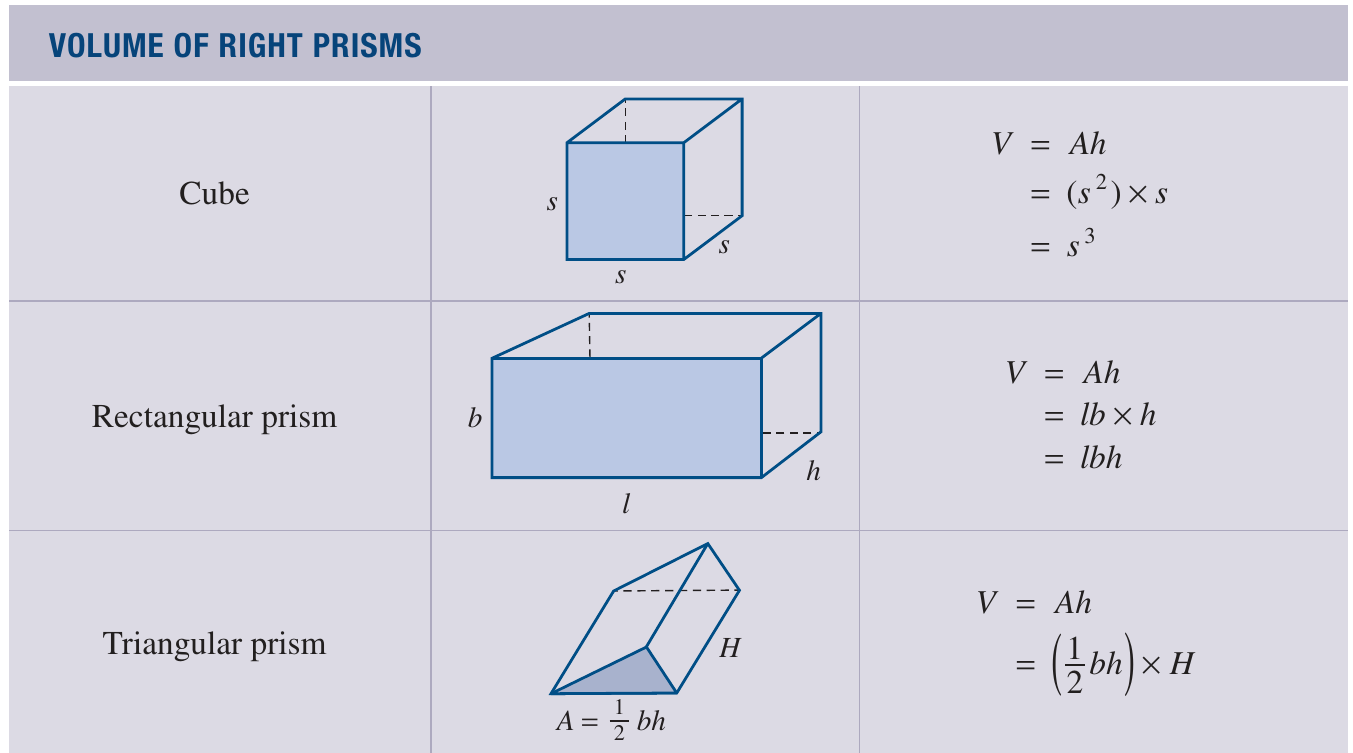
All right prisms follow the same fundamental principle: their volume equals the area of the base multiplied by the height (or length) of the prism.
General formula
Important
For any right prism:
where:
- = volume
- = area of the cross-section (base area)
- = height (or length) of the prism
This is the fundamental formula that applies to all prisms.
Specific formulas
Cube:
For a cube with side length :
This comes from where the base is a square with area , and the height is also .
Rectangular prism:
For a rectangular prism with length , breadth , and height :
This comes from where the base area is (a rectangle).
Triangular prism:
For a triangular prism with a triangular base of base and height , and prism height :
This comes from where the base area is (area of a triangle).
Worked examples
Example
Worked Example 1: Finding volume when base area is given
Question: A triangular prism has a base area of and a height of . What is the volume of the triangular prism?
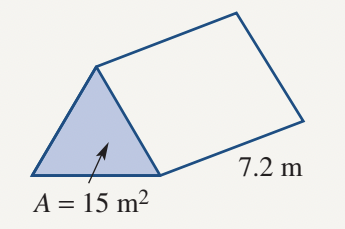
Solution:
- Use the volume formula for a right prism:
- Substitute the values into the formula:
- Calculate:
- Write the answer with correct units:
Note
Exam tip: When the base area is already given, simply multiply it by the height. You don't need to calculate the base area separately.
Example
Worked Example 2: Finding volume of a rectangular prism
Question: A rectangular prism has a length of , a breadth of , and a height of . Find the volume of this rectangular prism.
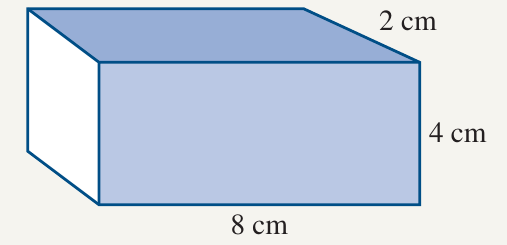
Solution:
-
Use the volume formula for a right prism:
-
The base is a rectangle, so the area formula is
-
Substitute the values into the formula:
- Calculate:
- Give the answer with correct units:
Note
Exam tip: For rectangular prisms, you can multiply all three dimensions together in one step.
Example
Worked Example 3: Finding volume of a trapezoidal prism
Question: Find the volume of the trapezoidal prism shown with the following dimensions: parallel sides of and , height of trapezoid , and prism depth of .
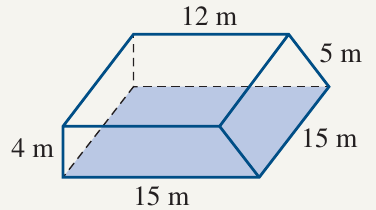
Solution:
Step 1: Find the area of the trapezoidal cross-section (the front face)
-
Use the area formula for a trapezium:
-
Substitute the values:
- Calculate:
- Write with units:
Step 2: Find the volume of the prism
-
Use the volume formula for a right prism:
-
Substitute the values:
- Calculate:
- Write with correct units:
Important
Exam tip: For prisms with complex cross-sections (like trapezoids), always calculate the cross-sectional area first, then multiply by the prism's depth or length.
Summary
Key Points to Remember:
- Volume measures the space inside a three-dimensional object and is always expressed in cubic units (, , etc.)
- All right prisms use the formula , where is the cross-sectional area and is the height
- For rectangular prisms, you can use the shortcut (multiply all three dimensions)
- When working with complex cross-sections (like trapezoids or triangles), calculate the cross-sectional area first, then multiply by the prism's length
- Always check your units and convert if necessary before calculating volume