Preliminary Preparation (HSC SSCE Mathematics Standard): Revision Notes
📚Revision Notes
Pythagoras' Theorem, Perimeter, and Area
Pythagoras' theorem
Understanding right-angled triangles
When you know the length of two sides in a right-angled triangle, you can use Pythagoras' theorem to calculate the length of the third side. This powerful mathematical relationship also allows you to prove whether a triangle has a right angle.
Note
A right-angled triangle is a triangle with one angle measuring exactly 90 degrees. The side opposite the right angle is called the hypotenuse, and it is always the longest side of the triangle.
The Pythagorean relationship
Pythagoras' theorem establishes a connection between the three sides of a right-angled triangle. The theorem states that the square of the hypotenuse equals the sum of the squares of the other two sides.
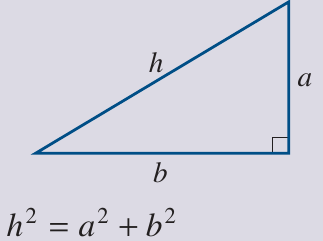
Formula:
where:
- represents the hypotenuse (longest side)
- and represent the two shorter sides
Finding the hypotenuse
When you need to find the length of the hypotenuse, you can substitute the known side lengths into the formula and solve for .
Example
Worked Example: Finding the length of the hypotenuse
Find the length of the hypotenuse, correct to two decimal places.
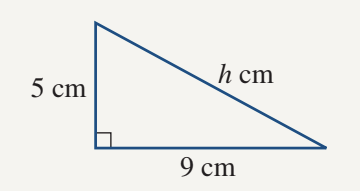
Solution:
Write Pythagoras' theorem:
Substitute the length of the sides:
Calculate the value of :
Take the square root to find :
Express answer correct to two decimal places:
The length of the hypotenuse is 10.30 cm.
Finding a shorter side
When the hypotenuse is known and you need to find one of the shorter sides, you rearrange the formula to make the unknown side the subject.
Example
Worked Example: Finding the length of a shorter side
What is the value of correct to one decimal place?
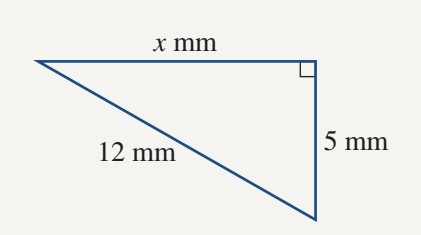
Solution:
Write Pythagoras' theorem:
Substitute the length of the sides:
Make the subject:
Take the square root to find :
Express answer correct to one decimal place:
The value of is 10.9 mm.
Important
Always identify the hypotenuse first - it's the side opposite the right angle and the longest side. When finding a shorter side, remember to subtract the squares before taking the square root.
Perimeter
What is perimeter?
The perimeter represents the complete distance around the outer boundary of a shape. Think of it as the length you would walk if you traced along the edge of the shape. Perimeter is always measured in linear units such as centimetres, metres, or kilometres.
Perimeter formulas
Different shapes have different formulas for calculating perimeter. Here are the most common ones:
| Name | Shape | Perimeter |
|---|---|---|
| Triangle | Triangle with sides , , | |
| Quadrilateral | Four-sided shape with sides , , , | |
| Square | Square with side | |
| Rectangle | Rectangle with length and breadth | |
| Circle | Circle with radius and diameter | Circumference: or |
Note
For circles, we use the term circumference instead of perimeter, but it means the same thing - the distance around the outside.
Calculating perimeter of rectangles
Example
Worked Example: Finding the perimeter of a rectangle
Find the perimeter of the following rectangle.
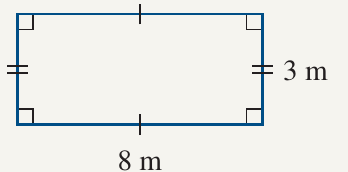
Solution:
The shape is a rectangle, so use the formula:
Substitute the values for and where and :
Evaluate:
Write the answer in words:
The perimeter of the rectangle is 22 m.
Calculating perimeter of triangles
When finding the perimeter of a triangle, you may need to use Pythagoras' theorem first if one side length is unknown.
Example
Worked Example: Finding the perimeter of a triangle
Find the perimeter of the triangle. Answer correct to one decimal place.
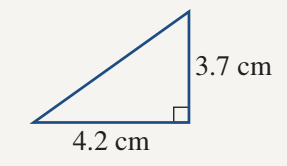
Solution:
Find the length of the hypotenuse or :
Write Pythagoras' theorem:
Substitute the length of the sides:
Evaluate the value of :
Add the lengths of sides to find the perimeter:
Express answer correct to one decimal place:
The perimeter of the triangle is 13.5 cm.
Calculating circumference of circles
For circles, remember that you can use either the radius or diameter formula.
Example
Worked Example: Finding the circumference of a circle
Find the perimeter of a circle with a radius of 9 mm. Answer correct to two decimal places.
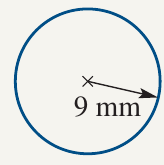
Solution:
The shape is a circle, so use the formula:
Substitute the value for where :
Evaluate:
Write the answer in words:
The perimeter of the circle is 56.55 mm.
Calculating perimeter of semicircles
A semicircle is half of a circle, so its perimeter includes the curved part plus the diameter (straight edge).
Example
Worked Example: Finding the perimeter of a semicircle
Find the perimeter of a semicircle with a diameter of 4 m. Answer correct to two decimal places.
Solution:
The shape is a semicircle, so use the formula:
Substitute the value for where to find the curved distance:
Evaluate:
Add the curved distance to the diameter:
Evaluate:
Write the answer in words:
The perimeter is 10.28 m.
Important
For semicircles, don't forget to add the straight edge (diameter) to the curved part when finding the perimeter.
Perimeter of composite shapes
A composite shape is made up of two or more simple shapes joined together. To find the perimeter of a composite shape, you need to add up all the lengths that form the outer boundary.
Note
Key points for composite shapes:
- Sides with matching markings have equal length
- Unknown side lengths can be found using the given lengths of other sides
- Use Pythagoras' theorem when right triangles are involved
- For circular parts, use
- Only count the outer boundary edges
Example
Worked Example: Finding the perimeter of composite shapes
Find the perimeter of each of these shapes.
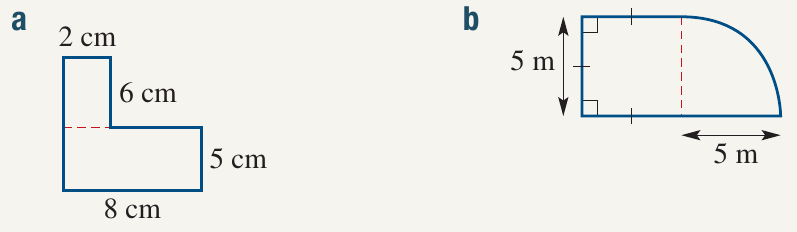
Solution:
Part a (L-shaped figure):
Find the unknown side lengths using the measurements given:
The missing horizontal side: cm
The missing vertical side: cm
Add the lengths of all the edges to find the perimeter:
Evaluate:
Write the answer in words:
The perimeter is 38 cm.
Part b (Rectangle with semicircle):
Use the formula for the curved length:
Substitute the value for where :
Evaluate:
Add the curved length to other edges:
Evaluate:
Write the answer in words:
The perimeter is 27.85 m.
Area
What is area?
The area of a shape represents the amount of surface enclosed within the boundaries of the shape. You can think of it as counting how many unit squares fit inside the shape. Area is always measured in square units, such as square centimetres (cm²), square metres (m²), or square kilometres (km²).
Unit conversions for area
When working with area, it's important to know these conversion relationships:
Note
When converting between area units, remember that you're dealing with squared units. For example, since 100 cm = 1 m, we have cm² = 1 m².
Area formulas
To calculate the area of common shapes, we use specific formulas:
| Name | Shape | Area |
|---|---|---|
| Triangle | Triangle with base and height | |
| Square | Square with side | |
| Rectangle | Rectangle with length and breadth | |
| Parallelogram | Parallelogram with base and height | |
| Trapezium | Trapezium with parallel sides and , height | |
| Rhombus | Rhombus with diagonals and | |
| Circle | Circle with radius |
Calculating area of triangles
For triangles, you need to identify the base and the perpendicular height.
Example
Worked Example: Finding the area of a triangle
Find the area of the triangle.
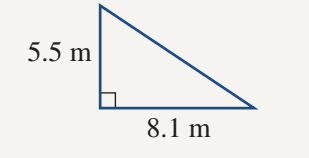
Solution:
The shape is a triangle, so use the formula:
Substitute the values for and where and :
Evaluate:
Write the answer using the correct units:
The area of the triangle is 22.275 m².
Calculating area of trapeziums
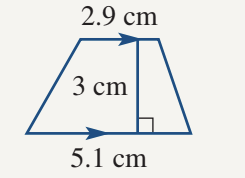
A trapezium has one pair of parallel sides. The area formula uses both parallel sides and the perpendicular height between them.
Example
Worked Example: Finding the area of a trapezium
Find the area of the quadrilateral.
Solution:
The shape is a trapezium, so use the formula:
Substitute the values for , , and :
Evaluate:
Write the answer using the correct units:
The area of the shape is 12 cm².
Calculating area of parallelograms
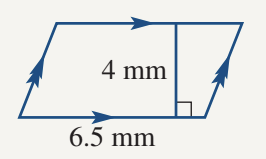
A parallelogram is a quadrilateral where opposite sides are parallel. The area depends on the base and perpendicular height.
Example
Worked Example: Finding the area of a parallelogram
Find the area of the following quadrilateral.
Solution:
The shape is a parallelogram, so use the formula:
Substitute the values for and where and :
Evaluate:
Write the answer using the correct units:
The area of the shape is 26 mm².
Important
For parallelograms, make sure you use the perpendicular height, not the slant length of a side.
Calculating area of circles
The area of a circle depends on the radius. Remember that the radius is half the diameter.
Example
Worked Example: Finding the area of a circle
Find the area of a circle with a radius of 5 metres. Give your answer correct to one decimal place.
Solution:
The shape is a circle, so use the formula:
Substitute the value for where :
Evaluate correct to one decimal place:
Write the answer using the correct units:
The area of the circle is 78.5 m².
Area of composite shapes
Composite shapes consist of two or more simple shapes combined. The area of a composite shape can be found by adding or subtracting the areas of the simple shapes that make it up.
Note
Key approach for composite shapes:
- Divide the composite shape into recognisable simple shapes
- Calculate the area of each simple shape separately
- Add the areas together (or subtract if there's a cut-out section)
- Express the answer with appropriate units
Example
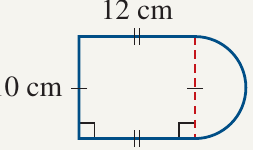
Worked Example: Finding the area of a composite shape
Find the area of the composite shape. Answer correct to one decimal place.
Solution:
Divide the shape into a rectangle and a semicircle.
Use the formula for the rectangle:
Substitute where and :
Evaluate:
Use the formula for the semicircle:
Substitute where :
Evaluate:
Add the area of the rectangle to the semicircle:
Evaluate:
Write the answer using the correct units:
The area of the shape is 159.3 cm².
Important
When dealing with composite shapes, draw lines to separate the shape into simple components. This makes it easier to identify which formulas to use.
Remember!
Summary
Key Points to Remember:
-
Pythagoras' theorem () works only for right-angled triangles and helps find missing side lengths when two sides are known. The hypotenuse is always the longest side and opposite the right angle.
-
Perimeter is the total distance around the outside boundary of a shape, measured in linear units (cm, m, km). For circles, we call this the circumference.
-
Area is the amount of surface enclosed within a shape's boundaries, measured in square units (cm², m², km²). Different shapes require different formulas.
-
For composite shapes, break them down into simpler shapes. Calculate the perimeter by adding outer boundary lengths, and calculate the area by adding (or subtracting) the areas of the component shapes.
-
Always ensure your measurements are in the same units before calculating, and remember to include the correct units in your final answer.