Simple Interest and Compound Interest (HSC SSCE Mathematics Standard): Revision Notes
📚Revision Notes
Simple Interest and Compound Interest
Introduction to interest
Interest is what you earn when you lend money or invest it, or what you pay when you borrow money. There are different methods for calculating interest, and understanding these methods helps you make better financial decisions.
Note
An investment, in the context of interest, is money that you deposit into a bank or financial institution. In return, the bank pays you interest. Think of it as a loan you're making to the bank.
Simple interest
Simple interest (also called flat interest) is calculated as a fixed percentage of the original amount. The key feature of simple interest is that it's always calculated on the initial amount (the principal), not on any accumulated interest.
For example, if you invest $100 in an account that pays 5% per annum (per year), you would receive $5 each year:
This $5 payment would remain constant each year because simple interest doesn't change over time.

Simple interest formula
Where:
- = Interest (simple or flat) earned for the use of money, paid by borrowers to lenders
- = Principal, the initial amount of money borrowed, lent or invested
- = Rate of simple interest per time period expressed as a decimal (e.g., 5% = 0.05)
- = Number of time periods (days, weeks, months or years)
Example
Worked Example: Finding Simple Interest
Question: Calculate the amount of simple interest paid on an investment of $12,000 at 10% simple interest per annum for 3 years.
Solution:
- Write the simple interest formula:
- Substitute , and into the formula:
- Evaluate:
- Write the answer in words:
Simple interest is $3600.
Amount owed or future value
When calculating loans or investments, you need to find the total amount by adding the interest to the principal. This gives you either the amount owed on a loan or the future value of an investment.
Amount owed formula
Where:
- = Amount owed or future value
- = Interest (simple or flat) earned
- = Principal, the initial quantity of money borrowed, loaned or invested
Example
Worked Example: Calculating the Amount Owed
Question: Find the amount owed on a loan of $50,000 at 7% per annum simple interest at the end of two years and six months.
Solution:
- Write the simple interest formula:
- Substitute , and into the formula:
- Evaluate:
- Write the amount owed formula:
- Substitute and into the formula:
- Evaluate:
- Write the answer in words:
Amount owed is $58,750.
Example
Worked Example: Calculating Value of an Investment
Question: Joel plans to make an investment of $200,000 at 7.5% p.a. simple interest for 2 years. What is the total value of his investment at the end of 2 years?
Solution:
- Write the simple interest formula:
- Substitute , and into the formula:
- Evaluate:
- Write the amount owed formula:
- Substitute and into the formula:
- Evaluate:
- Write answer in words:
Total value is $230,000.
Compound interest
Important
Compound interest is calculated differently from simple interest. With compound interest, you calculate interest on the principal at the start, and then at each time period, you calculate interest on the principal plus any accumulated interest. In other words, compound interest calculates interest on the interest.
How compound interest works
Let's see how $100 grows at a compound interest rate of 10% per annum:
Note
First year:
Interest = $100 × 0.10 × 1 = $10
Amount owed = $100 + $10 = $110
Second year:
Interest = $110 × 0.10 × 1 = $11
Amount owed = $110 + $11 = $121
Third year:
Interest = $121 × 0.10 × 1 = $12.10
Amount owed = $121 + $12.10 = $133.10
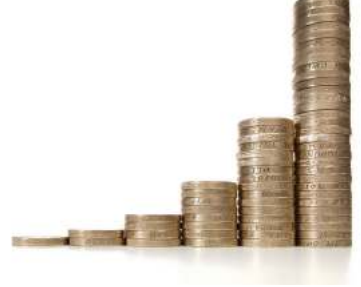
Notice that the interest earned increases each year. In the first year it was $10, in the second year $11, and in the third year $12.10. This happens because you're earning interest on your previously earned interest.
Compound interest formula
Where:
- = Amount (final balance) or future value of the loan
- = Principal, the initial amount of money borrowed or present value of the loan
- = Rate of interest per compounding time period expressed as a decimal
- = Number of compounding time periods
Interest earned or owed formula
To find the total compound interest earned or paid, subtract the principal from the final balance:
Where:
- = Amount of money or final balance
- = Interest (compound) earned or paid
- = Principal, the initial amount of money
Example
Worked Example: Finding Compound Interest (Annual Compounding)
Question: Paige invests $5000 over 5 years at a compound interest rate of 6.5% p.a. Calculate:
a the amount of the investment after 5 years, correct to the nearest cent
b the interest earned after 5 years, correct to the nearest cent.
Solution:
Part a:
- Write the compound interest formula:
- Substitute , and into the formula:
- Evaluate:
- Write answer in words:
Amount of investment earned is $6850.43.
Part b:
- Write the formula:
- Substitute and into the formula:
- Evaluate:
- Write in words:
Interest earned is $1850.43.
Example
Worked Example: Finding Compound Interest (Monthly Compounding)
Question: James borrowed $50,000 for 4 years at 11% p.a. interest compounding monthly. Calculate:
a the amount owed after 4 years, correct to the nearest cent
b the interest owed after 4 years, correct to the nearest cent.
Solution:
Part a:
- Write the compound interest formula:
- Calculate the number of time periods (4 years × 12 months) and the interest rate per time period:
- Substitute , and into the formula:
- Evaluate:
- Write answer in words:
Amount owed is $77,479.90.
Part b:
- Write the interest owed formula:
- Substitute and into the formula:
- Evaluate:
- Write in words:
Interest owed is $27,479.90.
Summary
Key Points to Remember:
-
Simple interest is calculated only on the original principal amount. It stays the same each time period. Use the formula .
-
Compound interest is calculated on the principal plus any previously earned interest. It grows over time because you earn interest on interest. Use the formula .
-
Always convert percentage rates to decimals in your calculations (e.g., 5% becomes 0.05).
-
For compound interest with different compounding periods (monthly, quarterly, etc.), divide the annual rate by the number of periods per year and multiply the number of years by the periods per year.
-
To find total interest earned or owed, subtract the principal from the final amount: .