Working with Time (HSC SSCE Mathematics Standard): Revision Notes
📚Revision Notes
Time Difference and Local Time
Understanding time zones and UTC
When travelling or communicating across different parts of the world, we need to account for time zones. Each location has a specific time relative to Coordinated Universal Time (UTC). The UTC system uses positive numbers for locations east of the Prime Meridian and negative numbers for locations west of it.
Note
UTC Examples Around the World:
- Seoul is UTC+9 (9 hours ahead of UTC)
- Chicago is UTC-6 (6 hours behind UTC)
- Suva, Fiji is UTC+12 (12 hours ahead of UTC)
- Miami is UTC-5 (5 hours behind UTC)
The positive (+) and negative (-) signs indicate whether a location is ahead of or behind UTC.
Calculating time difference and local time
To work out the local time in a different location, follow this systematic approach:
Step 1: Find the time difference
Calculate the time difference between the two locations by working with their UTC values. When the UTC values have opposite signs (one positive, one negative), add their absolute values together. When they have the same sign, subtract the smaller from the larger.
Step 2: Create an east-west timeline
Draw a horizontal line to represent the east-west relationship between locations. Place west (with a minus sign) on the left side and east (with a plus sign) on the right side.

Position your locations on this timeline according to their UTC values. Locations further west go on the left, while locations further east go on the right.
Step 3: Apply the addition or subtraction rule
To find the local time at your destination:
- If the destination is east of the location with the known time, add the time difference
- If the destination is west of the location with the known time, subtract the time difference
Important
Direction Rule for Time Calculations:
"East is Plus, West is Minus" - As you move eastward, time moves forward (add hours), and as you move westward, time moves backward (subtract hours).
Worked example: Seoul to Chicago
Example
Worked Example 10: Time Calculation from Seoul to Chicago
Let's examine a journey from Seoul (UTC+9) to Chicago (UTC-6).
Part a: Finding the time difference
Since Seoul is UTC+9 and Chicago is UTC-6, they have opposite signs. We calculate:
Time difference = hours
The time difference between these cities is 15 hours.
Part b: Finding local time in Chicago
Given: It is 5:00 p.m. in Seoul
Required: Local time in Chicago
First, draw the east-west timeline:
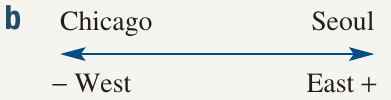
Chicago sits on the west side (UTC-6) and Seoul on the east side (UTC+9).
Since we need the time in Chicago, which is west of Seoul, we subtract the time difference:
Time in Chicago = p.m. h = a.m.
Therefore, when it is 5:00 p.m. in Seoul, it is 2:00 a.m. the same day in Chicago.
Part c: Calculating flight arrival time
Given:
- Flight departs Seoul at 5:00 p.m.
- Flight duration is 14 hours
- Time difference is 15 hours
To find the arrival time in Chicago, we need to:
- First convert the departure time to Chicago local time: p.m. h = a.m.
- Then add the flight duration: a.m. h = p.m.
The flight arrives in Chicago at 4:00 p.m..
Important
Exam Tip for Arrival Time Calculations:
When calculating arrival times, always convert to the destination's local time first, then add the flight duration. This prevents errors in your calculation. Never add flight duration to the departure time before converting time zones!
Worked example: Suva to Miami with date changes
This example demonstrates how time zone differences can affect the date as well as the time.
Example
Worked Example 11: Time and Date Changes from Suva to Miami
Part a: Finding the time difference
Suva, Fiji is at UTC+12, and Miami, Florida is at UTC-5. Since these have opposite signs:
Time difference = hours
Part b: Finding time and date in Miami
Given: It is 10:10 a.m. on Wednesday 6 January in Suva
Required: Time and date in Miami
Draw the east-west timeline with Miami (UTC-5) on the left (west) and Suva (UTC+12) on the right (east).
Since Miami is west of Suva, we subtract the time difference:
Time in Miami = a.m. h = p.m.
However, when we subtract 17 hours from a morning time, we cross back into the previous day. Therefore:
Miami's time is 5:10 p.m. on Tuesday 5 January
Notice how the date changed from Wednesday 6 January to Tuesday 5 January due to the large time difference.
Part c: Flight arrival with time zones
Given:
- Departure: 2:30 p.m. on 7 April (Suva time)
- Flight duration: 16 hours
- Time difference: 17 hours
To find the arrival time and date in Miami:
Step 1: Convert departure time to Miami local time
- Miami time at departure = p.m. h = p.m. on 6 April (previous day)
Step 2: Add flight duration
- Arrival time = p.m. h = p.m. on 7 April
Therefore, Moana arrives in Miami at 1:30 p.m. on 7 April (local time).
Important
Understanding Date Changes in Flight Calculations:
Although the flight departs on 7 April Suva time, when converted to Miami time, the departure is actually on 6 April. After the 16-hour flight, the arrival is on 7 April Miami time - the same date as the departure in Suva time!
This demonstrates how large time differences can create situations where you "gain" or "lose" days depending on your direction of travel.
Working with time calculations
When performing time calculations across time zones, keep these points in mind:
Note
Time Arithmetic Rules:
- When subtracting hours that exceed the current time, you move to the previous day
- When adding hours that exceed 24, you move to the next day
- Always complete time zone conversions before adding flight durations
Date Line Crossings:
- Large time differences (like 17 hours) often result in date changes
- Moving westward across many time zones puts you in an earlier date
- Moving eastward across many time zones puts you in a later date
Flight Calculation Steps:
- Convert departure time to destination time zone first
- Add flight duration to the converted time
- The result gives you the local arrival time and date
Summary
Key Points to Remember:
- UTC values indicate how many hours ahead (+) or behind (-) a location is from Coordinated Universal Time
- Time difference is found by calculating the gap between UTC values - add them when they have opposite signs, subtract when they have the same sign
- East-west timeline helps visualise the relationship: west is on the left (-), east is on the right (+)
- Direction matters: Add time when moving east, subtract time when moving west ("East is Plus, West is Minus")
- Date changes occur when time calculations cross midnight - watch for this with large time differences
- For flight arrivals: convert time zones first, then add flight duration