Timetables (HSC SSCE Mathematics Standard): Revision Notes
📚Revision Notes
Timetables
What is a timetable?
A timetable shows you when things are scheduled to happen. It lists the times for events or activities that are planned to occur. You'll see timetables in many places:
- School timetables showing your classes
- Train timetables for rail services
- Bus timetables for public transport
- Airline departure boards at airports
Note
Timetables can be written in either 12-hour format (using am and pm) or 24-hour format (using times like 15:30 instead of 3:30 pm). Make sure you know which format you're working with!
Reading train timetables
Train timetables show you when trains depart from and arrive at different stations. To use them effectively, you need to be able to:
- Find departure and arrival times for specific stations
- Calculate how long a journey takes
- Identify which trains meet your travel needs
Finding departure and arrival times
When reading a timetable, stations are usually listed down the left side, and times are shown across the top or in columns. To find when a train departs or arrives:
- Locate the station you're interested in
- Follow the row across to find the time in the appropriate column
- Dashes (---) mean the train doesn't stop at that station
Note
Reading timetables is all about following rows and columns: stations run down, times run across. This grid system makes it easy to find the information you need quickly.
Calculating journey duration
To work out how long a journey takes, use this method:
Simply subtract the departure time from the arrival time. Make sure you're careful with minutes when they cross the hour boundary.
Important
Common Mistake to Avoid:
When calculating journey times that cross the hour, be extra careful! For example, from 11:50 to 12:10 is 20 minutes, not 60 minutes. Always think about how many minutes have actually passed.
Worked example: Reading a train timetable
Example
Worked Example: Reading a Train Timetable
Let's look at a train timetable from Parramatta to Central.
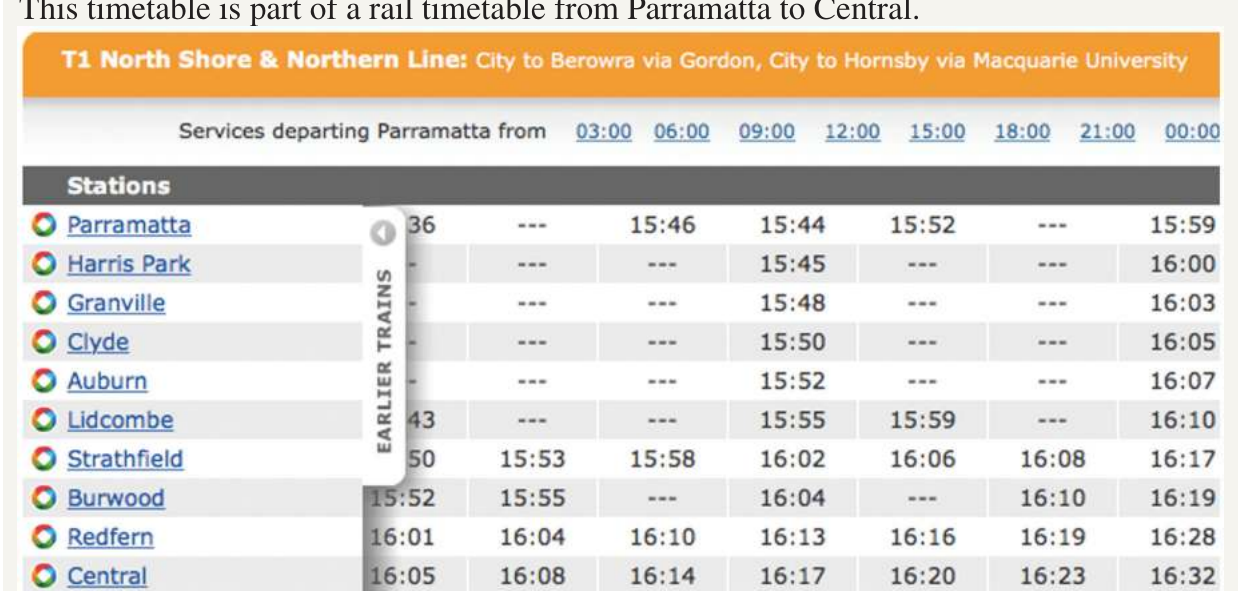
Question a: How long does the train take to travel from Granville to Burwood?
Solution:
- Find Granville in the station list and read across to see departure time: 15:48
- Find Burwood and read across to see arrival time: 16:04
- Calculate: minutes
The journey takes 16 minutes.
Question b: At what time does the 15:59 train from Parramatta depart Strathfield?
Solution:
- Find the column showing the 15:59 departure from Parramatta
- Follow this column down to the Strathfield row
- The train departs Strathfield at 16:17
Question c: How long does the 15:46 train take to go from Parramatta to Redfern?
Solution:
- Departure from Parramatta: 15:46
- Arrival at Redfern: 16:10
- Calculate: minutes
The journey takes 24 minutes.
Question d: Alan wants to travel from Parramatta and get to Central before 16:30. Describe the different options shown on this timetable.
Solution:
Look at the bottom row (Central) and identify all trains arriving before 16:30:
- All stations train: departs 15:44, arrives 16:17
- Fast train: departs 15:46, arrives 16:14
- Fast train: departs 15:52, arrives 16:20
All three of these options would get Alan to Central before his 16:30 deadline.
Working with journey times
Sometimes you need to apply a known journey time to calculate when a train will arrive if it departs at a different time. This is useful when services run at regular intervals or when you need to plan around a specific departure time.
Example
Worked Example: Calculating Arrival Times
Here's a regional train timetable showing Service 718 from Condobolin to Stockinbingal.
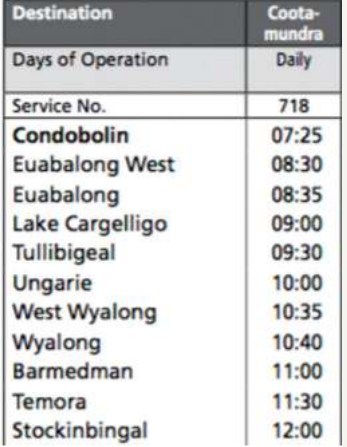
Question a: How long does the trip take from Condobolin to Stockinbingal?
Solution:
- Departure from Condobolin: 07:25
- Arrival at Stockinbingal: 12:00
- Calculate: (4 hours and 35 minutes)
The total journey time is 4 hours and 35 minutes.
Question b: Nina joins the train at Lake Cargelligo and gets off at Temora. How long is her trip?
Solution:
- Departure from Lake Cargelligo: 09:00
- Arrival at Temora: 11:30
- Calculate: (2 hours and 30 minutes)
Nina's journey takes 2 hours and 30 minutes.
Question c: Another train leaves Condobolin at 12:45 pm and travels at the same speed and stops at the same stations. When will this train arrive at Stockinbingal?
Solution:
From part a, we know the journey takes 4 hours and 35 minutes. To find the arrival time:
Converting to 12-hour format: 5:20 pm
Reading bus timetables
Bus timetables work similarly to train timetables but often include additional information like stop numbers and specific locations. This extra detail helps you find the exact pickup point.
Example
Worked Example: Reading a Bus Timetable
Here's part of a bus route timetable for the 373 service in Sydney.
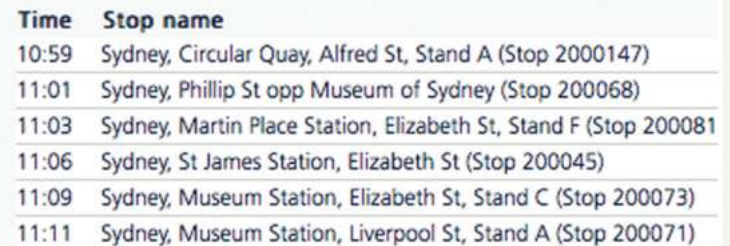
Question a: Where does the 373 bus start and finish?
Solution:
Read the route description at the top of the timetable: Circular Quay to Coogee
Question b: Where is stop 200081?
Solution:
Look through the stop names and find the one with number 200081: Martin Place Station, Elizabeth St, Stand F
Question c: When does the bus arrive at St James?
Solution:
Find St James Station in the list and read the time: 11:06
Question d: How long does it take to travel from Circular Quay to Museum station at Liverpool St?
Solution:
- Departure from Circular Quay: 10:59
- Arrival at Museum station (Liverpool St): 11:11
- Calculate: minutes
The journey takes 12 minutes.
Exam tips
When tackling timetable questions in exams, keep these strategies in mind to avoid common pitfalls and ensure accuracy:
Important
Key Strategies for Timetable Questions:
- Always check whether you're using 12-hour or 24-hour format
- When calculating journey times, be careful when crossing the hour (e.g., from 15:50 to 16:10)
- Check if the question asks for a specific train/bus or any option that meets the criteria
- Use subtraction to find journey duration: later time minus earlier time
- Remember that "---" in a timetable means the service doesn't stop at that location
Remember!
Summary
Key Points to Remember:
- A timetable is a schedule showing when events or activities are planned to occur
- Journey duration formula:
- Finding arrival time:
- Timetables can be in 12-hour format (with am/pm) or 24-hour format
- When reading timetables, stations/stops are usually listed vertically and times horizontally
- Always check your answer makes sense - journey times should be reasonable for the distance travelled