Compass and True Bearings (HSC SSCE Mathematics Standard): Revision Notes
📚Revision Notes
Compass and True Bearings
What are bearings?
A bearing describes the directional position of one location relative to another point or observer. Bearings are essential in navigation, surveying, and mapping to communicate directions precisely.
Note
There are two types of bearings used to express direction:
- Compass bearings - based on cardinal directions with angles from north or south
- True bearings - measured clockwise from north using three-figure notation
Both systems describe the same directions but use different methods of notation.
Compass bearings
The compass directions
Compass bearings use the four main cardinal directions of the compass:
- North (N)
- East (E)
- South (S)
- West (W)
The north-south axis runs vertically, while the east-west axis runs horizontally. Between these four cardinal directions are four additional intercardinal directions:
- North-east (NE)
- South-east (SE)
- South-west (SW)
- North-west (NW)
Note
Each intercardinal direction makes an angle of exactly with both the north-south and east-west axes. This creates eight evenly-spaced directions around the compass.
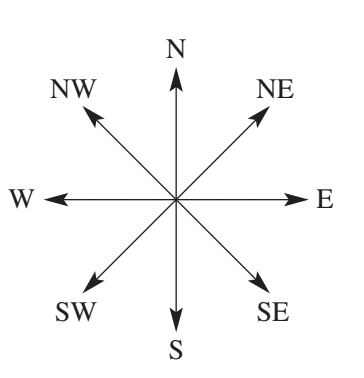
How compass bearings work
A compass bearing expresses direction by stating the angle measured from either north or south towards east or west. This system always uses the vertical north-south line as its reference.
Important
Format for writing compass bearings:
- Start with either N or S (never E or W)
- State the angle measured from that direction
- End with either E or W (the direction you're turning towards)
Example: A compass bearing of S50°W means:
- Start at south
- Measure an angle of
- Turn towards the west
Finding compass bearings from a diagram
When finding a compass bearing from a diagram, follow these steps:
Step 1: Identify which quadrant the direction lies in:
- North-east quadrant
- South-east quadrant
- South-west quadrant
- North-west quadrant
Step 2: Find the angle the direction makes with the vertical (north-south) line.
Step 3: Write the compass bearing using the format: N or S, then the angle, then E or W.
Example
Worked Example: Finding compass bearings
Find the compass bearing of point from and point from .
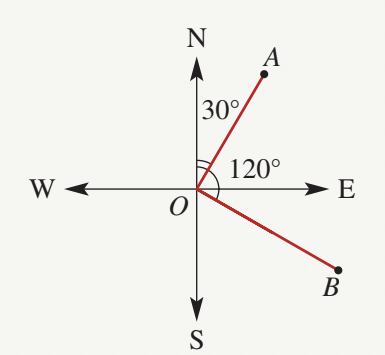
Solution for point A:
- The line lies in the north-east quadrant
- The angle from the north direction is
- Therefore, the compass bearing of from is N30°E
Solution for point B:
- The line lies in the south-east quadrant
- The angle shown from north is
- To find the angle from south:
- Therefore, the compass bearing of from is S60°E
Important
Exam tip: Always measure compass bearings from the vertical (north-south) line, never from the horizontal (east-west) line.
True bearings
What are true bearings?
A true bearing measures the angle in a clockwise direction starting from north and continuing around to the required direction. True bearings are written using three figures (digits) followed by the letter T.
True bearings are sometimes called three-figure bearings because they must always be written using three digits.
Example: represents the direction found by measuring clockwise from north. This is the same direction as the compass bearing S60°E.
Range and notation
Important
Three-figure requirement:
- The smallest true bearing is (north)
- The largest true bearing is (which is also north, completing a full circle)
- All true bearings between and must use three figures
- For example, write , not
- Write , not
Cardinal and intercardinal directions as true bearings
The eight main compass directions have the following true bearing equivalents:
| Direction | True Bearing |
|---|---|
| North (N) | |
| North-east (NE) | |
| East (E) | |
| South-east (SE) | |
| South (S) | |
| South-west (SW) | |
| West (W) | |
| North-west (NW) |
Note
Memory aid: Notice the pattern - each intercardinal direction adds going clockwise. Think of it like a clock:
- East = (quarter circle)
- South = (half circle)
- West = (three-quarters circle)
- Full circle back to North = =
Finding true bearings from a diagram
To find a true bearing from a diagram:
Step 1: Identify the angle measured clockwise from the north direction to the required direction.
Step 2: Write this angle using three figures.
Step 3: Add the letter T after the degree symbol.
Example
Worked Example: Finding true bearings
Find the true bearing of point from and point from in the following diagram.
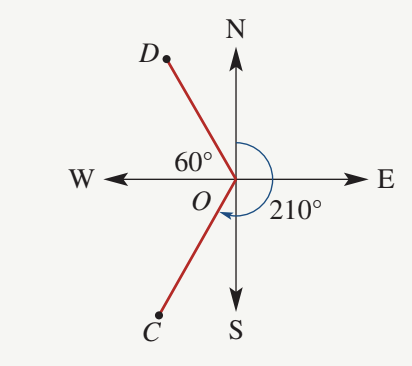
Solution for point C:
- The angle measured clockwise from north to is
- Therefore, from is
Solution for point D:
- The true bearing of west is
- Point is beyond west (measured clockwise)
- Therefore:
- So from is
Important
Exam tip: When a point lies between two cardinal directions, find the bearing to the nearest cardinal direction first, then add or subtract the additional angle.
Comparing compass and true bearings
Both bearing systems describe the same directions but use different notation methods.
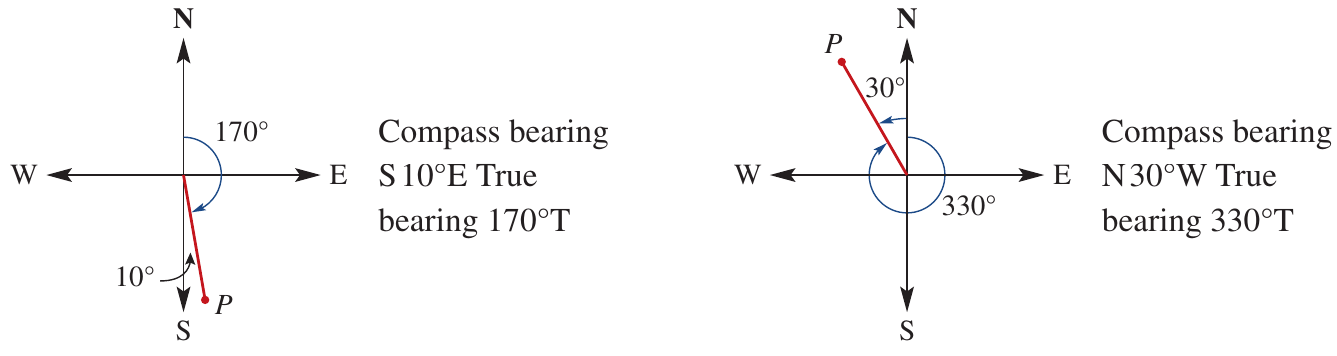
| Compass Bearing | True Bearing |
|---|---|
| States the angle from either north or south | Measures the angle clockwise from north only |
| Uses format: N/S + angle + E/W | Uses three-figure format with T |
| Example: S60°E | Example: |
| Angle is always less than | Angle ranges from to |
Conversion examples
Example
Worked Example: Converting between bearing systems
Example 1: Compass bearing S10°E
- Start at north ()
- South is at
- S10°E means going back from south towards east
- True bearing:
Example 2: Compass bearing N30°W
- From north, measure towards west (anticlockwise)
- Going clockwise:
- True bearing:
Important
Quick conversion guide from compass to true bearings:
- For NE quadrant: the true bearing equals the angle
- For SE quadrant: true bearing angle
- For SW quadrant: true bearing angle
- For NW quadrant: true bearing angle
Summary
Key Points to Remember:
- A bearing describes the directional position of one location from another point
- Compass bearings state the angle from north or south towards east or west (format: N/S + angle + E/W)
- The angle in a compass bearing is always measured from the vertical north-south line
- True bearings measure the angle clockwise from north using three figures followed by T (format: to )
- Cardinal directions as true bearings: N = , E = , S = , W =
- Intercardinal directions are at intervals: NE = , SE = , SW = , NW =
- Both systems describe the same directions using different notation - they are interchangeable