Right-Angled Trigonometry (HSC SSCE Mathematics Standard): Revision Notes
📚Revision Notes
Right-Angled Trigonometry
Understanding right-angled triangles
A right-angled triangle is a triangle that contains one angle of exactly (a right angle). When working with trigonometry, we need to identify three specific sides of the triangle.
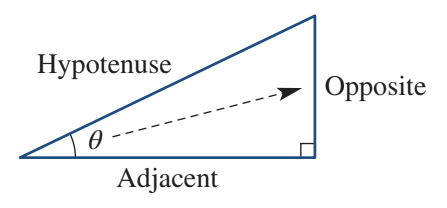
- Hypotenuse: The longest side of the triangle, which is always opposite the right angle
- Opposite side: The side that is opposite to the angle we're working with (usually called )
- Adjacent side: The shorter side that is next to the angle (but not the hypotenuse)
These definitions are essential because trigonometric ratios are based on the relationships between these sides.
Note
Correctly identifying which side is which is the first and most important step in any trigonometry problem. Take your time to label the sides relative to the angle you're working with.
Trigonometric ratios
We can create three important ratios by comparing different sides of a right-angled triangle. These ratios are called sine, cosine, and tangent.
Sine (sin) compares the opposite side to the hypotenuse:
Cosine (cos) compares the adjacent side to the hypotenuse:
Tangent (tan) compares the opposite side to the adjacent side:
The SOH CAH TOA mnemonic
To remember which ratio uses which sides, we use the mnemonic SOH CAH TOA (pronounced as a single word). This memory aid breaks down as follows:
Note
SOH CAH TOA breakdown:
- SOH: Sine - Opposite - Hypotenuse
- CAH: Cosine - Adjacent - Hypotenuse
- TOA: Tangent - Opposite - Adjacent
The order of the letters matches the order of the ratio. This mnemonic is extremely useful for quickly recalling which trigonometric function to use in different situations.
Measuring angles
In trigonometry, we can express angles in two different formats:
Degrees, minutes, and seconds (DMS format): This traditional system divides each degree into 60 minutes, and each minute into 60 seconds. For example: means 31 degrees, 5 minutes, and 51 seconds.
The conversions are:
- (one degree equals 60 minutes)
- (one minute equals 60 seconds)
Decimal degrees: This modern format expresses angles as decimal numbers. For example, is the decimal equivalent of .
Calculator tips
When solving trigonometry problems, remember to:
Important
Calculator setup is critical:
- Make sure your calculator is set to degree mode (not radian mode)
- Use the or button to convert between decimal degrees and degrees/minutes/seconds format
- For finding angles, use the inverse functions: , , or (often accessed by pressing SHIFT then the trig function button)
Using the wrong mode is one of the most common mistakes in trigonometry problems!
Worked example 1: Finding an unknown side
Example
Worked Example: Finding an Unknown Side Using Tangent
Problem: Find the length of the unknown side in the triangle shown. Give your answer correct to three decimal places.
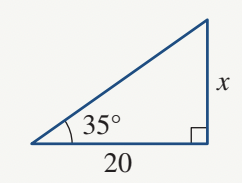
Solution:
First, we need to work out which sides of the triangle we're dealing with:
- The opposite side is the unknown
- The adjacent side is
Next, we select the trigonometric ratio that involves these two sides. Since we have opposite and adjacent, we use TOA:
Now we substitute the values we know:
To get by itself, we multiply both sides by :
Using a calculator:
Rounding to three decimal places:
Worked example 2: Finding an unknown angle
Example
Worked Example: Finding an Unknown Angle Using Inverse Sine
Problem: Find the angle in the triangle shown. Give your answer correct to the nearest minute.
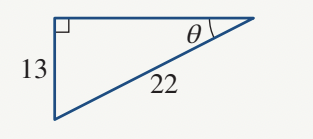
The triangle has an opposite side of and a hypotenuse of .
Solution:
First, we identify which sides we have:
- Opposite
- Hypotenuse
Since we have opposite and hypotenuse, we use SOH:
Substituting the known values:
To find the angle , we need to use the inverse sine function:
Using a calculator (press SHIFT then button):
Now we need to convert this decimal degree answer to degrees and minutes. Using the or button on the calculator:
Therefore, the angle is 36°13' (correct to the nearest minute).
Worked example 3: Real-world application
Example
Worked Example: Tent Pole Problem - Real-World Application
Problem: A vertical tent pole is supported by a rope tied to the top of the pole and to a peg on level ground. The peg is from the base of the pole and the rope makes an angle of to the horizontal. What is the length of the rope between the peg and the top of the tent pole? Give your answer correct to two decimal places.
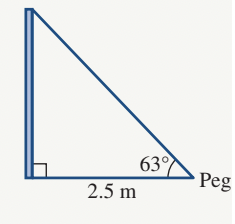
Solution:
First, we identify the unknown side and label it . Looking at our triangle:
- Adjacent side (the distance along the ground)
- Hypotenuse (the rope length we need to find)
- Angle
Since we have adjacent and hypotenuse, we use CAH:
Substituting the known values:
To get by itself, we first multiply both sides by :
Then divide both sides by :
Using a calculator:
Rounding to two decimal places:
Therefore, the length of the rope is 5.51 metres.
Remember!
Summary
Key Points to Remember:
- The three sides of a right-angled triangle are: hypotenuse (longest side), opposite (across from the angle), and adjacent (next to the angle)
- Use SOH CAH TOA to remember: sin uses opposite/hypotenuse, cos uses adjacent/hypotenuse, and tan uses opposite/adjacent
- When finding an unknown side, use the standard trig ratios (, , )
- When finding an unknown angle, use the inverse functions (, , )
- Always check your calculator is in degree mode, and remember that and