The Cosine Rule (HSC SSCE Mathematics Standard): Revision Notes
📚Revision Notes
The Cosine Rule
What is the cosine rule?
The cosine rule is a mathematical relationship that connects the sides and angles of any triangle, not just right-angled triangles. This makes it extremely useful for solving problems involving non-right-angled triangles.
Note
The cosine rule is particularly powerful because it extends trigonometry beyond right-angled triangles, allowing us to solve a much wider range of geometric problems.
You should use the cosine rule when you have:
- Two sides and the included angle (the angle between those two sides), and you need to find the third side, OR
- Three sides, and you need to find one of the angles
Understanding the derivation
The cosine rule can be derived using Pythagoras' theorem. Let's see how this works by constructing a perpendicular line from one vertex to the opposite side.
Consider triangle . We draw a perpendicular line of height from vertex down to point on side . This creates two right-angled triangles within the original triangle. Let the distance from to be , which means the distance from to is .
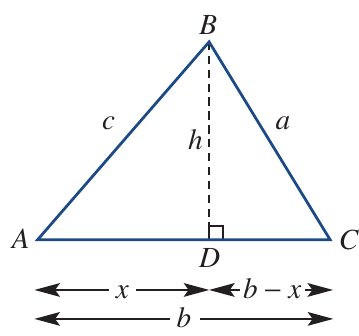
Using Pythagoras' theorem in triangle :
This means:
Also in triangle , we can write:
Therefore: ... ②
Now using Pythagoras' theorem in triangle :
Expanding the right side:
Rearranging:
Substituting from ①:
Finally, substituting from ②:
By constructing perpendiculars from the other vertices, we can derive similar formulas for the other sides. This gives us the complete set of cosine rule formulas.
The cosine rule formulas
Finding an unknown side
When you know two sides and the included angle, use these formulas to find the third side:
Important
Notice the pattern - the side you're finding is opposite the angle you know. The other two sides are adjacent to that angle. This pattern recognition will help you choose the correct formula quickly!
Note
Pattern Recognition Tip:
The cosine rule looks similar to Pythagoras' theorem () but includes a correction term (). Think of it as Pythagoras' theorem "adjusted" for non-right-angled triangles!
Finding an unknown angle
When you know all three sides, rearrange the formulas above to find an angle:
Important
The angle you're finding is opposite the side that appears alone (with a minus sign) in the numerator. The sides adjacent to the angle appear in the denominator.
Worked examples
Example
Worked Example: Finding an Unknown Side
Let's find the value of , correct to two decimal places, in a triangle where two sides measure and , with an included angle of .
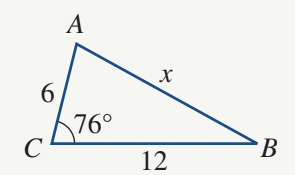
Step 1: Write the cosine formula to find a side.
Step 2: Substitute the values (, , ).
Step 3: Calculate the value of .
Step 4: Take the square root of both sides.
Exam tip: Always check your calculator is in degree mode when working with angles in degrees!
Example
Worked Example: Finding an Unknown Angle
Find the value of angle in a triangle with sides , , and , where is opposite the side of length . Answer in degrees, correct to one decimal place.
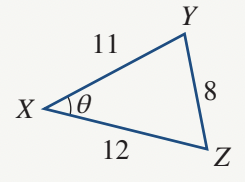
Step 1: Write the cosine formula to find an angle.
Step 2: Substitute the values (, , , ).
Step 3: Calculate the value of .
Step 4: Use your calculator to find .
Step 5: Write the answer correct to one decimal place.
Exam tip: Remember to use the inverse cosine function ( or arccos) on your calculator to find the angle from the cosine value.
Example
Worked Example: Real-World Application
Samuel is playing football and wants to shoot for goal. He is positioned m from one goalpost and m from the other goalpost. The goal is m wide. What is the size of angle that Samuel has to aim through to score? Answer correct to the nearest minute.

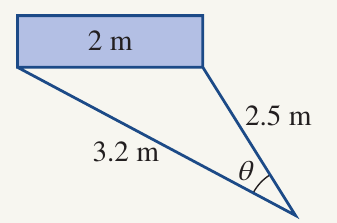
Step 1: Write the cosine formula to find an angle.
Step 2: Substitute the values (, , , ).
Step 3: Calculate the value of .
Step 4: Use your calculator to find .
Step 5: Convert decimal degrees to degrees and minutes.
(The decimal part minutes minutes)
Step 6: Write the answer in words.
The size of the angle for Samuel to score a goal is .
Exam tip: To convert decimal degrees to minutes, multiply the decimal part by 60. For example, minutes.
Summary
Key Points to Remember:
- The cosine rule works for any triangle, not just right-angled triangles.
- Use the cosine rule when you have two sides and the included angle (to find the third side) or three sides (to find an angle).
- The pattern is important: the side you're finding or the angle you're finding is always opposite the relevant angle or side in the formula.
- When finding a side, the formula resembles Pythagoras' theorem with an extra correction term: .
- Always check your calculator is in the correct mode (degrees or radians) before calculating!
- Memory aid: Think "SAS" (Side-Angle-Side) → use cosine rule to find the third side, or "SSS" (Side-Side-Side) → use cosine rule to find angles.