The Sine Rule (HSC SSCE Mathematics Standard): Revision Notes
📚Revision Notes
The Sine Rule
Introduction to non-right-angled triangles
The sine rule is a powerful tool that allows us to work with triangles that don't contain a right angle. When we have a non-right-angled triangle, we can still find unknown sides and angles using this special relationship.
Naming sides and angles in a triangle
In any triangle, we follow a standard naming convention. Each side is named with a lowercase letter that corresponds to the angle opposite to it.
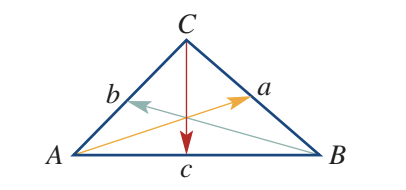
Note
Triangle Naming Convention:
- Side is opposite angle
- Side is opposite angle
- Side is opposite angle
This naming system makes it easier to apply formulas and ensures we're working with the correct pairs of sides and angles.
What is the sine rule?
The sine rule describes a special relationship between the sides of a triangle and the sines of their opposite angles. We can express this relationship in words as: "Side divided by the sine of angle equals side divided by the sine of angle , which also equals side divided by the sine of angle ."
Deriving the sine rule
We can prove the sine rule by constructing a perpendicular line. Let's draw a vertical line of length from vertex down to point on the base of the triangle.
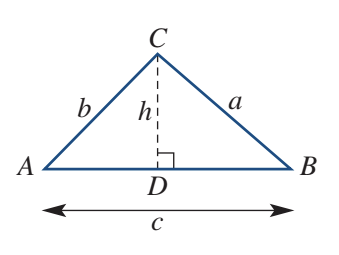
In the right-angled triangle , we can write:
Therefore:
Similarly, in the right-angled triangle :
Therefore:
Since both expressions equal , they must equal each other:
Dividing both sides by gives us:
By constructing a perpendicular line from a different vertex, we can show in the same way that:
Combining these results gives us the complete sine rule.
The sine rule formula
The sine rule can be written in two different forms, depending on whether you need to find a side or an angle.
Important
The Sine Rule
To find a side, use:
To find an angle, use:
When to use the sine rule
You can use the sine rule in a non-right-angled triangle when you know:
- Two sides and an angle opposite one of those sides, or
- Two angles and one side
Important
Before applying the sine rule, always check that the sides and angles you're opposite each other in the triangle.
Finding an unknown side
Let's look at an example where we need to find an unknown side.
Example
Worked Example: Finding an Unknown Side
Find the value of , correct to one decimal place, in a triangle where one angle is , another angle is , the side opposite the angle is units, and is opposite the angle.
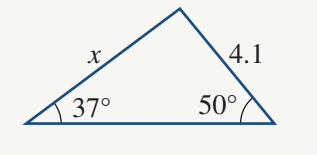
Solution:
Step 1: Check that the sides and angles are opposite each other.
We have: opposite , and opposite .
Step 2: Write the sine rule for finding a side.
Step 3: Substitute the known values where , , , and .
Step 4: Multiply both sides by .
Step 5: Evaluate using a calculator.
Step 6: Round to one decimal place.
Finding an unknown angle
Now let's see how to find an unknown angle using the sine rule.
Example
Worked Example: Finding an Unknown Angle
Hannah is standing m from the base of a m sloping wall. The angle of elevation to the top of the wall is . Find the angle at the top of the wall, to the nearest minute.
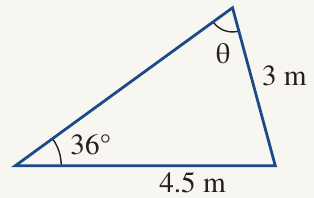
Solution:
Step 1: Check that the sides and angles are opposite each other.
We have: m opposite , and m opposite .
Step 2: Write the sine rule for finding an angle.
Step 3: Substitute the known values where , , , and .
Step 4: Multiply both sides by .
Step 5: Evaluate using a calculator.
Step 6: Find the angle using inverse sine and convert to degrees and minutes.
Step 7: State the answer clearly.
The angle at the top of the wall is 61°51'.
Exam tips
Note
Tips for Success:
- Always start by checking which sides and angles are opposite each other
- Remember which form of the sine rule to use: fractions for finding sides, reciprocals for finding angles
- Make sure your calculator is in degree mode
- When finding an angle, don't forget to take the inverse sine of your answer
- Show all working clearly, including substitution steps
Remember!
Summary
Key Points to Remember:
- The sine rule works for any triangle, not just right-angled ones
- Each side is named after the angle opposite to it
- Use when finding sides
- Use when finding angles
- The sine rule can be used when you know two sides and an angle opposite one of them, or two angles and one side