Rates and Concentrations (HSC SSCE Mathematics Standard): Revision Notes
📚Revision Notes
Rates and Concentrations
What are rates?
A rate compares two quantities that have different units of measurement. When we express a rate, we're showing the relationship between two different types of measurements. For example, when you measure how fast a car travels, you're comparing the distance covered to the time it takes. Unlike ratios, which compare quantities with the same units, rates always involve different units that must be clearly specified.
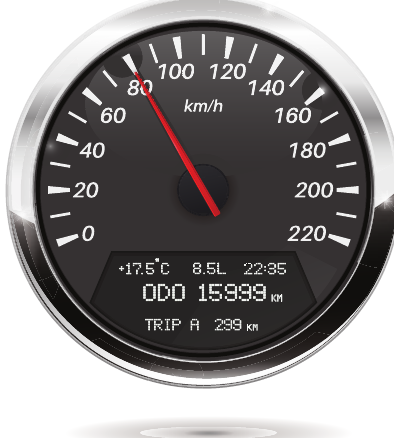
The sequence in which you write a rate matters significantly. A rate is always expressed as the first quantity per one unit of the second quantity. For instance, $2.99/kg means $2.99 for every one kilogram, and 80 km/h represents 80 kilometres for every one hour.
We encounter rates constantly in everyday life as we measure how things change over time. Understanding rates helps us make comparisons and informed decisions.
Note
Common Rate Examples in Daily Life:
Rates appear everywhere around us, helping us quantify and compare different aspects of our world:
- Growth rate: Tracks how quickly a child grows from birth to 15 years of age
- Running rate: Measures your running pace in metres per second
- Typing rate: Shows your typing speed in words per minute
- Wage rate: Indicates the amount of money you earn per hour worked
Each of these rates gives us valuable information by comparing one quantity to another. The key is to always state both units clearly so others understand exactly what you're measuring.
Converting rates
Sometimes you need to express a rate using different units to make it more useful or easier to understand. Converting rates involves changing both the numerator and denominator to new units while maintaining the same relationship between the quantities.
Procedure for converting a rate:
1. Write the rate as a fraction, with the first quantity as the numerator and 1 as the denominator
2. Convert the numerator to the required unit
3. Convert the denominator to the required unit
4. Simplify the fraction to get your final answer
Example
Worked Example: Converting Rates Between Units
Let's convert two different rates to demonstrate this process.
Part a: Convert 55200 m/h to m/min
Write the rate as a fraction:
The numerator is already in metres, so no conversion needed.
Convert the denominator from hours to minutes:
Simplify by dividing:
Part b: Convert $6.50/kg to c/g
Write the rate as a fraction:
Convert dollars to cents by multiplying by 100:
Convert kilograms to grams by multiplying by 1000:
Simplify:
Important
Remember: When converting rates, you must change both units in the correct direction. If you're converting to a smaller unit (like hours to minutes), you multiply. If converting to a larger unit, you divide. Always keep track of which conversions you've made to avoid errors.
The unitary method
The unitary method is a powerful problem-solving technique that simplifies rate calculations. This method works by first calculating the value for a single unit, then multiplying to find any other quantity you need. It's particularly useful when you know the total for multiple units and need to find the value for a different number of units.
Steps for using the unitary method:
1. Find one unit of a quantity by dividing by the total amount
2. Multiply the result from step 1 by the number of units you need
This approach breaks complex problems into two simple steps, making calculations more straightforward and less prone to errors.
Example
Worked Example: Calculating Distance from Petrol Consumption
A car travels 360 km on 30 L of petrol. How far does it travel on 7 L?
Start with the given information:
Find the distance for 1 litre by dividing both sides by 30:
Multiply both sides by 7 to find the distance for 7 litres:
Therefore, the car travels 84 km on 7 litres of petrol.
Example
Worked Example: Typing Speed and Comparing Prices
Part a: Bella can touch type at 70 words per minute. How many words can she type in 20 minutes?
Bella's typing rate is 70 words in one minute.
To find the number of words in 20 minutes, multiply:
Number of words
Bella types 1400 words in 20 minutes.
Part b: A supermarket sells 400 mL soft drink cans singly for $2.40, in a six-pack for $11.95, or in a carton of 24 for $39.95. Compare the cost of one can in each option.
Single can price: $2.40
Six-pack: Find the cost per can by dividing:
Carton: Find the cost per can by dividing:
Buying a single can costs $2.40, in a six-pack costs $1.99 per can, and in a carton costs $1.66 per can. The carton offers the best value.
Speed
Speed is a special type of rate that compares the distance travelled to the time taken. In Australia, we typically measure car speed in kilometres per hour (km/h). Understanding speed is essential for everyday activities like driving, planning journeys, and estimating travel times.
Note
How We Measure Speed:
The speedometer in a car displays your instantaneous speed at any given moment. While speedometers are generally reliable, they have a tolerance of about 5%, meaning they might not be perfectly accurate.
Modern GPS devices can also show speed by calculating the distance travelled over time intervals. Additionally, cars have odometers that track the total distance travelled by the vehicle.
Speed formulas
There are three related formulas for calculating speed, distance, and time. A helpful memory aid is the triangle diagram, which shows how these three quantities relate to each other.

Important
The Three Speed Formulas:
(Speed equals distance divided by time)
(Time equals distance divided by speed)
(Distance equals speed multiplied by time)
Where:
- = Distance
- = Speed
- = Time
Using the Triangle Diagram: Cover the quantity you want to find. The remaining two variables show you how to calculate it. For example, if you cover (speed), you see over , which gives you .
Example
Worked Example: Speed Calculations
Part a: Find the average speed of a car that travels 341 km in 5 hours.
Use the speed formula:
Substitute the known values ( km and hours):
Calculate:
The average speed is 68.2 km/h.
Part b: How long will it take a vehicle to travel 294 km at a speed of 56 km/h?
Use the time formula:
Substitute the known values ( km and km/h):
Calculate:
This can also be expressed as 5 hours and 15 minutes.
To convert the decimal 0.25 hours to minutes, multiply by 60:
Therefore, it will take approximately 5 hours and 15 minutes to travel 294 km at 56 km/h.
Summary
Key Points to Remember:
-
A rate compares two quantities with different units - always specify both units clearly (e.g., km/h, $/kg)
-
Order matters in rates - the first quantity is per one unit of the second quantity
-
The unitary method simplifies calculations - find the value for one unit first, then multiply to solve the problem
-
Use the triangle diagram for speed problems - cover what you're finding to reveal the formula: , , or
-
Converting rates requires changing both parts - convert the numerator and denominator to new units, then simplify the fraction