Real-World Examples (HSC SSCE Mathematics Standard): Revision Notes
📚Revision Notes
Real-World Examples
Heart rate
Heart rate tells us how fast your heart is beating. It is measured in beats per minute, abbreviated as bpm. You can find your pulse by pressing gently on your wrist or neck with two fingers. This pulse shows each time your heart beats.
Note
There are different ways to measure heart rate. During exercise, people often use a heart rate monitor with a chest strap that sends information to a watch. For medical purposes, doctors use an electrocardiograph to get precise measurements.
Your resting heart rate is measured when you are awake but relaxed. For most people, this is between and bpm.
Maximum heart rate
Your maximum heart rate (MHR) is the highest number of beats per minute your heart can safely reach during intense exercise.
Important
MHR Formula
A simple formula estimates your maximum heart rate based on your age:
This formula is widely used because it provides a quick and reasonable estimate.
For example, an -year-old would have an estimated MHR of bpm.
Target heart rate
When exercising, there is an ideal heart rate range that provides the best cardiovascular benefits. This is called the target heart rate (THR). The THR depends on several factors including your age, fitness level, gender, and training history.
Important
Calculating Your Target Heart Rate Zone
To find your THR, calculate between 65% and 85% of your MHR:
- Lower limit:
- Upper limit:
For instance, if an -year-old has an MHR of bpm, their THR would be:
- Lower: bpm
- Upper: bpm
So the target range is approximately to bpm.
Example
Worked Example: Estimating Maximum Heart Rate
Question: Estimate the maximum heart rate for an -year-old.
Solution:
Write the formula:
Substitute for age:
Evaluate:
Answer: The maximum heart rate for an -year-old is estimated to be 202 bpm.
Interpreting heart rate data
Health professionals use tables to assess fitness levels based on resting heart rate. These tables compare your heart rate against standard ranges for different age groups.
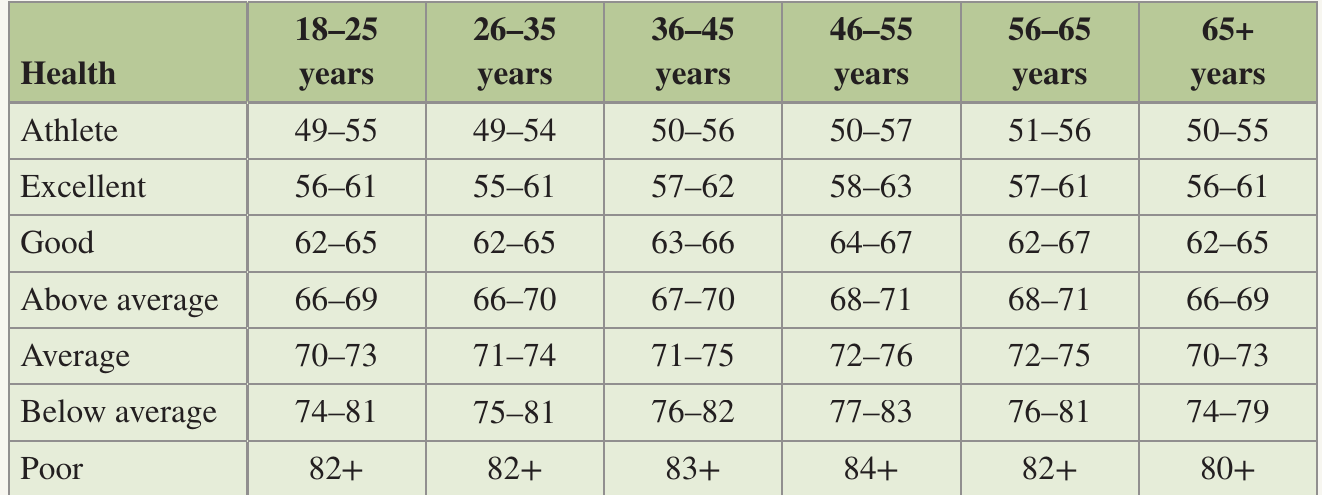
Example
Worked Example: Reading Heart Rate Tables
Question: Using the table above, answer these questions about men's resting heart rates:
a) What is the average resting heart rate for a man aged years in good health?
b) What is the average resting heart rate for a man aged years in below-average health?
c) What is the health status of a man aged years with a resting heart rate of bpm?
d) What is the health status of a man aged years with a resting heart rate of bpm?
Solution:
Part a:
Find age in the age ranges. It falls in the - years column.
Read the resting heart rate for good health in that column.
Answer: The average resting heart rate is 64-67 bpm.
Part b:
Find age in the age ranges. It falls in the - years column.
Read the resting heart rate for below average health in that column.
Answer: The average resting heart rate is 74-81 bpm.
Part c:
Find age in the age ranges. It falls in the - years column.
Look for where bpm appears in that column: - bpm.
Read the health category for that row.
Answer: The health status is excellent.
Part d:
Find age in the age ranges. It falls in the - years column.
Look for where bpm appears in that column: + bpm.
Read the health category for that row.
Answer: The health status is poor.
Energy rate
Understanding energy consumption helps us make informed decisions about electricity use and costs.
Energy basics
Energy is the capacity to do work. It exists in many forms, including heat, light, and electricity. In physics, energy is measured in joules (J). For larger amounts, we use megajoules (MJ), which equals one million joules.
Power describes how quickly energy is used or produced. The watt (W) is the standard unit of power, and it equals one joule per second.
Note
Common power prefixes include:
- Milliwatt (mW): one thousandth of a watt
- Kilowatt (kW): one thousand watts
- Megawatt (MW): one million watts
Electrical energy
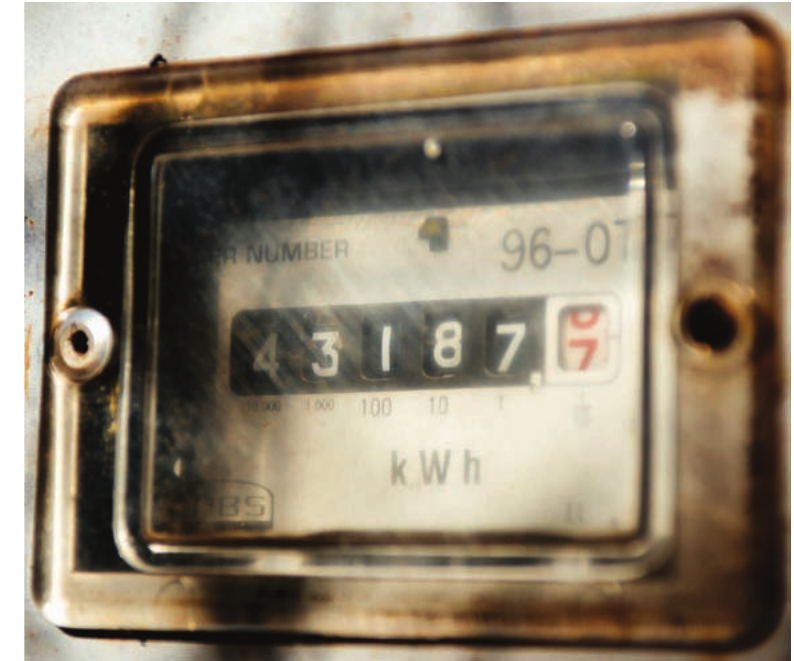
For electricity bills, the joule is impractical. Instead, we measure electrical energy using kilowatt-hours (kWh). This unit combines power and time.
A kilowatt-hour represents the energy used when a W device runs for one hour. To find energy consumption, multiply the power (in kilowatts) by the time (in hours).
Note
For example:
- A W device running for one hour uses watt-hours or kWh
- A W device running for two hours also uses watt-hours or kWh
Important
Key Conversion
The average Australian household uses about megawatt-hours per year, which equals approximately kWh annually. This consumption produces around eight tonnes of emissions.
Energy rating labels
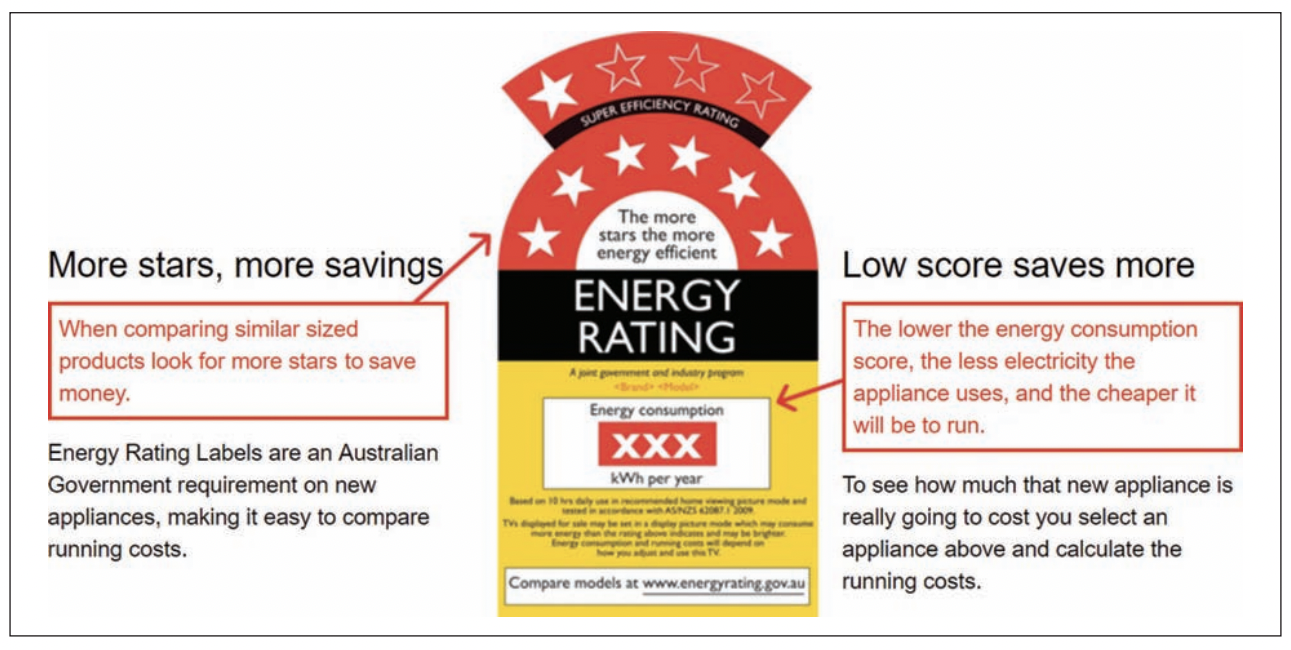
Australian law requires energy rating labels on many household appliances including refrigerators, televisions, washing machines, dryers, and air conditioners. These labels help consumers compare energy efficiency.
Note
Understanding Energy Rating Labels
The label contains two key pieces of information:
-
Star rating: More stars mean better energy efficiency. When comparing similar products, choose the one with more stars to save money.
-
Energy consumption figure: This number (shown in the red box on the label) tells you how many kilowatt-hours the appliance typically uses per year. A lower number means lower running costs.
To calculate running costs, multiply the energy consumption figure by your electricity price (usually given per kWh).
Example
Worked Example: Calculating Appliance Running Costs
Question: Find the cost of running these appliances if electricity costs $0.21 per kWh:
a) A kW air conditioner for eight hours
b) A W television for hours
Solution:
Part a:
Calculate the energy used by multiplying power (in kW) by time (in hours):
Calculate the cost by multiplying energy by the price per kWh:
Answer: Running the air conditioner costs $5.88.
Part b:
First convert watts to kilowatts:
Calculate the energy used:
Calculate the cost:
Answer: Running the television costs $0.84.
Energy-efficient housing
BASIX (Building Sustainability Index) is a scheme that regulates energy efficiency in residential buildings. This online tool assesses house designs against energy and water targets.
The system considers factors such as:
- Location and house size
- Building materials
- Water usage
- Thermal comfort
- Energy consumption
Sustainable houses often include rainwater tanks, efficient showerheads, solar hot water systems, high-performance windows, and energy-efficient lighting.

Example
Worked Example: Solar PV System Savings
Question: Christian is installing a solar photovoltaic (PV) system. His average daily consumption is kWh. The solar system will meet this need and export an extra kWh daily to the electricity grid. His energy retailer charges $0.2167 per kWh and pays $0.08 per kWh for exported energy. What is the expected daily saving?
Solution:
Calculate the cost of daily consumption without solar:
(rounded to two decimal places)
Calculate the payment for exported energy:
Add both amounts to find the total daily saving:
Answer: The expected daily saving is $5.16.
Important
Key Formulas for Energy Costs
- Energy (kWh) = Power (kW) Time (hours)
- Cost ($) = Energy (kWh) Electricity rate ($/kWh)
Fuel consumption rate
Fuel consumption measures how efficiently a vehicle uses petrol or diesel. In Australia, fuel consumption is expressed as litres per 100 kilometres.
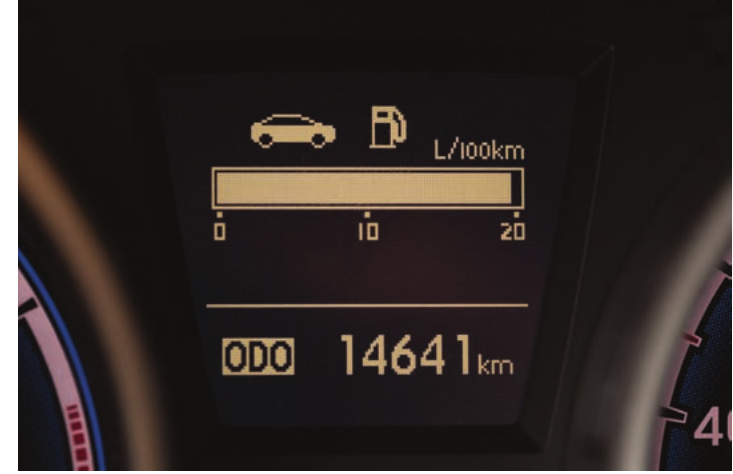
Measuring fuel consumption
Note
The Measurement Process
To calculate fuel consumption:
- Fill the vehicle's fuel tank completely
- Record the odometer reading (shown as "ODO" on the dashboard)
- Drive the vehicle
- Fill the tank again and record the litres needed
- Record the new odometer reading
- Calculate the distance travelled (new reading minus old reading)
Fuel consumption formula
Important
Standard Fuel Consumption Formula
The formula multiplies fuel used by to express the result as litres per km, which is the standard Australian format.
Example
Worked Example: Calculating Fuel Consumption
Question: A medium-sized car travelled km using L of petrol. What was the fuel consumption?
Solution:
Write the fuel consumption formula:
Substitute the values:
Calculate:
Answer: The fuel consumption is 9.2 litres per 100 kilometres.
Remember!
Summary
Key Points to Remember:
-
Maximum heart rate is estimated using the formula: MHR Age. Target heart rate for exercise is to of your MHR.
-
Energy consumption is calculated by multiplying power (in kW) by time (in hours). The result is measured in kilowatt-hours (kWh). Remember: kWh MJ.
-
Energy rating labels help compare appliance efficiency. More stars mean more savings, and lower energy consumption figures mean cheaper running costs.
-
Solar PV systems can reduce electricity bills in two ways: by meeting your energy needs directly and by exporting excess energy to the grid for payment.
-
Fuel consumption is measured as litres per km. Use the formula: (Litres used ) Distance travelled (km).