Simultaneous Equations (HSC SSCE Mathematics Standard): Revision Notes
📚Revision Notes
Simultaneous Equations
What are simultaneous equations?
Simultaneous equations are pairs of linear equations that we solve together to find a common solution. When we have two straight-line equations, they will intersect at exactly one point unless they are parallel. This point of intersection gives us the simultaneous solution - the values of and that satisfy both equations at the same time.
A single linear equation like has infinitely many solutions. For example, when , , or when , . However, when we have two linear equations together, there is typically only one pair of values that works for both equations. Finding this pair of values is called solving the equations simultaneously.
Note
The key insight is that while a single equation has infinite solutions, two equations together typically have just one solution that satisfies both conditions. This makes simultaneous equations incredibly useful for solving real-world problems where multiple constraints must be met at once.
Solving simultaneous equations graphically
The graphical method involves drawing both lines on the same coordinate plane and identifying where they cross. This intersection point represents the solution to both equations.
Steps for the graphical method
To solve simultaneous equations graphically, you need to draw a coordinate plane with clearly labelled axes, then sketch both linear equations on the same axes. The point where the lines intersect gives you the simultaneous solution. This visual approach helps you understand what's happening geometrically when two equations are solved together.
Using the gradient-intercept form
When equations are in the form , we can easily identify the gradient (steepness of the line) from the coefficient of , and the y-intercept (where the line crosses the y-axis) from the constant term. This makes sketching the lines straightforward.
Example
Worked Example: Graphical solution
Question: Find the simultaneous solution of and .
Solution:
First, identify the key features of each line:
For :
- Gradient is
- y-intercept is
For :
- Gradient is
- y-intercept is
Now sketch both lines on the same coordinate plane. Start each line at its y-intercept, then use the gradient to plot additional points.
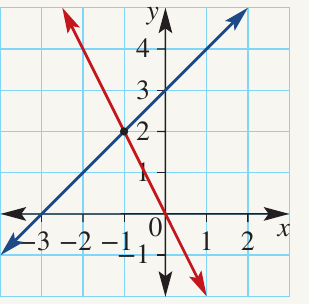
The lines intersect at the point .
Therefore, the simultaneous solution is and .
Alternative method: Tables of values
Instead of graphing, we can create tables of values for each equation. If the same and values appear in both tables, that's the point of intersection. This method is particularly useful when you want to verify your graphical solution or when graphing tools aren't available.
Create a table for using values of :
Create a table for using the same values:
Looking at both tables, we can see that when , both equations give . This confirms our graphical solution.
Solving simultaneous equations algebraically
While the graphical method is visual and intuitive, algebraic methods give us exact answers without needing to read values from a graph. There are two main algebraic approaches: substitution and elimination.
Important
Algebraic methods are essential when you need precise answers. Graphical methods can be affected by drawing accuracy and scale limitations, but algebraic solutions are mathematically exact.
Method 1: Substitution
The substitution method works by expressing one variable in terms of the other, then replacing it in the second equation. This is particularly useful when one of the equations already has or as the subject.
To solve using substitution, choose one equation and ensure one variable is the subject (usually ). Take the expression for this variable and substitute it into the other equation. Solve the resulting equation to find one variable, then substitute this value back into either original equation to find the other variable. Finally, check your solution by substituting both values into the other equation.
Example
Worked Example: Substitution method
Question: Solve and using substitution.
Solution:
Label the equations:
... (1)
... (2)
Since both equations already have as the subject, substitute the expression for from equation (2) into equation (1):
Now solve for by collecting like terms:
To find , substitute into equation (2):
Check: Substitute both values into equation (1):
The solution is and , or the point .
Method 2: Elimination
The elimination method involves adding or subtracting the two equations to eliminate one variable. This works when the coefficients of one variable are the same (or opposites).
To use elimination, arrange both equations so like terms are aligned. If necessary, multiply one or both equations so that the coefficient of one variable matches (or is opposite). Then add or subtract the equations to eliminate one variable, solve for the remaining variable, and substitute this value into either original equation to find the other variable. Always check your solution by substituting both values back into the original equations.
Example
Worked Example: Elimination method
Question: Solve and using elimination.
Solution:
Label the equations:
... (1)
... (2)
Both equations have the same coefficient for (which is ), so we can subtract equation (2) from equation (1):
Simplify the left side (since ) and the right side:
Solve for :
Substitute into equation (2):
Check: Verify in equation (1):
The solution is and , or the point .
Note
Both the substitution and elimination methods give the same answer. When equations have or already as the subject, substitution is often quicker. When equations need rearranging, elimination can be more efficient. Choose the method that seems most straightforward for the particular problem you're solving.
Real-world applications
Simultaneous equations are powerful tools for solving practical problems. When two situations can be described using linear equations, the point of intersection often has important meaning in the real-world context. This could represent anything from break-even points in business to optimal solutions in planning problems.
Business applications: Break-even analysis
In business, we often want to know when income equals costs - this is called the break-even point. By graphing income and costs as linear equations, the intersection shows exactly when a business moves from making a loss to making a profit. Understanding this point is crucial for business planning and decision-making.
Example
Worked Example: Income and costs
Question: Zaina buys and sells books. Income from selling books is calculated using where is income in dollars and is the number of books. Costs are calculated using .
a) What is the income when 6 books are sold?
b) What are the costs when 6 books are sold?
c) Graph both equations on the same axes.
d) How many books must be sold for costs to equal income?
Solution:
a) Substitute into the income formula:
Income for 6 books is $96.
b) Substitute into the cost formula:
Costs for 6 books is $72.
c) For the income line :
- Gradient is 16 (steep upward slope)
- Vertical intercept is 0 (passes through origin)
For the cost line :
- Gradient is 8 (less steep upward slope)
- Vertical intercept is 24 (starts at $24)
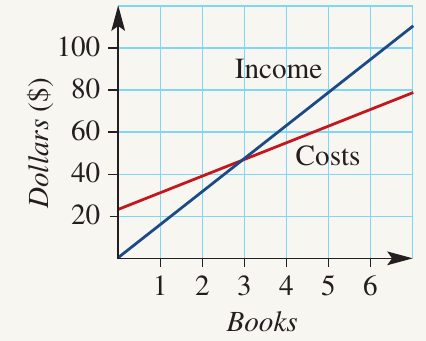
d) The lines intersect at the point .
This means when , both income and costs equal $48.
Therefore, 3 books must be sold for income to equal costs (the break-even point).
Note
Notice in this example that at 6 books, Zaina makes a profit ($96 income minus $72 costs = $24 profit). However, if she sold only 2 books, she would make a loss because her costs would be higher than her income. The break-even point at 3 books is the critical threshold.
Example
Worked Example: Word problem with test marks
Question: Isabella's Mathematics mark exceeded her English mark by 15. She scored a total of 145 for both tests. Find Isabella's marks in each subject by plotting intersecting graphs.
Solution:
First, translate the word problem into two equations.
Let = Mathematics mark and = English mark.
"Mathematics mark exceeded English mark by 15":
"Total of 145 for both tests":
Rearrange equation (2) to make the subject:
Now identify the key features for graphing:
For equation (1):
- Gradient is 1
- Vertical intercept is 15
For equation (2):
- Gradient is
- Vertical intercept is 145
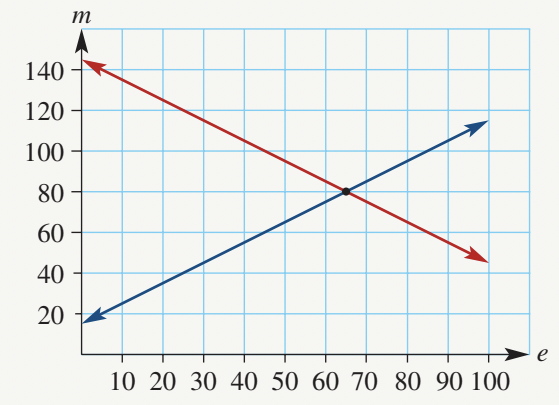
The lines intersect at .
This means and .
Answer: Isabella scored 65 in English and 80 in Mathematics.
Check: Does her Maths mark exceed her English mark by 15? ✓
Do both marks total 145? ✓
Important
When solving word problems, always define your variables clearly at the start. Take time to carefully translate the words into mathematical equations - this is often the hardest part. Once you have the correct equations, the rest of the solution follows the same methods you've already learned.
Exam tips
When solving graphically, draw your axes clearly and use a ruler for straight lines. Always label your axes and mark the point of intersection clearly. For algebraic methods, show all your working step by step - this helps you avoid errors and ensures you receive partial credit even if your final answer is incorrect.
Check your solution by substituting back into both original equations. In word problems, define your variables clearly at the start and write your final answer in words, referring back to the context of the question.
Note
The substitution method is often easiest when or is already the subject. Use elimination when coefficients can be easily matched. With practice, you'll develop an intuition for which method is quickest for each problem.
Summary
Key Points to Remember:
- Two straight lines will intersect at exactly one point unless they are parallel
- The intersection point gives the simultaneous solution that satisfies both equations
- Three methods to solve: graphically (draw and read), substitution (replace one variable), or elimination (add/subtract equations)
- All three methods give the same answer when done correctly
- Real-world applications include break-even analysis in business and solving word problems
- Always check your solution by substituting values back into both original equations
- When choosing a method: use graphing for visual understanding, substitution when one variable is isolated, and elimination when coefficients align well