Applications of the Uniform Circular Motion Model (HSC SSCE Physics): Revision Notes
📚Revision Notes
Applications of the Uniform Circular Motion Model
Introduction
The uniform circular motion model is a powerful tool that helps us understand many real-world situations. This mathematical framework can be applied to:
- Planets, moons and satellites orbiting in space
- Electrons moving around atomic nuclei
- Charged particles travelling through magnetic fields
- Everyday situations like objects on strings and vehicles turning corners
In this note, we'll explore three common applications: an object whirling on a string (both horizontally and vertically), and cars navigating corners on flat and banked roads.
Motion in a horizontal circle
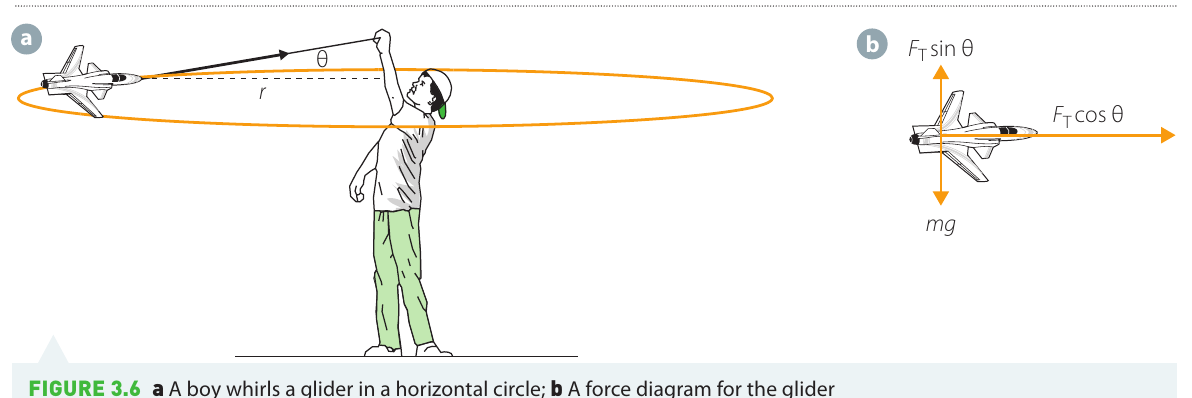
When you whirl an object in a horizontal circle (like swinging a toy on a string), two forces act on the object:
- Gravitational force () acting downwards
- Tension force () from the string
Understanding tension forces
Note
A string can only provide tension (a pulling force) along its length. Strings are "floppy" and cannot push or exert forces in any other direction. According to Newton's third law, the tension force exerted by the string is also experienced by the string itself - we call this "the tension in the string".
Breaking down the forces
When the string makes an angle with the horizontal, the tension force has two components:
- Horizontal component:
- Vertical component:
Important
Always start by drawing a force diagram! This helps you visualise all the forces acting on the object.
Vertical force balance
Since the object isn't moving up or down (zero vertical acceleration), the vertical component of tension must equal the gravitational force:
Therefore:
Horizontal force and centripetal motion
The horizontal component of tension is the only force acting horizontally:
This horizontal force provides the centripetal force needed for circular motion:
The tension maintains constant magnitude but continuously changes direction to point towards the centre of the circle.
Example
Worked Example: Horizontal Circular Motion
Problem: A 250 g glider on a string is swung in a horizontal circle with radius 1.2 m. The glider completes one revolution every 2.0 s.
Part a: What is the speed of the glider?
Given:
- s
- m
- kg
The speed relates to angular velocity:
Angular velocity connects to period:
Substituting:
Part b: What is the horizontal component of the tension?
Using the centripetal force equation:
Exam tip: Always convert units to SI before calculating, and round your final answer to appropriate significant figures.
Motion in a vertical circle
When whirling an object in a vertical circle, both the gravitational force () and the tension contribute to the net centripetal force.
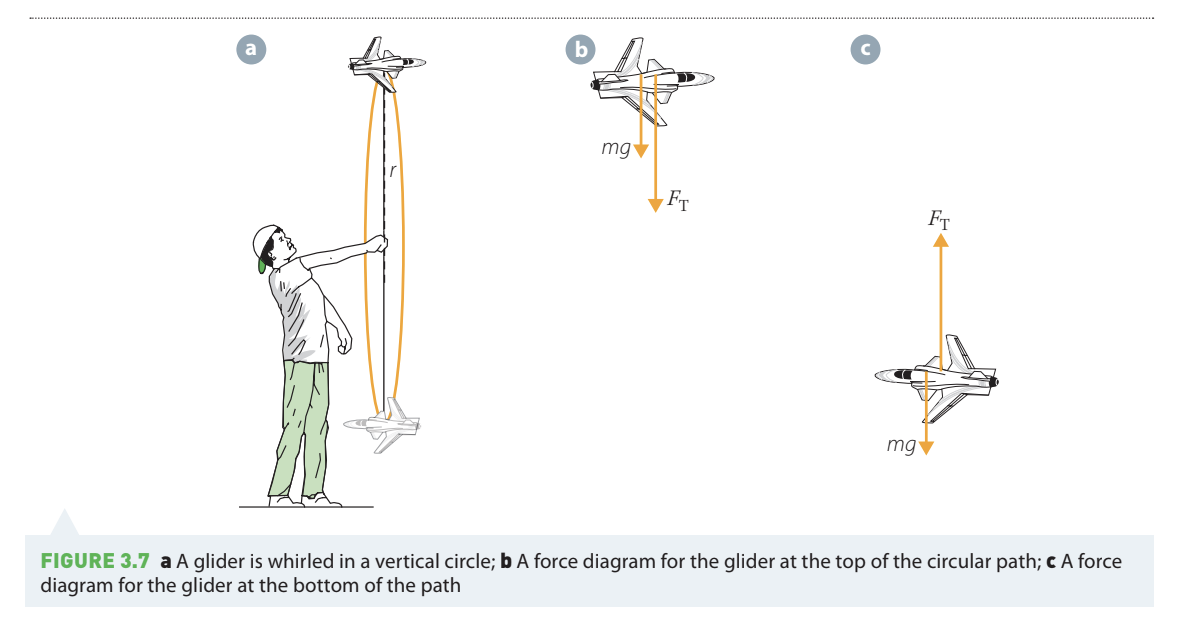
At any point on the circle:
Tension varies with position
At the bottom of the circle: The net force points upward, so tension must be greater than the gravitational force (they act in opposite directions).
At the top of the circle: Both and point toward the centre (same direction). The tension must be less than at the bottom and may even drop to zero.
Important
In vertical circular motion, tension varies in both direction and magnitude throughout the motion. This is fundamentally different from horizontal circular motion where tension maintains constant magnitude.
Example
Worked Example: Vertical Circular Motion
Problem: If the glider from the previous example is whirled vertically in the same radius at the same constant speed, what is the tension when the glider is at the bottom?
Given (from previous example):
- m
- kg
- m·s
At the bottom, the net force equation is:
Rearranging for tension:
Substituting values:
Notice the tension at the bottom (5.4 N) is greater than the horizontal tension (3.0 N) calculated earlier.
A car turning a horizontal corner
To navigate a curved path - whether running around a bend or driving around a corner - you must push outwards on the ground. The ground pushes back toward the centre of your circular path (Newton's third law).
The role of friction
Note
The contact force between tyres and road has two components:
- Friction component (parallel to surface)
- Normal component (perpendicular to surface)
When driving, it's the friction force on the tyres that makes the car move forwards. When cornering on a flat road, friction provides the centripetal force:
Speed and safety
A car's ability to negotiate a corner successfully depends on:
- Corner sharpness (radius )
- Vehicle speed ()
Important
The required frictional force increases with the square of velocity. This means doubling your speed requires four times the friction force!
There's a maximum friction force the road can provide. This maximum is significantly reduced by:
- Water, mud or oil on the road
- Worn tyres
- Smooth road surfaces
Note
Exam tip: This quadratic relationship between force and speed explains why slowing down for corners is so important for safety.
Cornering on a banked road
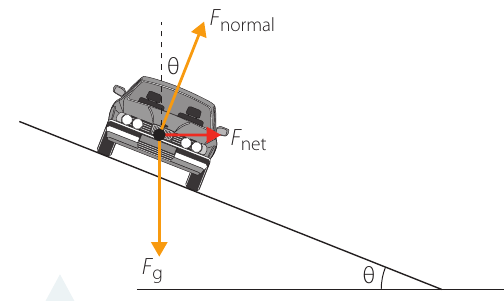
Some roads have banked corners where the outside edge is slightly higher than the inside edge. A banked corner is essentially an inclined plane angled across the road, creating a net force that helps accelerate the car around the corner.
Forces on a banked corner
At least two forces act on a car turning a banked corner:
- Gravitational force ()
- Contact force from the road (which has normal and friction components)
For simplicity, we'll first consider only gravitational and normal forces:
Vertical force balance
If the car maintains constant height (doesn't slide across the road), the vertical forces must balance:
Therefore:
Which gives:
Horizontal component provides centripetal force
The horizontal component of the normal force is:
Using our expression for :
Since this provides the centripetal force:
This equation helps us calculate the ideal banking angle for a given speed and corner radius.
The role of friction
Note
In reality, friction is never zero. The friction force may act:
- Up the slope when the car travels slowly (preventing it sliding down)
- Down the slope when the car travels fast (preventing it sliding up)
Example
Worked Example: Banking Angle Calculation
Problem: A 1500 kg car travels at 80 km·h around a bend banked at 10° to the horizontal.
Part a: What is the net force acting on the car?
Given:
- kg
- km·h m·s = 22.2 m·s
The net force is:
Part b: What radius must the road have so the car can turn with no friction force?
Using the centripetal force equation:
Rearranging:
Exam tip: Notice that mass cancels out when calculating banking angle. The ideal angle depends only on speed and radius, not the vehicle's mass!
Investigation: Designing a race track
This practical investigation combines physics concepts with spreadsheet skills to design a race track with appropriately banked corners.
Aim
To design a race track where each corner is banked at an appropriate angle, using spreadsheet software to calculate the angles.
Materials
- Computer with spreadsheet software
- Paper, pens, compass, ruler
Method
Note
Step 1: Sketch your race track carefully to scale. Use a compass for drawing corners and measure the radius of each curve. Mark the radius values on your drawing.
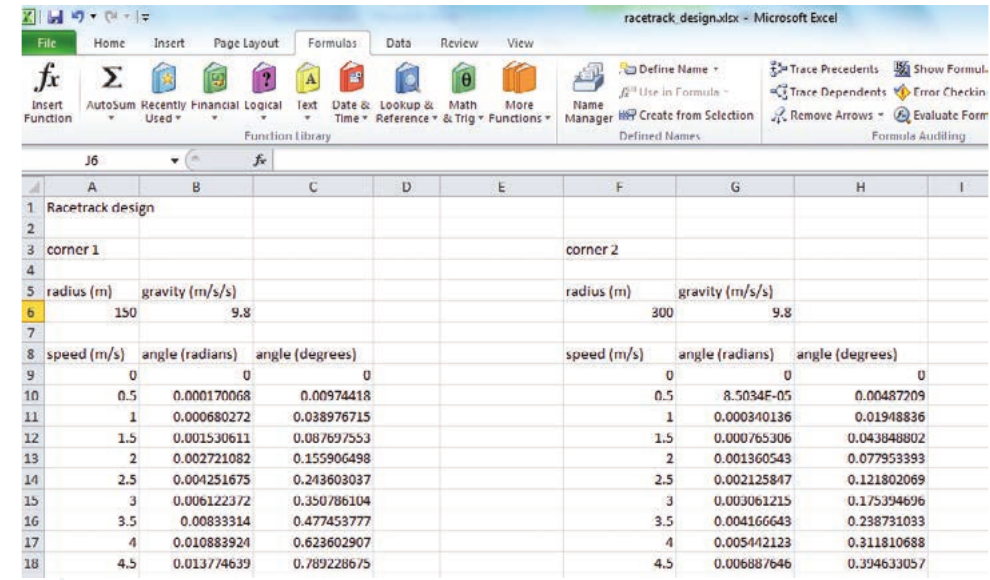
Step 2: Set up constant values in your spreadsheet:
- Corner radius ()
- Acceleration due to gravity ( m·s)
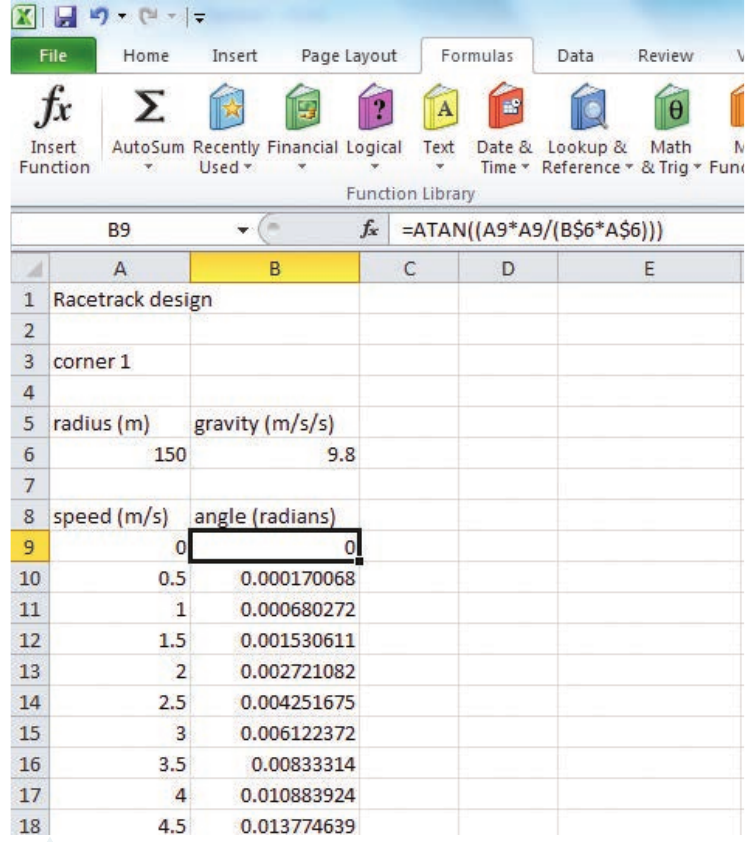
Step 3: Create columns for speed, banking angle (in radians), and banking angle (in degrees).
Step 4: Enter speeds starting from 0, incrementing by 0.5 m·s (or your chosen increment).
Step 5: Calculate the required banking angle. Rearrange the equation:
To get:
Note
In Excel, the formula is: =ATAN((A9*A9/(B6)))
Where:
- A9 contains the speed
- A6 contains the radius
- B6 contains the value of
The dollar signs ($) prevent Excel from changing these cell references when copying the formula.
Step 6: Convert angles to degrees using: =DEGREES(B9)
Important
Step 7: Check your formulas manually with a calculator. Once verified, copy the calculations for each corner of your track, changing the radius value each time.
Results and analysis
- Create a plot of required banking angle versus speed for at least one corner
- Decide on suitable banking angles for each corner based on desired speeds
- Mark the speed and angle on your race track design
- Estimate the lap time for your track
Discussion points
- How does required banking angle vary with speed?
- What effect does radius of curvature have?
- Compare your design with classmates - whose is fastest? Most exciting?
- How does your design compare to real race tracks?
Note
Learning aid: Banking angle increases non-linearly with speed - small speed increases at high speeds require much larger banking angles.
Remember!
Summary
Key Points to Remember:
-
Horizontal circular motion: The horizontal component of tension provides centripetal force:
-
Vertical circular motion: Tension varies with position. At the bottom: ; At the top:
-
Flat corners: Friction provides the centripetal force: . Required force increases with the square of speed!
-
Banked corners: Banking angle relates to speed and radius: . The ideal angle is independent of vehicle mass.
-
Safety consideration: Maximum friction force is reduced by water, oil, mud, and worn tyres. This is why slowing down for corners is crucial, especially in wet weather.