Kepler’s Laws (HSC SSCE Physics): Revision Notes
📚Revision Notes
Kepler's Laws
Before Isaac Newton developed his Law of Universal Gravitation, there was no single theory that could explain the orbits of planets and moons throughout the solar system. However, astronomers created useful models based on careful observations of the night sky. One of the most significant was Johannes Kepler's model.
Kepler worked with the detailed astronomical observations collected by Tycho Brahe over many years. Remarkably, all of Brahe's measurements were made before the telescope was invented, yet they were precise enough for Kepler to develop a mathematical model describing planetary motion. Whilst Newton's theory of gravity eventually provided a more complete explanation, Kepler's laws remain important for understanding orbital mechanics and have significant historical value.
Note
Kepler's laws are empirical, meaning they were discovered through careful mathematical analysis of observational data rather than being derived from a theoretical framework. This makes them especially remarkable - Kepler found precise mathematical relationships without understanding the underlying physics!
Kepler's first law: the law of orbits
Before Kepler's time, astronomers assumed that planets orbited in perfectly circular paths. This belief partly stemmed from the idea that the heavens were perfect and that circles represented perfection. However, Kepler discovered that planetary positions could be predicted far more accurately if planets were assumed to move in elliptical orbits rather than circular ones.
Important
Kepler's first law states: All planets move in elliptical orbits with the Sun at one focus.
This was revolutionary because it challenged the long-held belief in perfect circular orbits and provided a more accurate model of planetary motion.
Understanding ellipses
An ellipse is a curved, oval shape with specific geometric properties:
- The major axis is the longest line passing through the centre, connecting two opposite points on the ellipse's edge
- The minor axis is the shortest line passing through the centre, connecting two opposite points on the ellipse's edge
- An ellipse has two special points called foci (singular: focus)
- For any point on the ellipse's edge, the sum of distances to both foci is always the same
A circle is actually a special case of an ellipse where the major and minor axes are equal in length, and both foci occupy the same position at the centre.
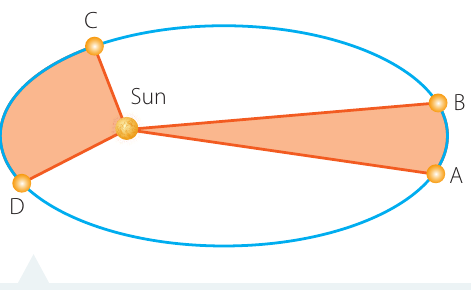
Eccentricity
Most planetary orbits in our solar system are very close to circular. The diagram shown above exaggerates the elliptical shape for clarity. Eccentricity measures how much an orbit deviates from being perfectly circular. It ranges from (perfectly circular) to (highly elongated).
Note
Eccentricity values in our solar system:
- Mercury and Pluto have the highest eccentricities at approximately
- All other planets have eccentricities less than
- Earth's eccentricity is just , making its orbit nearly circular
Most planetary orbits would appear circular to the eye on a diagram drawn to scale.
Kepler's second law: the law of areas
Kepler observed that planets do not travel at constant speeds throughout their orbits. They move faster when closer to the Sun and slower when further away. Through careful analysis, he discovered a precise mathematical relationship describing this variation.
Important
Kepler's second law states: A line joining a planet to the Sun sweeps out equal areas in equal time intervals.
This means if a planet moves from point A to point B in a certain time , and takes the same time to move from point C to point D (where C and D are closer to the Sun), the two shaded areas shown in the diagram are equal, even though the planet travels different distances.
Energy explanation
We can understand the second law using energy conservation principles. Consider a planet orbiting a star as a closed system with no external forces doing work. The total mechanical energy (sum of kinetic and potential energies) remains constant.
As a planet moves closer to the Sun:
- The gravitational potential energy of the system decreases (becomes more negative)
- To conserve total energy, the kinetic energy must increase
- Therefore, the planet speeds up
Conversely, as the planet moves away from the Sun, gravitational potential energy increases, kinetic energy decreases, and the planet slows down.
Note
Remember: Closer means faster! This relationship between distance and speed is a direct consequence of energy conservation in the gravitational field.
Kepler's third law: the law of periods
Kepler's third law describes the relationship between a planet's orbital period and its distance from the Sun.
Important
Kepler's third law states: The square of a planet's orbital period is proportional to the cube of its mean orbital radius.
Mathematically: , or
Connection to Newton's theory
Kepler deduced this relationship purely from observational data, without any theoretical basis. Later, Newton showed that this relationship could be derived from his Law of Universal Gravitation combined with the principles of circular motion:
where:
- is the orbital period
- is the orbital radius
- is the universal gravitational constant
- is the mass of the central body (e.g., the Sun)
Note
The agreement between Kepler's empirically-derived relationship and Newton's theoretically-derived formula provided strong support for Newton's Law of Universal Gravitation. This was one of the great triumphs of theoretical physics - showing that observed patterns could be explained by fundamental physical laws.
Determining stellar mass
The third law allows us to determine the mass of stars (or planets) by observing the orbits of their satellites. A graph plotting against produces a straight line for all objects orbiting the same central body.
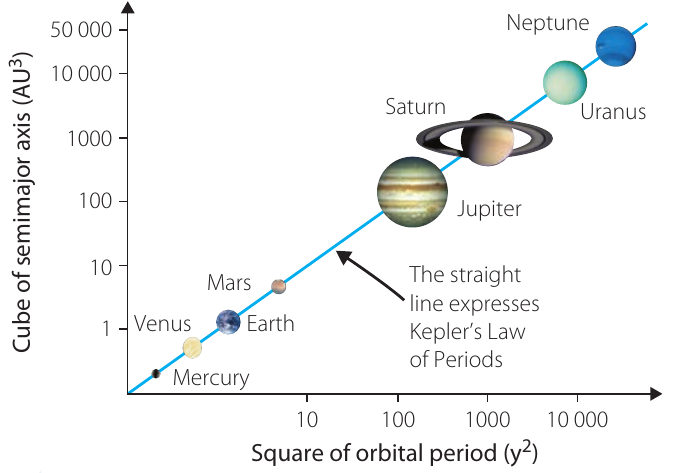
The gradient of this line equals . By measuring the gradient from observational data, we can calculate the mass of the central star. This technique works not only for our Sun but for distant stars with observable planetary systems.
Note
Note that AU (astronomical unit) equals m, which is Earth's average distance from the Sun.
Worked example: applying Kepler's third law
Example
Worked Example: Finding an Orbital Period
Problem: A small planet orbits a star every days. A second planet orbits the same star at a distance nine times the orbital radius of the first planet. What is the orbital period of the second planet?
Solution approach:
Step 1: Identify the given information
- Planet 1: days
- Planet 2:
Step 2: Recall Kepler's third law
For any planet orbiting a star:
Step 3: Recognise the constant relationship
Since both planets orbit the same star, the value of is identical for both:
Step 4: Rearrange to solve for
Step 5: Substitute values
Since :
Step 6: Calculate the final answer
The second planet has an orbital period of 810 days.
Key insight: Notice how the planet at nine times the distance takes times as long to orbit. This is because - the orbital period scales with .
Remember!
Summary
Key Points to Remember:
-
Kepler's laws are empirical: They were discovered through careful analysis of astronomical observations before Newton's theoretical framework existed
-
First law (orbits): All planets move in elliptical orbits with the Sun at one focus. Most planets in our solar system have nearly circular orbits (low eccentricity)
-
Second law (areas): A line from the Sun to a planet sweeps equal areas in equal times. This means planets move faster when closer to the Sun and slower when further away, which follows from energy conservation
-
Third law (periods): The square of the orbital period is proportional to the cube of the orbital radius (). This relationship allows astronomers to determine the mass of stars from observations of their planets
-
Historical significance: The agreement between Kepler's observational laws and Newton's theoretical predictions provided crucial evidence supporting Newton's Law of Universal Gravitation
-
Practical application: Use the relationship when comparing two objects orbiting the same central body