The Orbits of Planets and Satellites (HSC SSCE Physics): Revision Notes
📚Revision Notes
The Orbits of Planets and Satellites
Introduction to orbital motion
When we observe planets orbiting stars or satellites circling Earth, we're seeing gravitational physics in action. The gravitational field model helps us understand how these objects maintain their orbits and allows us to calculate important information like the masses of distant stars or the speed needed to place a satellite in a stable orbit.
The key insight is that orbiting objects are in continuous free fall towards the body they orbit, but their sideways motion means they keep missing it. This creates a circular (or elliptical) path.
Note
Think of orbital motion as "falling around" the Earth. The satellite is constantly falling towards Earth, but because it's moving sideways fast enough, the ground curves away beneath it at the same rate it falls. This is what Isaac Newton illustrated with his famous "Newton's cannon" thought experiment.
Circular orbital motion
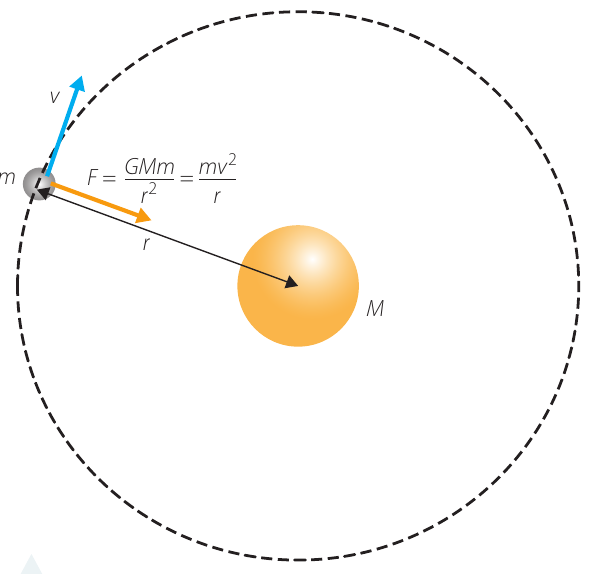
When we model an orbit as circular, we can combine our understanding of uniform circular motion with Newton's Law of Universal Gravitation. The object in orbit experiences a net force directed towards the centre, which we call the centripetal force.
For an object of mass orbiting a much larger mass at radius :
This net centripetal force is provided entirely by the gravitational force between the two objects:
Important
The gravitational force pulling an object towards the centre provides exactly the right amount of centripetal force to keep it in orbit at that distance and speed. If an object moves too slowly for its altitude, it will fall; if it moves too fast, it will escape to a higher orbit or leave entirely.
Centripetal acceleration and orbital velocity
From the force equation, we can derive the centripetal acceleration of an orbiting body:
Notice that the acceleration depends only on the mass of the central object and the orbital radius - the mass of the orbiting object cancels out. This is why all objects at the same orbital radius have the same orbital speed, regardless of their mass.
We can rearrange this to find the orbital velocity:
This shows that objects in higher orbits (larger ) move more slowly than those in lower orbits. This relationship is crucial for understanding satellite motion.
Note
This inverse relationship between orbital radius and velocity might seem counterintuitive at first. You might expect that satellites farther from Earth would need to move faster, but the opposite is true! The gravitational force is weaker at greater distances, so less centripetal force (and therefore less velocity) is needed to maintain the orbit.
Calculating stellar masses from orbital data
One powerful application of these equations is determining the mass of distant stars by observing their planets. By measuring a planet's orbital period and radius, we can calculate the mass of the star it orbits.
We start with the relationship for uniform circular motion:
where is the orbital period. Rearranging for velocity:
Combining this with our orbital velocity equation and rearranging:
This is a form of Kepler's Third Law, and it's remarkable - we can determine a star's mass just by watching how its planets move!
Example
Worked Example: Calculating the Sun's mass from Jupiter's orbit
Jupiter has an orbital period of 12 years and orbits at an average distance of 780 million km from the Sun. We can use this information to calculate the Sun's mass.
Step 1: Convert to SI units
Period:
Radius:
Step 2: Apply the formula
Starting with , we rearrange to get:
Then substitute :
Step 3: Dimensional analysis
Before substituting numbers, we should check the dimensions:
This confirms our formula is dimensionally correct.
Step 4: Calculate
Answer: The Sun's mass is kg (to 2 significant figures)
Satellite orbits and their periods
We can rearrange the mass equation to express the orbital period in terms of the orbital radius:
This equation is extremely useful for satellite applications. It tells us:
- If we want a satellite to have a specific orbital period, we can calculate the required altitude
- If we know a satellite's altitude, we can determine its orbital period and velocity
- The relationship applies to any orbiting object, including natural satellites like moons
Geostationary satellites
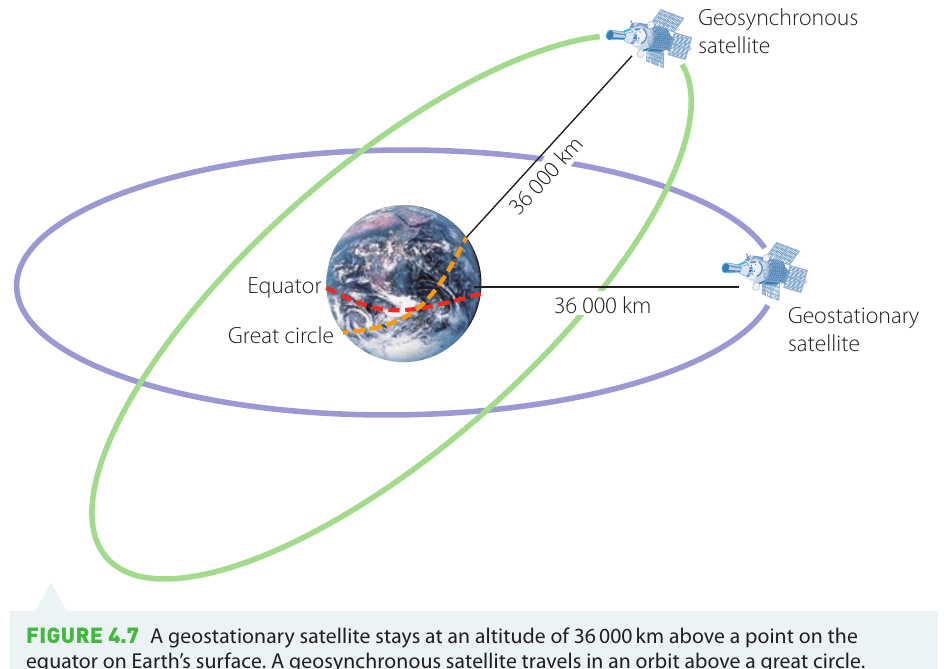
A geostationary satellite is a special type of satellite that stays above the same point on Earth's equator at all times. These satellites are invaluable for telecommunications and GPS because ground stations can maintain a constant connection without having to track the satellite's movement.
For a satellite to remain stationary relative to Earth's surface, it must have the same orbital period as Earth's rotation: one day (24 hours or 86,400 seconds).
Calculating the geostationary orbit altitude
Example
Worked Example: Determining the geostationary orbit altitude
Let's determine the orbital radius for a geostationary satellite.
Given:
- Period:
- Earth's mass:
- Gravitational constant:
Using:
Rearranging:
Calculating:
This is the orbital radius measured from Earth's centre. To find the altitude above Earth's surface, we subtract Earth's radius ( m):
Answer: All geostationary satellites orbit at approximately 36,000 km above Earth's surface.
Geosynchronous satellites
While a geostationary satellite stays above a fixed point on the equator, a geosynchronous satellite has the same 24-hour period but may orbit above any great circle on Earth's surface.
A great circle is any circle on Earth's surface whose radius extends from Earth's centre, giving it the same circumference as the equator. Both types of satellite have:
- The same orbital period (24 hours)
- The same altitude (approximately 36,000 km)
Note
The key difference is that a geosynchronous satellite's orbit may be tilted relative to the equator, so it traces a figure-eight pattern in the sky as viewed from the ground, rather than staying at a fixed point. This makes geosynchronous satellites less useful for fixed ground stations but still valuable for applications requiring periodic coverage of specific regions.
Near-Earth orbits
Near-Earth orbit (also called low-Earth orbit) satellites typically orbit at altitudes less than 1,200 km above Earth's surface. These satellites have much shorter orbital periods than geostationary satellites - typically between 80 and 130 minutes.
Characteristics and uses
Near-Earth satellites serve different purposes from geostationary satellites:
- Weather monitoring - their rapid passage over Earth's surface allows them to update weather maps frequently
- Military surveillance - low altitude provides high-resolution imaging
- Mapping - they can map large areas of Earth's surface efficiently
- Scientific research - experiments in microgravity conditions
The lower altitude means these satellites experience a stronger gravitational field (approximately 90% of the surface value) and must travel faster to maintain orbit.
The International Space Station
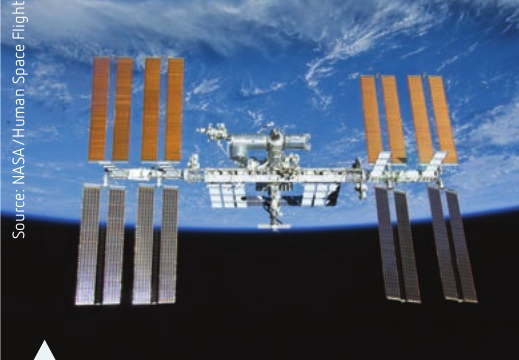
The International Space Station (ISS) is the largest near-Earth satellite, orbiting at an altitude of approximately 400 km. Despite this relatively low altitude, astronauts aboard experience "weightlessness" because the station and everything in it are in continuous free fall around Earth.
Important
The gravitational field at the ISS altitude is about 90% of Earth's surface value, so gravity certainly hasn't "disappeared" - the sensation of weightlessness comes from free fall, not lack of gravity. This is a common misconception: astronauts aren't floating because there's no gravity, but because they and their spacecraft are falling together around Earth.
Example
Worked Example: ISS orbital period and velocity
Let's calculate the orbital period and velocity of the ISS.
Given:
- Altitude:
- Earth's mass:
- Earth's radius:
Part (a): Orbital period
First, find the orbital radius:
Using:
This equals approximately 1.5 hours or 93 minutes.
Part (b): Orbital velocity
Using:
Answer: The ISS travels at nearly 8 kilometres per second - fast enough to circle Earth every 93 minutes!
Key relationships summary
Here are the essential equations you need to remember:
| Relationship | Equation | What it tells us |
|---|---|---|
| Gravitational force equals centripetal force | The condition for stable circular orbit | |
| Orbital velocity | Higher orbits have lower velocities | |
| Orbital period | or | Period depends on orbital radius |
| Mass of central body | Calculate stellar masses from orbital data | |
| Period-radius relationship | Kepler's Third Law in mathematical form |
Summary
Key Points to Remember:
-
The gravitational force provides the centripetal force that keeps satellites and planets in orbit. Without gravity, they would fly off in a straight line.
-
Orbital velocity decreases with altitude: objects in higher orbits move more slowly than those in lower orbits. This is why geostationary satellites (36,000 km altitude) have 24-hour periods, while the ISS (400 km altitude) orbits in just 93 minutes.
-
Geostationary satellites stay above the same point on Earth's equator at 36,000 km altitude, making them ideal for communications. Geosynchronous satellites have the same altitude and period but may orbit above any great circle.
-
Near-Earth orbit satellites (below 1,200 km) move much faster and have shorter periods, making them useful for Earth observation, weather monitoring, and scientific research.
-
The mass of the orbiting object doesn't affect its orbital period or velocity - only the mass of the central body and the orbital radius matter. This is why satellites of different masses at the same altitude all have the same orbital speed.