Net Force in One and Two Dimensions (HSC SSCE Physics): Revision Notes
📚Revision Notes
Net Force in One and Two Dimensions
Introduction to net force
In most real-world situations, multiple forces act on an object simultaneously. When this happens, we need to consider the combined effect of all these forces. This combined effect is called the net force or total force.
The net force is the vector sum of all individual forces acting on an object. It determines the object's acceleration according to Newton's second law. Understanding how to calculate net force is essential for predicting how objects will move when subjected to multiple forces.
Note
The net force determines an object's motion, not the individual forces acting on it. This is why we must consider all forces together when analyzing motion.
Newton's second law with multiple forces
You may recall Newton's second law in its simple form: , which applies when only a single force acts on an object. However, in almost all practical situations, there are at least two forces acting, and often many more.
Important
The more general form of Newton's second law accounts for multiple forces:
This equation tells us that the acceleration of an object depends on the net force acting on it, not just individual forces.
The net force equation
The net force on an object is defined mathematically as:
This means we add all the forces acting on object A as vectors. The method we use to add these forces depends on whether they act in one dimension or two dimensions.
Adding forces in one dimension
When all forces act along a single line (one dimension), we can use simple algebraic addition. The key is to establish a positive direction and treat forces in that direction as positive, whilst forces in the opposite direction are negative.
Forces in the same direction
Consider a block subjected to two forces both acting towards the right.
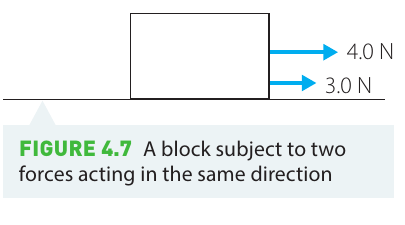
If we define right as the positive direction, the net force is:
The block will accelerate to the right. When forces act in the same direction, the net force is simply the sum of the magnitudes, and the object accelerates in that direction.
Forces in opposite directions
Now consider a block subjected to two forces acting in opposite directions.
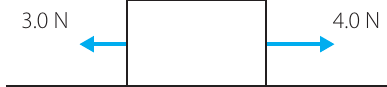
If right is still the positive direction, the force acting left must be negative:
The block will still accelerate to the right, but at a much lower rate than in the previous example. When forces oppose each other, the net force is the difference between their magnitudes, acting in the direction of the larger force.
Note
When working in one dimension, always establish your positive direction first. This makes calculations straightforward and reduces errors.
Adding forces in two dimensions
When forces act at angles to each other, we cannot simply add them algebraically. We must treat them as vectors and use vector addition techniques.
Forces at right angles
Consider a block subjected to two forces acting at right angles to each other.
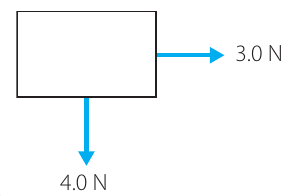
We cannot add these forces algebraically because they act in different directions. Instead, we treat them as the two perpendicular components of the net force.
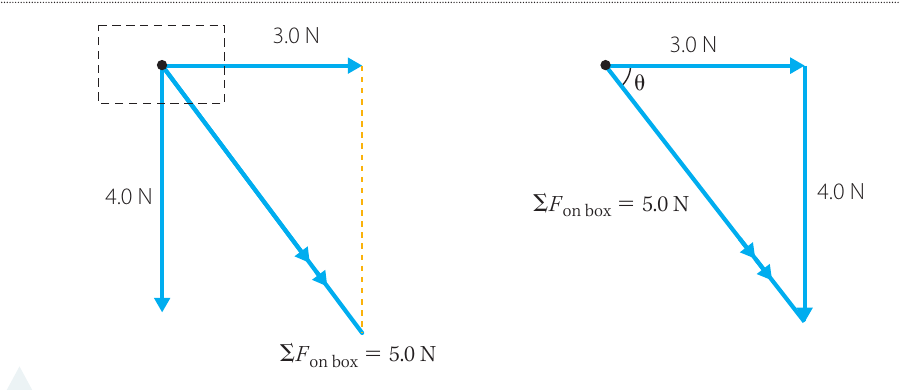
Using Pythagoras's theorem
When two forces are perpendicular, we can find the magnitude of the net force using Pythagoras's theorem:
Note
Notice that the net force () is less than when the forces acted in the same direction (), but greater than when they acted in opposite directions (). The relative orientation of forces significantly affects the net force magnitude.
Finding the direction using trigonometry
To find the angle at which the net force acts, we use trigonometry:
Therefore:
Worked example: Tugboats pulling a barge
Example
Worked Example: Tugboats Pulling a Barge
Two tugboats apply forces on a barge through ropes, as shown below. What is the resultant force due to the two tugboats?
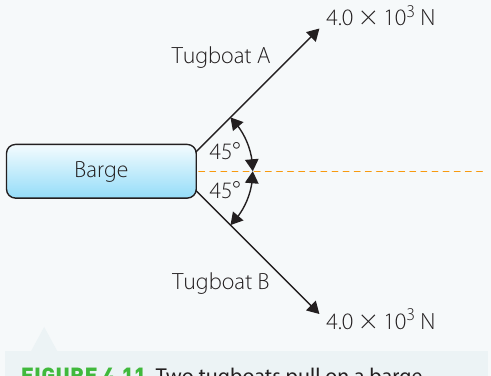
Given information:
- The two forces are acting at to each other
Solution:
Since the forces are perpendicular, we apply Pythagoras's theorem:
Therefore, (to 2 significant figures)
Force diagrams
Force diagrams are visual representations that help us understand the forces acting on an object. They are particularly useful when working with forces in two dimensions.
How to draw a force diagram
Note
When drawing a force diagram, follow these rules:
- Draw the force arrow so its tail is at the point where the force acts
- Make the length of the arrow proportional to the magnitude of the force
- Point the arrow in the direction the force acts
- Only show forces acting on the object of interest
- Do not show forces exerted by the object on other things
What not to include
Important
Newton's third law pairs: You cannot show both forces in a Newton's third law pair on a single force diagram, because one acts on the object and the other acts on something else.
Net force: The net force is not an actual force—it's a sum of forces. If you do include it on your diagram, use a different style of arrow to distinguish it from actual forces.
Resolving forces into components
When forces are not perpendicular to each other, we need to break them down into perpendicular components before adding them. This process is called resolving forces into components.
Horizontal and vertical components
Consider a person pulling a suitcase at an angle to the horizontal with force of magnitude .
Using trigonometry, we can decompose this force into horizontal and vertical components:
Horizontal component:
Vertical component:
The two components add vectorially to give the total force .
Note
The components and are perpendicular to each other, which makes them easier to add. This is the key advantage of resolving forces into components.
Finding magnitude from components
If we know the components, we can find the magnitude of the force using Pythagoras's theorem:
Worked example: Components of a force on a suitcase
Example
Worked Example: Components of a Force on a Suitcase
Phil is racing to get to the airport luggage check-in before his flight closes. He exerts a force of at an angle of to the horizontal on his suitcase. Calculate the horizontal and vertical components of this force.
Given information:
Solution:
Horizontal component:
Vertical component:
Therefore, and
Adding forces using perpendicular components
When multiple forces act at various angles, we use a systematic method to find the net force. This involves breaking each force into components, adding all components in each direction separately, then recombining them.
The component addition method
Important
Step 1: Break each force into its perpendicular components
For each force, calculate:
Step 2: Add all the components to get the net component
Step 3: Add all the components to get the net component
Step 4: Find the magnitude of the net force using Pythagoras's theorem
Step 5: Find the direction using trigonometry
Worked example: Boat on a river
Example
Worked Example: Boat on a River
Eleanor is taking her boat out on the river to do some fishing. Due to the river current, she has to steer the boat at an angle to the direction she actually wants to go. The propeller exerts a force on the boat, with magnitude pointing NE. The water exerts a force with magnitude pointing directly west. What is the magnitude of the net force exerted on the boat?
Solution approach:
Choose north as the positive direction and east as the positive direction.
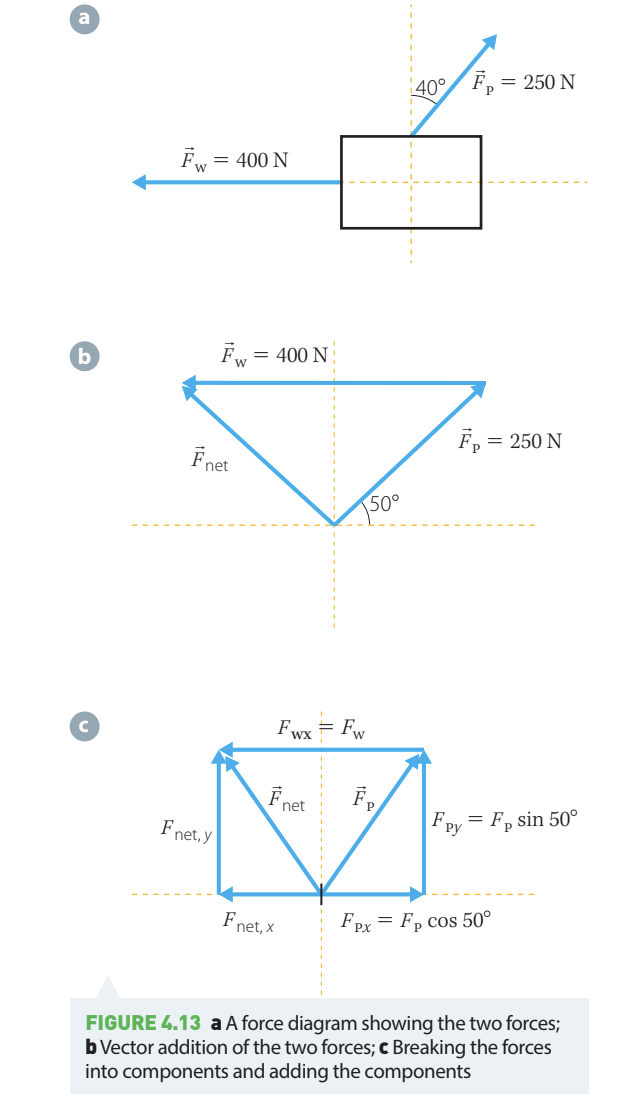
Step 1: Decompose the forces
For the propeller force ( from the positive -axis):
For the water force (pointing west, which is from positive -axis):
Step 2: Add the components
Step 3: Find the magnitude
Therefore, (to 2 significant figures)
Applying Newton's third law
Remember that forces are interactions, so forces always come in pairs. Whenever an object exerts a force on something, it experiences an equal and opposite force. This is Newton's third law:
Real-world example: Boat propeller
Newton's third law explains how a propeller makes a boat move. The turning blades of the propeller push on the water, pushing it backwards away from the boat. According to Newton's third law, the water exerts an equal and opposite force on the propeller, pushing it forwards. Since the propeller is attached to the boat, this pushes the boat forwards. The propeller wouldn't work unless it had something to push against.
Real-world example: Walking
Newton's third law helps us understand why we need friction between our feet and the ground to walk. When you push backwards against the ground with your foot, you exert a friction force against the ground. From Newton's third law, the ground exerts an equal and opposite friction force forwards on you. It is this friction force that pushes you forwards when you walk. Without friction between your feet and the ground, you wouldn't be able to walk.
Note
Newton's third law force pairs always act on different objects. This is why both forces in the pair cannot appear on the same force diagram.
Contact forces and their components
When your foot touches the ground, the total contact force can be considered as the sum of two components:
- Normal force: perpendicular to the surface
- Friction force: parallel to the surface
Worked example: Ground reaction force
Example
Worked Example: Ground Reaction Force
A foot exerts a normal force of downwards on the ground and a friction force of to the left on the ground. Calculate the total contact force exerted by the ground on the foot, assuming the foot does not slip.
Solution:
Take the positive direction to be right and the positive direction to be up.
Given forces exerted by foot on ground:
Apply Newton's third law:
Therefore:
Calculate total contact force:
Therefore, (to 3 significant figures)
Remember!
Summary
Key Points to Remember:
-
The net force is the vector sum of all forces acting on an object: . It determines the object's acceleration according to Newton's second law: .
-
In one dimension, add forces algebraically by choosing a positive direction. Forces in that direction are positive; forces in the opposite direction are negative.
-
In two dimensions, forces must be added vectorially. For perpendicular forces, use Pythagoras's theorem: .
-
To add non-perpendicular forces, resolve each force into perpendicular components using and , add components separately, then recombine using Pythagoras's theorem.
-
Newton's third law states that if object A exerts a force on object B, then object B exerts an equal and opposite force on object A: . These force pairs act on different objects and cannot both appear on a single force diagram.