Momentum and Energy in Elastic Collisions (HSC SSCE Physics): Revision Notes
📚Revision Notes
Momentum and Energy in Elastic Collisions
Introduction to elastic collisions
When objects collide, the total momentum of the system is always conserved. However, the total kinetic energy after the collision may not equal the total kinetic energy before. This is because energy can transform into other forms during a collision.
An elastic collision is a special type of collision where the total kinetic energy remains the same before and after the collision. In other words, no kinetic energy is transformed into other forms such as heat, sound, or deformation.
Note
In elastic collisions, both momentum and kinetic energy are conserved, making them unique among collision types. This conservation allows us to make precise predictions about the motion of objects after they collide.
Conditions for elastic collisions
For a collision to be elastic, two conservation laws must be satisfied. These laws work together to define the behavior of objects in elastic collisions and provide the mathematical framework for solving collision problems.
Important
Conservation of kinetic energy:
or
Conservation of momentum:
or
Both of these conditions must be satisfied simultaneously for a collision to be truly elastic.
Real-world elastic collisions
Very few real collisions are truly elastic. In almost all collisions, some energy transforms into thermal energy, sound, or deformation. However, we can model a collision as elastic if the amount of energy transformed from kinetic to other forms is small compared with the total kinetic energy.
Newton's cradle
A Newton's cradle toy demonstrates approximately elastic collisions between steel balls. When you lift one ball and release it, the ball swings down and collides with the next ball. Momentum and energy transfer along the line of balls to the last one, which swings upward. When that ball swings back down, momentum and energy transfer back in the other direction.

Important
Exam tip: Newton's cradle is only an approximately elastic collision because some energy is lost to friction, air resistance, and sound. However, because the energy loss is small compared to the total kinetic energy, we can treat it as elastic for modelling purposes.
Perfectly elastic collisions
A perfectly elastic collision can occur only when no friction is involved and no energy is lost as heat or sound. This is possible when the interaction takes place via field forces rather than contact forces. A gravitational sling-shot manoeuvre is an example of this.
Note
Field forces, such as gravitational and electromagnetic forces, allow objects to interact without physical contact. This means no energy is lost to friction, heat from deformation, or sound, making perfectly elastic collisions possible.
Worked example: proton collision in a particle accelerator
Example
Worked Example: Head-on Elastic Collision of Protons
Let's examine a head-on elastic collision between two protons in a particle accelerator. The first proton has a speed of m s to the right, and the second proton moves right with a speed of m s. We need to calculate the speeds of the two protons after the collision.
Solution approach
Step 1: Identify the data
- Both protons have equal mass:
- Initial velocities: m s, m s
- Unknown: and (final velocities)
Step 2: Apply conservation of momentum
Since all masses are equal, we can simplify:
Step 3: Group terms by particle
We now have one equation but two unknowns, so we need to use the conservation of kinetic energy.
Step 4: Apply conservation of kinetic energy
Simplifying:
Step 5: Group terms and factorise
Step 6: Combine with momentum equation
Dividing the energy equation by the momentum equation:
This simplifies to:
Step 7: Solve for velocities
Rearranging:
Substituting into the momentum equation and solving:
Result: The two protons have swapped velocities:
- m s
- m s
Key insight: In an elastic collision between two objects of equal mass, the objects exchange velocities.
Useful equations for elastic collisions
From the worked example, we can derive two very useful equations for analyzing elastic collisions. These equations provide a powerful framework for solving collision problems efficiently.
Note
Equation 1 (Conservation of momentum):
This equation applies to any collision, elastic or not.
Equation 2 (Velocity relation for elastic collisions):
This equation only applies to elastic collisions. Although we derived it assuming equal masses, it is also true when the masses are different.
Important
Exam tip: These two equations together provide a powerful method for solving elastic collision problems. Use equation 1 for any collision, and add equation 2 when the collision is elastic.
Special case: collision with a much larger object
When one object is very much larger than the other (), we can make a useful approximation. An example is when a ball collides with the surface of Earth.
In this case:
- The momentum of Earth before and after the collision is not measurably different
- We can say that
- From the velocity relation:
- If we take Earth's surface velocity to be zero ():
Note
Key result: For a completely elastic collision with a very much larger object, the small object reverses direction and bounces off with the same speed. The large object is unaffected.
This explains why a ball bounces back from the ground with nearly the same speed it had when it hit the ground (assuming minimal energy loss to sound and deformation).
Gravitational sling-shot manoeuvre
The equation helps us understand how a gravitational sling-shot manoeuvre works. A spacecraft (object 1) approaches a planet moving at velocity and swings close to it through the gravitational field without contact. It swings through and away again at speed:
Since planets move very fast in their orbits (Earth's orbital speed is about m s), a sling-shot manoeuvre about Earth could change a spacecraft's speed by approximately m s.
Note
Why this works: The gravitational interaction is a field force (not a contact force), so no energy is lost to friction, heat, or sound. This makes it a perfectly elastic collision.
This technique has been used by many space missions to change trajectory and speed without using fuel, including the Voyager spacecraft that explored the outer planets.
Investigation: elastic collisions with ball bearings
Aim
To investigate approximately elastic collisions in one dimension using steel ball bearings.
Materials
- Steel ball bearings
- Weighing scales
- Marker
- Containers for ball bearings
- Motion sensors with data loggers OR 3 stopwatches OR webcam and stopwatch
- Flat track for the ball bearings to run along
Risk assessment
| WHAT ARE THE RISKS IN DOING THIS INVESTIGATION? | HOW CAN YOU MANAGE THESE RISKS TO STAY SAFE? |
|---|---|
| Ball bearings are hard and can cause damage. | Do not roll the ball bearings at high speeds. |
Method
- Select some ball bearings and weigh them. If the weights differ, mark them or put them in labelled containers.
- Set up your equipment to measure the speed of the ball bearings before and after the collision, or the times taken for each ball to move a measured distance.
- Place the target ball bearing at its position.
- Begin recording or have everyone ready with stopwatches.
- Roll the incoming ball bearing towards the target.
- Record times/speeds for the incoming ball bearing before and after the collision, and for the target after the collision.
- Repeat steps 3–6.
Results and analysis
Record your data in a table like this:
| INCOMING BALL (BEFORE) | INCOMING BALL (AFTER) | TARGET BALL (AFTER) | |
|---|---|---|---|
| Δx (m) | |||
| Δt (s) | |||
| v (m s⁻¹) | |||
| pₓ (kg m s⁻¹) | |||
| Eₖ (kg m² s⁻²) |
Analysis steps:
- Use your measurements of time, position, and mass to calculate velocity, momentum, and kinetic energy for each ball.
- Calculate the total momentum of the system before and after the collision. Include uncertainty estimates.
- Calculate the total kinetic energy of the system before and after the collision. Include uncertainty estimates.
Discussion questions
- Was momentum conserved in this collision, within the bounds of your uncertainties?
- Was kinetic energy conserved in this collision, within the bounds of your uncertainties?
- Is the elastic-collisions model an appropriate one for the collision of steel ball bearings?
Note
Expected outcomes: Steel ball bearings approximate elastic collisions quite well because they are hard and smooth, minimizing energy loss. However, some energy will be lost to sound, friction with the track, and slight deformation. Within experimental uncertainty, you should find that both momentum and kinetic energy are approximately conserved.
Check your understanding
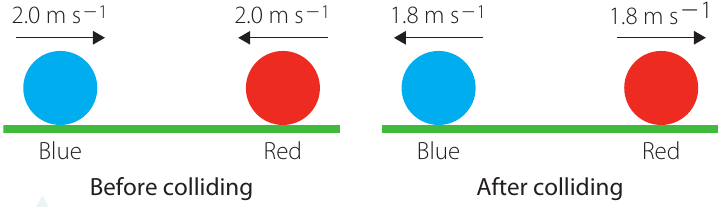
Question: Two billiard balls of equal mass roll directly towards each other at 2.0 m s, as shown in the diagram. Describe the motion of the balls after the collision, including their speeds. Assume the collision is elastic.
Example
Worked Example: Billiard Ball Collision
Answer: Since the balls have equal mass and the collision is elastic, they will exchange velocities. The blue ball moving right at 2.0 m s will end up moving left at 2.0 m s after the collision. The red ball moving left at 2.0 m s will end up moving right at 2.0 m s after the collision. In other words, each ball bounces back with the same speed it approached with, but in the opposite direction.
Note: The diagram shows speeds of 1.8 m s after collision, which would indicate this is not a perfectly elastic collision – some kinetic energy has been lost.
Remember!
Summary
Key Points to Remember:
-
Momentum is conserved in all collisions, but kinetic energy may be transformed into other forms.
-
An elastic collision is one where total kinetic energy is conserved: no kinetic energy is transformed into other forms like heat or sound.
-
Two key equations for elastic collisions: (momentum conservation) and (velocity relation).
-
Equal mass elastic collision: Objects exchange velocities. The incoming object takes on the velocity of the target, and vice versa.
-
Collision with much larger object: If a small object collides elastically with a much larger stationary object, it bounces back with the same speed but opposite direction ().
-
Real collisions are rarely perfectly elastic: Most collisions lose some kinetic energy to sound, heat, and deformation. We can model them as elastic when energy loss is small compared to total kinetic energy.