Lenz’s Law and Conservation of Energy (HSC SSCE Physics): Revision Notes
📚Revision Notes
Lenz's Law and Conservation of Energy
Understanding Lenz's Law
Lenz's Law is a fundamental principle in electromagnetism that tells us how induced currents behave when magnetic flux changes through a conductor.
Lenz's Law states: An induced emf always acts to produce an induced current in the direction that causes a magnetic flux opposing the change in flux that induced the emf.
This might sound complex, so let's break it down:
Note
How Induced Currents Respond to Flux Changes:
- When the magnetic flux through a conductor is increasing, the induced current creates a magnetic field in the opposite direction
- When the magnetic flux through a conductor is decreasing, the induced current creates a magnetic field in the same direction
- In both cases, the induced current acts to reduce the change in flux
Visualising Lenz's Law
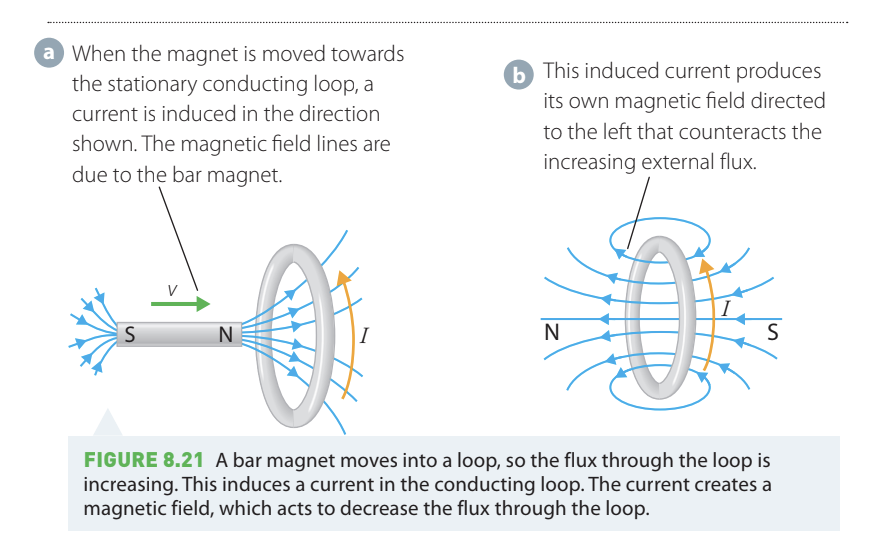
The diagram above shows what happens when a bar magnet moves towards a stationary conducting loop:
- As the magnet approaches (moving to the right), the magnetic flux through the loop increases
- This changing flux induces an emf in the loop
- The induced emf drives a current around the loop
- This induced current creates its own magnetic field pointing to the left
- The new magnetic field opposes the increasing external flux from the approaching magnet
Important
Key insight: The induced current essentially tries to "push back" against the change that created it. This opposition is the fundamental characteristic of Lenz's Law.
Connection to conservation of energy
Lenz's Law is not just an observation—it's a fundamental requirement of energy conservation.
Important
What if Lenz's Law didn't exist?
Imagine if an induced current acted to increase an already increasing flux:
- The flux would increase even more
- This would induce an even stronger current
- This stronger current would increase the flux further still
- The process would continue indefinitely
This would mean the magnetic flux would increase to infinity, which is impossible. Energy is stored in magnetic fields, and this energy must come from somewhere. An infinite increase in flux would require infinite energy from nowhere—a clear violation of energy conservation.
Therefore: Lenz's Law ensures that electromagnetic induction always opposes changes and extracts energy from the source of motion, rather than creating energy from nothing.
Lenz's Law and DC motors
Understanding Lenz's Law is essential for understanding how DC motors really work.
The back emf phenomenon
When you first turn on a DC motor:
- The supplied emf (voltage from the battery or power supply) creates a current in the coil
- This current experiences a force in the magnetic field from the magnets (the motor effect)
- The force creates a torque that makes the coil start rotating
- As the coil rotates, the magnetic flux through it changes
- This changing flux induces an emf in the coil
Note
The Crucial Part:
According to Lenz's Law, this induced emf must oppose the change that created it. The induced emf therefore acts in the opposite direction to the supplied emf. This is called back emf.
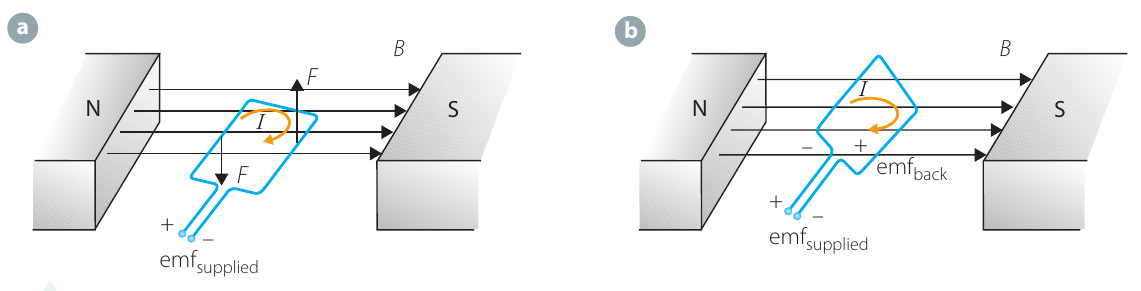
The diagram shows:
- (a) The supplied emf drives current through the coil, creating forces that cause rotation
- (b) As the coil rotates, the changing flux induces a back emf that opposes the supplied emf
Mathematical relationship
The negative sign in Faraday's Law, , represents Lenz's Law. It tells us the induced emf has opposite polarity to what would increase the flux.
The total emf across the motor coil is the sum of the supplied emf and the back emf, remembering they have opposite signs. Using Ohm's Law, the current through the coil is:
where is the resistance of the coil.
How motor speed affects current
Note
When the motor first starts turning:
- The rotation is slow
- The rate of flux change () is small
- The back emf is small
- The current is large (because is large)
As the motor speeds up:
- The rotation becomes faster
- The rate of flux change increases
- The back emf increases
- The current decreases (because becomes smaller)
Eventually, there's a theoretical maximum speed where:
- Back emf equals supplied emf
- Current drops to zero
- The motor can't go any faster
In practice, motors run below this maximum speed because they need current to overcome friction and drive whatever load is attached.
Practical implications
Important
Starting resistors: Because current is much larger when a motor first starts, many motors have starting resistors. These are switched into the circuit at startup to limit current, then switched out once the motor reaches operating speed. This prevents damage to the motor windings.
Adding loads to motors: When you add a load to a motor (like holding the wheels of a remote-control car still), the motor slows down. As it slows:
- The back emf decreases
- The current increases
- If the load is too great and the motor slows too much, the current can become large enough to burn out the motor due to resistive heating
Exam tip: Always remember that back emf increases with motor speed and acts to reduce the current through the motor.
Magnetic braking
Magnetic braking is a practical application of Lenz's Law that uses induced currents to slow down moving objects.
Understanding eddy currents
Induced currents can be created in any material containing free charge carriers. When a magnet moves near a piece of metal:
- The changing magnetic field induces an emf in the metal
- This emf causes loops and spirals of current, called eddy currents, to flow in the metal
- According to Lenz's Law, these eddy currents create magnetic fields opposing the change
- These opposing magnetic fields exert a force on the magnet that opposes its motion
Magnet falling through a pipe
Consider dropping a magnet (north pole first) down a vertical copper pipe. Copper is not ferromagnetic, so there's no magnetic attraction. However:
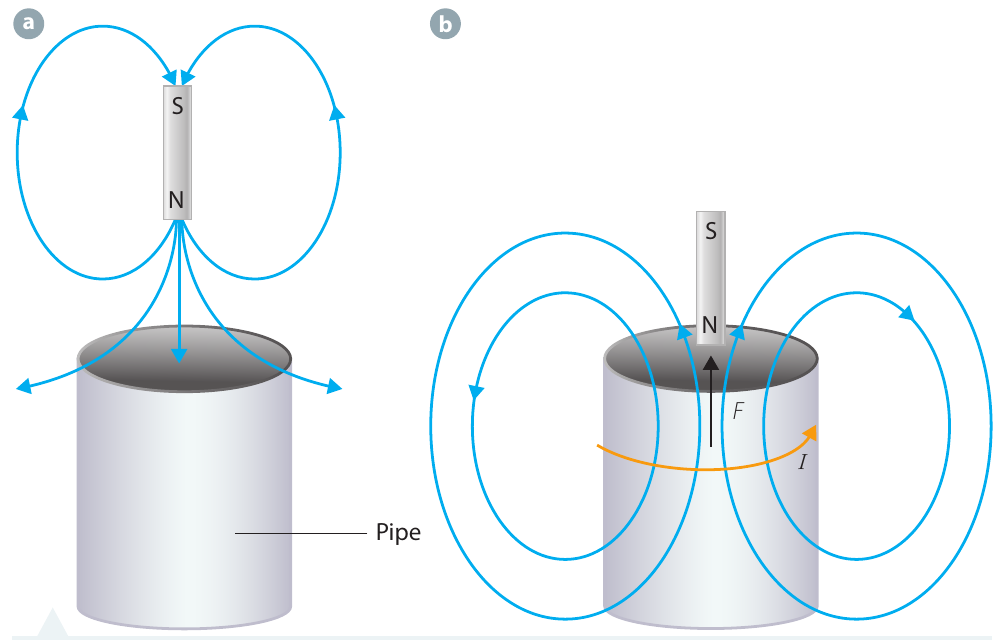
As the magnet falls:
- The magnetic flux through each "ring" of the pipe increases as the magnet approaches
- Each ring has an induced current that creates a magnetic field pointing upward
- This is equivalent to a north pole appearing below the falling magnet
- The falling magnet experiences a repulsive force pushing upward
- This force opposes the motion and slows the magnet down
This is magnetic braking.
Note
Important: It doesn't matter whether the magnet moves or the pipe moves. The interaction between eddy currents and the magnet acts to reduce relative movement. Whichever is moving will be slowed down.
Why magnetic braking works
Whenever a moving conductor is in a magnetic field, or a moving magnet is near a conductor, eddy currents are induced that oppose the motion. This applies to both:
- Straight-line motion (like a falling magnet)
- Rotational motion (like a spinning disc)
The energy of the moving object is converted into:
- Electrical energy in the eddy currents
- Heat energy due to resistance in the conductor
Applications of magnetic braking
Magnetic braking is widely used in transport and industry:
Note
High-speed trains: Some modern trains use magnetic braking systems. Large electromagnets are positioned near the rails. When activated, they induce eddy currents in the rails or brake discs, creating a braking force without physical contact. This reduces wear and provides smooth, controllable braking.
Industrial machinery: Magnetic braking is used as a safety feature in equipment with large rotating parts:
- Saw mills use magnetic braking to stop blades quickly when the saw is turned off
- This prevents accidents and allows faster, safer operation
Molten metal control: In steel casting and other metalworking, magnetic braking controls the flow of molten metals into moulds. Electromagnets can be quickly switched on and off to precisely control flow rates.
Why electromagnets? Most industrial applications use electromagnets rather than permanent magnets because they can be switched on and off quickly to control when braking occurs.
Investigation 8.3: Magnetic braking
This investigation demonstrates magnetic braking by dropping a magnet through different pipes.
Aim
To investigate magnetic braking of a magnet falling through different pipes.
Materials
- Retort stand and clamps
- Copper pipe, at least 50 cm long, approximately 5 cm diameter
- Copper pipe of same dimensions with lengthwise slit cut into it
- Plastic pipe of same dimensions
- Magnet
- Metre ruler
- Stopwatch
- Small cushion (for catching the magnet safely)
- Plumb-bob (weight on a string)
Safety considerations
Important
Risk: Magnets can break or become demagnetised when dropped.
Management: Be careful with magnets. Put them down when not in use. Always place the cushion below the pipe before dropping the magnet.
Risk: A falling magnet can cause injury.
Management: Keep heads and hands clear of the bottom of the pipe when dropping the magnet.
Method
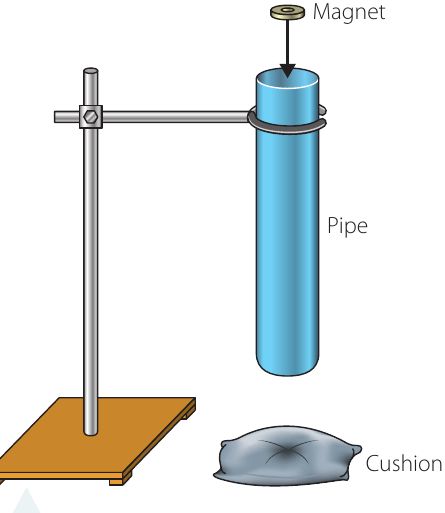
- Measure the length of all pipes and ensure they're identical. Record this length.
- Attach the metre ruler to the retort stand. Use the plumb-bob to ensure it's vertical.
- Place the cushion below the ruler. Hold the magnet near (but not touching) the top of the ruler. Time how long the magnet takes to fall from rest through a height equal to the pipe length. Repeat at least three times to estimate uncertainty.
- Remove the ruler. Attach the plastic pipe vertically to the retort stand (use the plumb-bob). Ensure the cushion is below the bottom of the pipe.
- Drop the magnet (north pole down) down the pipe. Time how long it takes to fall from rest at the top until it emerges from the bottom. Make repeat measurements.
- Replace the plastic pipe with the copper pipe containing the lengthwise slit. Repeat step 5.
- Replace the slitted copper pipe with the complete copper pipe (no slit). Repeat step 5.
- Repeat step 5 with the magnet falling south pole down through the complete copper pipe.
Recording results
Record your measurements in a table:
| PIPE | (s) | (s) | (s) | (s) | (m s) | (m s) | gained (J) | lost (J) | Mechanical energy lost (J) |
|---|---|---|---|---|---|---|---|---|---|
| none | |||||||||
| plastic | |||||||||
| slit Cu | |||||||||
| solid Cu |
Also note the pipe length and whether fall time differed between north-pole-down and south-pole-down orientations.
Analysis of results
- Calculate the average time from your repeat measurements. Calculate uncertainty from the range.
- Calculate average speed of the magnet:
- Calculate final speed as it emerged from each pipe by assuming constant acceleration: (This is an approximation, particularly when resistive forces act)
- Calculate kinetic energy gained:
- Calculate gravitational potential energy lost: where is the pipe length
- Calculate mechanical energy lost to resistive forces:
Discussion points
Note
Energy dissipation: The energy lost to resistive forces (especially magnetic braking in copper pipe) is much greater than for free fall. This energy is converted to heat in the pipe and in the magnet due to eddy currents flowing through the resistance of the materials.
Effect of the slit: The copper pipe with a lengthwise slit shows less magnetic braking than the complete copper pipe. The slit prevents eddy currents from forming complete loops around the pipe's circumference. Without complete current loops, the magnetic braking effect is reduced.
Magnetic pole orientation: The orientation (north or south pole down) should not significantly affect the results. The magnitude of the induced currents and forces depends on the rate of flux change, not the direction of the magnetic field.
What you should observe
Important
Expected Results:
The magnet falls:
- Fastest through no pipe or the plastic pipe (no magnetic braking)
- Slower through the slitted copper pipe (some magnetic braking)
- Slowest through the complete copper pipe (maximum magnetic braking)
This demonstrates that:
- Magnetic braking requires a conductor (copper, not plastic)
- Magnetic braking is stronger when eddy currents can form complete loops (solid pipe vs slitted pipe)
- Magnetic braking is a demonstration of Lenz's Law—the induced currents oppose the motion that created them
Additional demonstrations
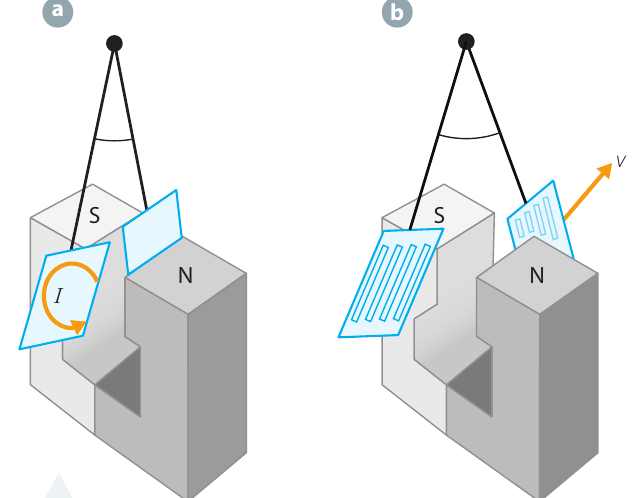
A magnetically braked pendulum provides another dramatic demonstration of Lenz's Law:
Note
Setup (a): A solid metal plate (copper or aluminium) swings between the poles of a strong horseshoe magnet. When the pendulum swings into the magnetic field:
- Eddy currents are induced in the plate
- These currents create magnetic fields opposing the motion
- The pendulum stops oscillating very quickly
Setup (b): A metal plate with many slits cut into it behaves differently. The slits prevent eddy currents from forming complete loops. Without large eddy current loops, magnetic braking is much less effective, and the pendulum continues swinging for longer.
This demonstrates that magnetic braking depends on eddy currents being able to flow freely through the conductor.
Remember!
Summary
Key Points to Remember:
-
Lenz's Law states that induced currents always create magnetic fields opposing the change in flux that induced them. If external flux increases, induced flux opposes it; if external flux decreases, induced flux reinforces it.
-
Lenz's Law is a consequence of energy conservation. If induced currents enhanced the change instead of opposing it, we could create infinite energy, which is impossible.
-
Back emf in DC motors occurs when the rotating coil experiences changing flux, inducing an emf that opposes the supplied emf. This limits the current through the motor: Back emf increases with motor speed, reducing current as the motor speeds up.
-
Magnetic braking uses eddy currents induced in conductors by changing magnetic fields. These eddy currents create opposing magnetic forces that slow down relative motion between conductor and magnet. This principle is used in trains, industrial machinery, and molten metal control.
-
Practical applications of these principles include starting resistors in motors (to limit high startup currents), electromagnetic brakes (for safety and control), and energy harvesting systems (where mechanical motion is converted to electrical energy through electromagnetic induction).