Deep Inside the Atom (HSC SSCE Physics): Revision Notes
📚Revision Notes
The Standard Model of Matter
Introduction to the Standard Model
The Standard Model of matter is a fundamental framework in physics that describes all matter and forces in the Universe using fundamental particles. This model has been developed over decades and represents one of the most successful theories in modern physics. It organizes particles into different categories based on their properties and interactions.
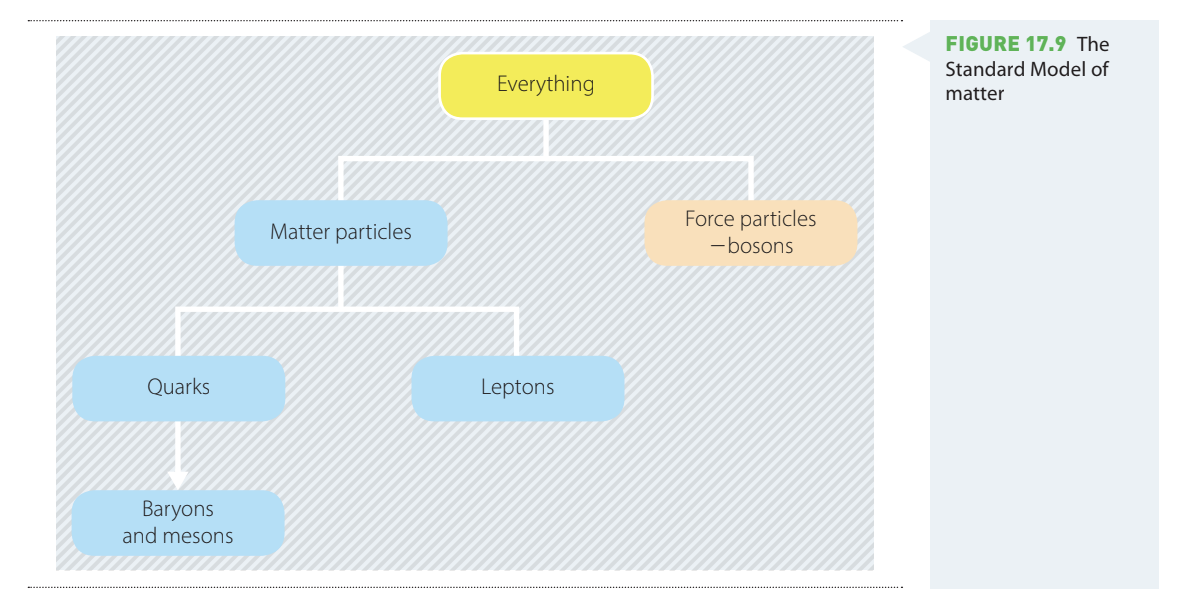
The Standard Model can be visualized as a hierarchical structure, with everything in the Universe being made up of either matter particles or force particles (called bosons). Matter particles further divide into quarks and leptons, while quarks can combine to form larger particles called baryons and mesons.
Note
The Standard Model's hierarchical organization helps us understand how complex structures (like atoms and molecules) emerge from combinations of just a few types of fundamental particles. Think of it as a cosmic building code that governs how everything in the Universe is constructed.
Quarks: the building blocks of matter
What are quarks?
In 1964, physicists Murray Gell-Mann and George Zweig proposed the existence of particles with fractional electric charges, which they called quarks. These particles were later recognized as fundamental particles – meaning they are the smallest particles that cannot be broken down any further. Through experiments using particle accelerators, scientists have confirmed that quarks are indeed fundamental building blocks of matter.
Note
The term "quark" was taken by Murray Gell-Mann from James Joyce's novel "Finnegans Wake." Despite its playful origin, the name stuck and is now used universally in physics to describe these fundamental particles.
The six flavours of quarks
Quarks come in six different types, which physicists call "flavours". The term "flavours" refers to the different quantum properties that distinguish one type of quark from another. These six flavours are organized into three generations:
| Generation | Quarks | Symbol | Charge |
|---|---|---|---|
| 1 | Up | u | |
| 1 | Down | d | |
| 2 | Charm | c | |
| 2 | Strange | s | |
| 3 | Top | t | |
| 3 | Bottom | b |
Important
Notice that quarks have fractional charges – either or of the electron's charge. This is quite unusual compared to most particles we encounter, which have whole number charges. This fractional nature is one of the key pieces of evidence that led scientists to understand that protons and neutrons are not fundamental particles, but are instead made of smaller constituents.
Anti-quarks
For every quark, there exists a corresponding anti-quark with opposite charge. For example:
- An anti-up quark (written as ) has a charge of
- An anti-down quark (written as ) has a charge of
Important properties of quarks
Important
Quarks do not exist by themselves in nature. They are always found in combinations with other quarks, forming more stable composite particles. This is because of the strong nuclear force that binds them together.
All quarks interact through the strong nuclear force, which explains why this force acts equally between protons, neutrons, and any combination of nucleons – they are all made from the same types of quarks.
Hadrons: combinations of quarks
What are hadrons?
When quarks combine together, they form particles called hadrons. All hadrons have whole number (integral) electric charges, even though they are made of quarks with fractional charges. There are two main types of hadrons: baryons and mesons.
Baryons: three-quark combinations
Baryons are particles made from three quarks combined together. The most important baryons are the nucleons – protons and neutrons – which make up the everyday matter around us.
Example
Worked Example: Calculating Proton Charge
Protons:
- Composition: two up quarks and one down quark (uud)
- Charge calculation:
- This gives protons their characteristic charge of
Neutrons:
- Composition: one up quark and two down quarks (udd)
- Charge calculation:
- This results in neutrons having no overall charge
Because all baryons are made from quarks, they all interact through the strong nuclear force. This explains why the strong nuclear force acts equally between two protons, a proton and a neutron, or two neutrons – they are all composed of the same types of quarks in different combinations.
Mesons: quark-antiquark pairs
Mesons are particles made from a quark and an anti-quark combined together. Unlike baryons, mesons are generally unstable and have very short lifetimes before they decay into other particles.
Example
Worked Example: The Positive Pion ()
- Composition: an up quark and an anti-down quark
- Charge calculation:
Because mesons are so unstable and short-lived, detecting and identifying them requires specialized equipment and sophisticated analysis techniques, such as those used at particle physics laboratories like CERN.
Leptons: lightweight fundamental particles
What are leptons?
Leptons are another type of fundamental particle, distinct from quarks. The word "lepton" comes from the Greek word meaning "light" or "small", reflecting the fact that these particles have either very little mass or no mass at all. Like quarks, there are six flavours of leptons, also organized into three generations.
Note
Despite their name suggesting they are all lightweight, not all leptons are actually lighter than quarks. The tau lepton, for example, is actually heavier than some quarks. The name reflects the properties of the first leptons discovered (electrons), which were indeed very light.
The six flavours of leptons
Each generation contains an electrically charged lepton paired with its corresponding neutrino (which has no charge):
| Generation | Lepton | Symbol | Charge |
|---|---|---|---|
| 1 | Electron | ||
| 1 | Electron-neutrino | ||
| 2 | Muon | ||
| 2 | Muon-neutrino | ||
| 3 | Tau | ||
| 3 | Tau-neutrino |
Anti-leptons
Just like quarks have anti-quarks, every lepton has a corresponding anti-lepton with opposite charge. For example, the positron () is the anti-particle of the electron.
How leptons interact
All leptons interact through the weak nuclear force. Additionally, the electrically charged leptons (electron, muon, and tau) also interact through the electromagnetic force. However, unlike quarks, leptons do not interact through the strong nuclear force.
Understanding particle generations
The concept of "generations" is crucial to understanding the Standard Model. Here is what distinguishes the three generations:
Note
First generation particles:
- These make up all ordinary matter around us
- Examples: up and down quarks (forming protons and neutrons), electrons, and electron-neutrinos
- These particles are stable and do not decay
Second generation particles:
- These are less stable than first generation particles
- They quickly decay to form first generation particles
- Examples: charm and strange quarks, muons, and muon-neutrinos
- They have greater mass than first generation particles
Third generation particles:
- These are the least stable and most massive
- They decay rapidly to form second generation particles
- Examples: top and bottom quarks, tau particles, and tau-neutrinos
Because second and third generation particles are unstable and short-lived, they cannot constitute everyday matter. This also makes them harder to detect experimentally. As a general rule, as the generation number increases, so does the mass of the particles.
Bosons: the force carrier particles
The four fundamental forces
According to the Standard Model, there are four fundamental forces in the Universe. Each of these forces is thought to act through the exchange of special particles called bosons (also known as force particles or force carriers):
| Force | Particles Involved | Force Carrier | Range | Relative Strength |
|---|---|---|---|---|
| Gravity | All particles with mass | Graviton (not yet observed) | Infinite | Much weaker ↓ |
| Weak nuclear force | Quarks and leptons | W and Z bosons | Short range | |
| Electromagnetic force | Electrically charged particles | Photon | Infinite | |
| Strong nuclear force | Quarks and gluons | Gluon | Short range | Much stronger ↓ |
How force particles work
Note
Force particles can be thought of as messengers that are exchanged between matter particles. When matter particles interact:
- Attraction forces work by having matter particles pull on the force particles as they are exchanged
- Repulsion forces work by having the force particles being pushed away as they are exchanged
The four force carriers explained
1. Photons (electromagnetic force):
- Carry the electromagnetic force between electrically charged particles
- Have infinite range
- Responsible for light, electricity, magnetism, and chemical bonds
2. Gluons (strong nuclear force):
- Carry the strong nuclear force between quarks
- Have very short range (only effective within the nucleus)
- The strongest of all forces
- Responsible for binding quarks together and holding the nucleus together
3. W and Z bosons (weak nuclear force):
- Carry the weak nuclear force between quarks and leptons
- Have very short range
- Responsible for certain types of radioactive decay, including beta decay
4. Gravitons (gravity):
- Theoretically carry the gravitational force between all particles with mass
- Would have infinite range
- Unlike other force particles, gravitons have never been detected
- They were included in the Standard Model for mathematical completeness, but their existence remains unproven
The scale of fundamental particles
Understanding the relative sizes of particles helps us appreciate just how small fundamental particles are compared to everyday objects.
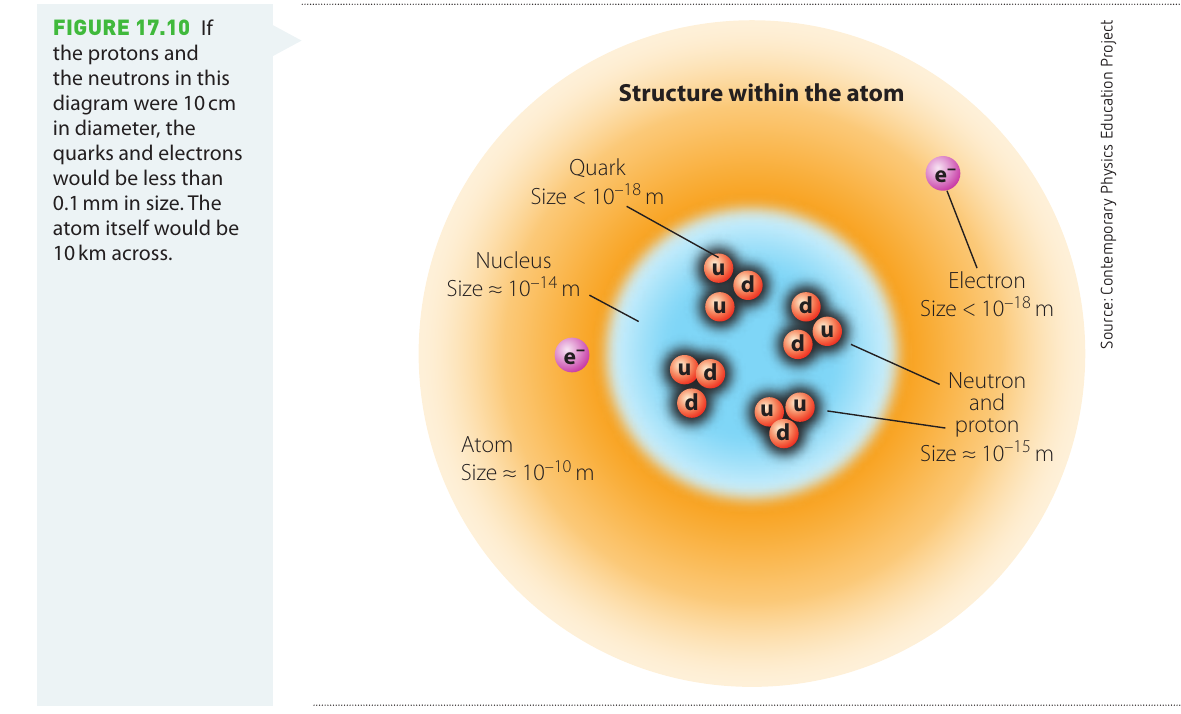
The diagram above illustrates the hierarchical structure of matter at different scales:
- Atoms: approximately meters in diameter (0.0000000001 meters)
- Nucleus: approximately meters in diameter (10,000 times smaller than the atom)
- Protons and neutrons: approximately meters in diameter
- Quarks and electrons: less than meters in size (at least 1000 times smaller than protons)
Important
Understanding the Scale:
To put this in perspective: if we scaled up protons and neutrons to be 10 cm in diameter (about the size of a tennis ball), the quarks and electrons inside would be less than 0.1 mm in size (smaller than a grain of sand). At this same scale, the entire atom would be approximately 10 kilometers across!
This enormous difference in scale demonstrates why it took scientists so long to discover the internal structure of atoms and why such powerful equipment is needed to study fundamental particles.
Discovery of the Higgs boson
What is the Higgs boson?
The Higgs boson is a fundamental particle that plays a crucial role in the Standard Model. Named after physicist Peter Higgs (one of the scientists who first predicted its existence in 1964), this particle is responsible for giving mass to other particles. Without the Higgs boson and the associated Higgs field, all fundamental particles would be massless and the Universe as we know it could not exist.
The historic discovery at CERN
On 4 July 2012, scientists at CERN made a groundbreaking announcement: they had detected the Higgs boson using the Large Hadron Collider (LHC). This discovery came from analyzing data collected by the ATLAS detector after countless high-energy particle collisions.
Important
Why This Discovery Was Monumental:
The detected Higgs boson had a mass within the range predicted by the Standard Model, confirming decades of theoretical work. This was a monumental achievement in physics because:
- It validated the Standard Model of particle physics
- It confirmed predictions made nearly 50 years earlier
- It required the most powerful particle accelerator ever built
Had the Higgs boson not been detected by the LHC, the entire Standard Model would have been called into question. Its detection using the extremely powerful LHC has served to reinforce one of science's most important theories.
In 2013, Peter Higgs and François Englert were jointly awarded the Nobel Prize in Physics for their prediction of this particle.
The evolution and future of the Standard Model
A long journey of understanding
The Standard Model represents the culmination of over a century of scientific progress in understanding the atom. Scientists have advanced from:
- Thomson's "plum pudding" model (a uniform sphere with electrons embedded)
- Rutherford's nuclear model (a dense nucleus with orbiting electrons)
- Bohr's quantum model (electrons in specific energy levels)
- The quantum mechanical models of de Broglie, Pauli, and Heisenberg (wave-particle duality and uncertainty)
- Finally to the Standard Model (fundamental particles and force carriers)
Current status
The Standard Model has now stood for more than 40 years as a remarkably successful theory. It can predict and explain an enormous range of phenomena in particle physics with extraordinary precision. The discovery of the Higgs boson in 2012 was a major triumph, confirming one of the model's key predictions.
Limitations and future directions
Despite its success, scientists recognize that the Standard Model is not complete. There are several phenomena it cannot explain:
Note
Current Limitations of the Standard Model:
- The nature of dark matter (which makes up most of the matter in the Universe)
- The nature of dark energy (which drives the accelerating expansion of the Universe)
- Why gravity is so much weaker than the other forces
- The matter-antimatter asymmetry in the Universe
Ongoing research at facilities like CERN continues to test the Standard Model and search for new physics beyond it. Future discoveries may lead to even more sophisticated models that can answer these remaining questions.
Remember!
Summary
Key Points to Remember:
-
The Standard Model organizes all fundamental particles into matter particles (quarks and leptons) and force particles (bosons).
-
Quarks come in six flavours (up, down, charm, strange, top, bottom) with fractional charges, and always combine to form hadrons. Baryons are three-quark combinations (like protons and neutrons), while mesons are quark-antiquark pairs.
-
Leptons include six flavours (electron, muon, tau, and their corresponding neutrinos), organized into three generations. First generation particles form ordinary matter, while higher generations are heavier and less stable.
-
The four fundamental forces are carried by bosons: photons (electromagnetic), gluons (strong nuclear), W and Z bosons (weak nuclear), and possibly gravitons (gravity – not yet observed).
-
The Higgs boson, discovered at CERN in 2012, is responsible for giving mass to other particles and was the last major prediction of the Standard Model to be confirmed experimentally.