Nucleosynthesis in Stars (HSC SSCE Physics): Revision Notes
📚Revision Notes
Nucleosynthesis in Stars
Introduction to stellar nucleosynthesis
Nucleosynthesis is the process by which smaller atomic nuclei combine through nuclear fusion to form larger nuclei. This fundamental process occurs in the cores of stars under conditions of extreme temperature and pressure.
According to the Big Bang Theory, the first nucleosynthesis occurred approximately three minutes after the Universe began. This early process created primarily light elements: hydrogen isotopes, helium, and some lithium. However, every other element in the periodic table has been synthesised within stars through stellar nucleosynthesis.
The energy source for stars comes from mass being converted into energy, as described by Einstein's famous equation:
where:
- = energy (in joules)
- = mass (in kilograms)
- = speed of light (approximately m s)
Note
This equation shows that mass and energy are equivalent and that even a tiny amount of mass can be converted into enormous amounts of energy. The speed of light squared ( m s) is such an enormous number that this explains why nuclear reactions release such tremendous amounts of energy.
Mass defect and energy release
During nuclear fusion reactions, the total mass of the products is slightly less than the total mass of the reactants. This difference is called the mass defect. The "missing" mass has been converted into energy according to Einstein's equation. Because the speed of light squared () is such an enormous number, even a very small mass defect results in a tremendous energy release.
Important
Fusion reactions that produce elements up to and including iron (element 26) are self-sustaining because they release more energy than is needed to initiate them. These are called exothermic reactions.
However, forming elements heavier than iron requires a net input of energy, making such reactions endothermic and unsustainable under normal stellar conditions. This is why iron represents a critical limit in stellar nucleosynthesis.
Main Sequence stars
Main Sequence stars represent the stable, mature phase of a star's life cycle. Our Sun is a Main Sequence star, as are most stars in the Universe. These stars range from small red dwarfs (about one-tenth the Sun's diameter) to massive blue-white stars.
All Main Sequence stars share a common energy source: the fusion of hydrogen nuclei into helium nuclei in their cores. However, this fusion doesn't happen all at once. The probability of four hydrogen nuclei (, which are simply protons) simultaneously colliding and fusing is extremely small. Instead, fusion occurs through a series of steps involving collisions between just two particles at a time.
There are two main pathways for hydrogen fusion in Main Sequence stars:
The proton-proton chain
The proton-proton (PP) chain is the dominant energy source in stars with masses up to approximately 1.5 times the Sun's mass, and with core temperatures up to about 18 million Kelvin (18 MK). This pathway accounts for approximately 85% of the energy produced in our Sun.
Example
Worked Example: The Proton-Proton Chain
The PP chain occurs in three main steps:
Step 1: Formation of deuterium
Two protons collide and fuse. One proton undergoes beta-plus decay, converting into a neutron and emitting a positron () and an electron neutrino ():
This produces deuterium (), which has one proton and one neutron. This step occurs twice to produce two deuterium nuclei.
Step 2: Formation of helium-3
Each deuterium nucleus then fuses with another proton to form helium-3. Most of the energy from this reaction is released as a gamma ray ():
This step also occurs twice, producing two helium-3 nuclei.
Step 3: Formation of helium-4
Finally, the two helium-3 nuclei collide and fuse to form stable helium-4, releasing two protons back into the star:
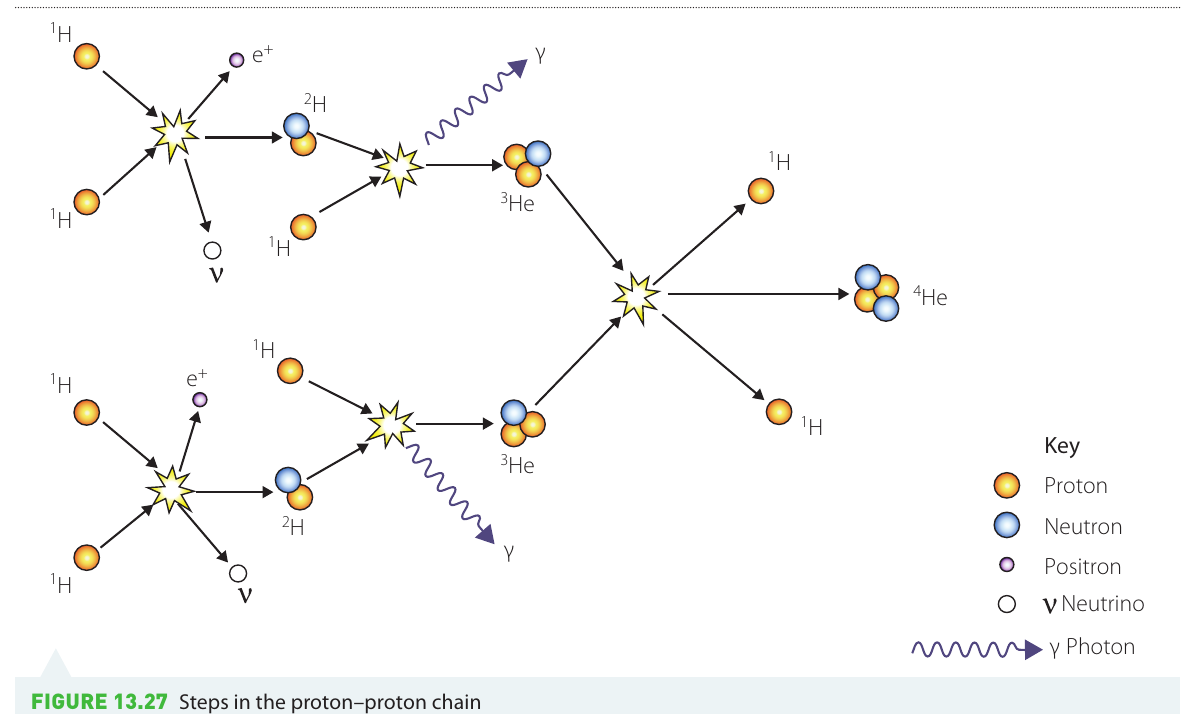
The net result of the proton-proton chain can be summarised as:
This equation shows that four hydrogen nuclei (protons) combine to produce one helium-4 nucleus, along with two positrons, two neutrinos, and two gamma ray photons.
Note
Understanding neutrinos
Neutrinos are extremely unusual particles that interact with matter very rarely. It is estimated that billions of neutrinos pass through your body every second, yet only a few might interact with your atoms in your entire lifetime.
Scientists detect neutrinos using massive underground detectors, such as tanks filled with thousands of tonnes of water. When a neutrino occasionally interacts with a water molecule, it produces a tiny flash of light that can be recorded.
The CNO cycle
The carbon-nitrogen-oxygen (CNO) cycle is an alternative pathway for hydrogen fusion that becomes dominant in stars with core temperatures exceeding 18 million Kelvin. Unlike the proton-proton chain, this pathway requires the presence of carbon-12 nuclei.
In the CNO cycle, carbon-12 acts like a catalyst in a chemical reaction. It participates in the fusion process but is regenerated at the end, emerging unchanged. The cycle involves the following steps:
- A proton fuses with carbon-12 to form nitrogen-13, releasing a gamma ray
- Nitrogen-13 undergoes beta-plus decay to carbon-13, emitting a positron and neutrino
- Carbon-13 fuses with a proton to form nitrogen-14, releasing a gamma ray
- Nitrogen-14 fuses with a proton to form oxygen-15, releasing a gamma ray
- Oxygen-15 undergoes beta-plus decay to nitrogen-15, emitting a positron and neutrino
- Nitrogen-15 fuses with a proton to form carbon-12 (regenerated) and helium-4
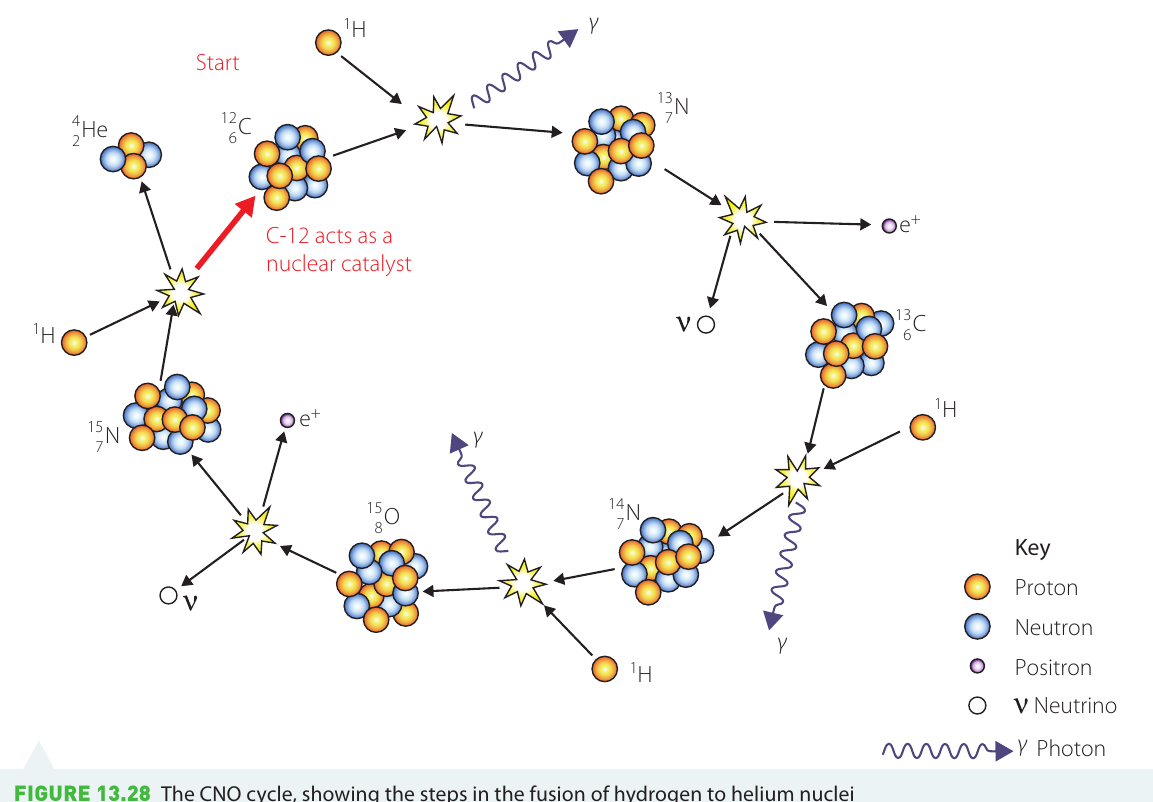
The net equation for the CNO cycle is:
Notice that this is nearly identical to the proton-proton chain equation, except the CNO cycle produces three gamma rays instead of two.
Note
Comparing the two pathways
Both the proton-proton chain and the CNO cycle achieve the same overall result: converting four hydrogen nuclei into one helium nucleus while releasing energy. The key differences are:
- Temperature requirement: The PP chain dominates at lower temperatures (up to 18 MK), while the CNO cycle requires higher temperatures
- Catalyst requirement: The CNO cycle requires carbon-12, while the PP chain does not
- Energy release: The CNO cycle releases slightly more energy as gamma radiation (three photons vs two)
- Stellar mass: Smaller stars rely mainly on the PP chain, while more massive stars use the CNO cycle more extensively
The energy released in both pathways comes from the mass defect - the difference between the mass of four protons and the mass of one helium nucleus plus the other particles produced.
Post-Main Sequence stars
Once a Main Sequence star has consumed most of its hydrogen fuel, its evolution depends critically on its mass. The core begins to collapse, while a shell of helium nuclei (accumulated during hydrogen fusion) surrounds it.
The helium flash and red giants
In stars with sufficient mass, gravitational compression creates the extreme conditions needed for helium fusion. This process begins dramatically in what is called the helium flash, marking the star's transformation into a red giant. During this phase, helium nuclei fuse to form heavier elements such as carbon and oxygen.
Fusion of heavier elements
Very massive stars can continue fusing elements progressively heavier than helium:
- Helium fuses to form carbon and oxygen
- Carbon fuses to form neon and magnesium
- Neon, oxygen, and silicon undergo further fusion
- The process continues all the way to iron
All these fusion reactions are exothermic, releasing energy that provides outward radiation pressure. This pressure counteracts the star's gravitational force, preventing it from collapsing.
The iron limit
Important
The Iron Barrier
Iron occupies a unique position in stellar nucleosynthesis. Fusion reactions that produce elements up to and including iron release energy (exothermic). However, fusing iron into heavier elements requires a net input of energy (endothermic).
This means that once a star's core contains primarily iron, no further fusion can occur to provide energy and support the star. Iron represents the absolute limit of self-sustaining stellar fusion.
Layered structure
In massive Post-Main Sequence stars, different fusion processes occur at different depths. The heaviest elements settle toward the centre due to gravity, creating a layered structure resembling an onion:
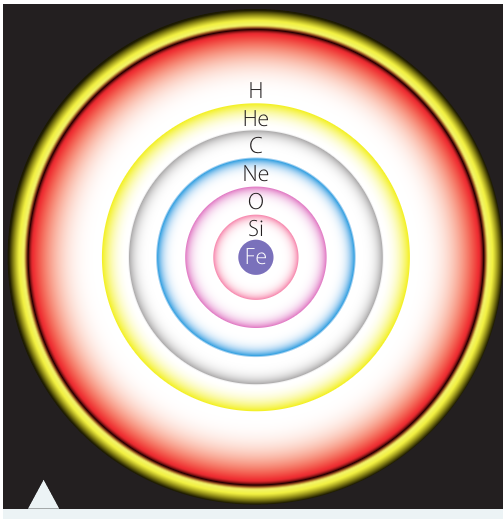
- Core: Iron (Fe)
- Inner layers: Silicon (Si), oxygen (O), neon (Ne)
- Middle layers: Carbon (C)
- Outer layers: Helium (He)
- Surface: Hydrogen (H)
Note
Each layer represents a different fusion process occurring at specific temperatures and pressures. The innermost layers contain the heaviest elements because they have settled there due to gravity, and they require the highest temperatures to fuse.
Supernovas and elements heavier than iron
When a very massive star exhausts its nuclear fuel, the core can no longer resist gravitational collapse. The core suddenly collapses, releasing enormous gravitational potential energy. This energy increases the temperature and pressure dramatically, triggering a supernova - one of the most energetic events in the Universe.
During a supernova:
- The outer layers of the star are blown off at tremendous speeds, scattering elements into space
- The inward collapse of the core is so extreme that protons and electrons combine to form neutrons
- The extreme conditions create elements heavier than iron through rapid neutron capture
- If the core is massive enough, it may collapse further to form a neutron star or black hole
Important
The origin of heavy elements on Earth
The existence of elements heavier than iron on Earth (such as gold, silver, lead, and uranium) proves that one or more supernovas occurred before our solar system formed. These exploding stars scattered their newly-created heavy elements into space, where they eventually became incorporated into the cloud of gas and dust that formed our Sun and planets.
More recently, scientists have discovered that collisions between neutron stars can also produce heavy elements through similar extreme conditions.
Summary
Key Points to Remember:
-
Nucleosynthesis is the process of forming larger atomic nuclei from smaller ones through nuclear fusion in stellar cores
-
Main Sequence stars fuse hydrogen into helium through two main pathways: the proton-proton chain (dominant in smaller, cooler stars like our Sun) and the CNO cycle (dominant in larger, hotter stars)
-
Both fusion pathways convert four hydrogen nuclei into one helium nucleus, releasing energy from the mass defect according to Einstein's equation
-
Post-Main Sequence stars can fuse elements progressively heavier than helium, creating carbon, oxygen, silicon, and ultimately iron in self-sustaining reactions
-
Elements heavier than iron cannot be produced by self-sustaining fusion and instead form during supernovas or neutron star collisions under extreme conditions of temperature and pressure
-
The presence of heavy elements on Earth is direct evidence that our solar system formed from the remnants of previous stellar explosions