Radiation Transforms Into Matter (HSC SSCE Physics): Revision Notes
📚Revision Notes
Radiation transforms into matter
Introduction to the Big Bang Theory
The Big Bang Theory (BBT) is our best scientific explanation for how the Universe began and developed over approximately 13.8 billion years. This theory helps us understand how all the elements in the periodic table were formed, from the lightest hydrogen to the heaviest elements.
The BBT developed through careful collection and analysis of evidence from across the Universe. Since we cannot physically collect samples from distant regions of space, scientists study the characteristic electromagnetic radiation that different elements emit. Each element produces a unique "fingerprint" of radiation across the electromagnetic spectrum, including microwaves, infrared, visible light, ultraviolet, X-rays, and gamma rays.
Note
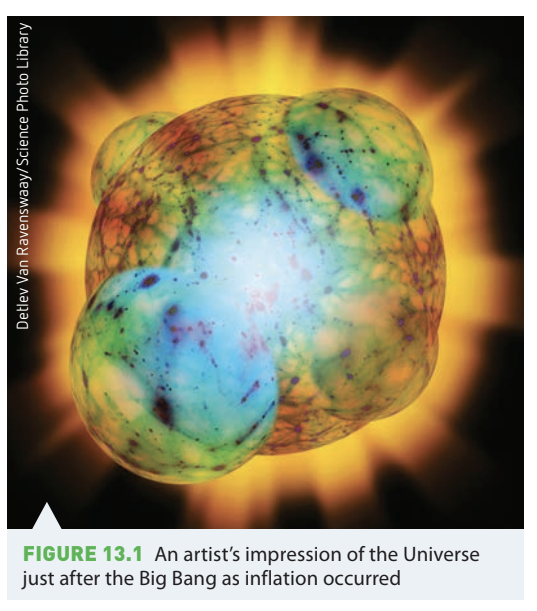
As new evidence emerged, the original theory has been refined several times. The expansion of the Universe is now understood to have occurred in distinct phases rather than uniformly:
- The expansion began with a relatively slow start
- This was followed by a period of rapid cosmic inflation
- Recent evidence suggests the expansion is actually accelerating, not uniform
Energy and matter in the early Universe
According to the BBT, energy is fundamental to understanding the Universe's origin. At the very beginning, energy was all that existed. This energy emerged from an incredibly dense and hot point called a singularity. The temperature at this moment was unimaginably high.
As this energy spread outward, it became distributed across increasingly vast distances. This expansion caused the temperature in any given region to drop significantly compared to the conditions at the singularity.
The transformation of energy into particles
A crucial principle of the BBT is that particles can form from pure energy. At extremely high temperatures, any particles that formed were immediately destroyed again. However, as temperatures decreased, particles became more stable and longer-lasting. This stability allowed them to begin combining with each other.
Over time, conditions became suitable for atoms and molecules to form. All the energy from the original singularity remains in the Universe today - it has simply been redistributed into the matter and radiation we observe. The total amount of energy remains constant, just as it was at the beginning.
Elementary particles
What are elementary particles?
An elementary particle is a particle that cannot be broken down into smaller components. The search for these fundamental building blocks has revealed much about the nature of matter.
Note
The understanding of elementary particles evolved over time:
- Initially, atoms were thought to be indivisible
- The discovery of electrons and radioactivity showed atoms were divisible
- Alpha particle scattering experiments revealed atoms consist mostly of empty space, with a dense positive nucleus surrounded by electrons
- Protons were identified and used to organise the periodic table in 1914
- The neutron was discovered in 1932 to explain mass discrepancies in atomic nuclei
Important
While electrons are truly elementary (indivisible), protons and neutrons can actually be divided into smaller particles. Therefore, electrons are elementary particles, but protons and neutrons are not.
Antiparticles and matter-antimatter annihilation
Every particle has a corresponding antiparticle with opposite properties. During the early Universe, slightly more matter than antimatter formed overall. This small imbalance explains why we observe mainly matter today, rather than antimatter. Scientists still don't fully understand why this imbalance occurred.
When matter and antimatter meet, they undergo annihilation, converting back into pure radiant energy.
Example
Electron-Positron Annihilation
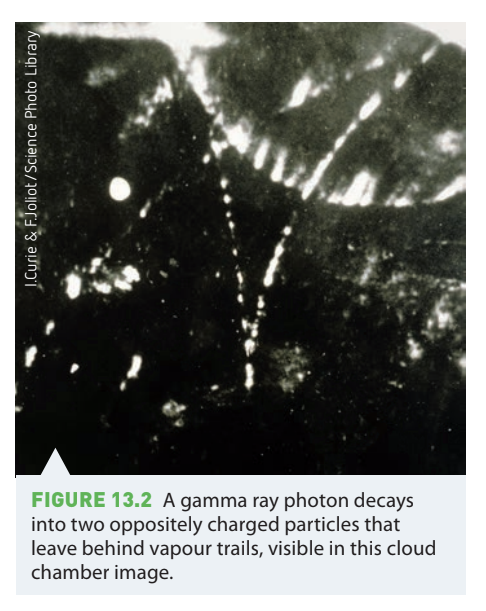
The antiparticle of an electron is called a positron. When these particles meet:
Step 1: An electron and positron collide
- Both particles have equal but opposite charge
- Both have the same mass
Step 2: Complete annihilation occurs
- Both particles are completely destroyed
- Their mass is converted to pure energy
Step 3: Energy is released as radiation
- Two characteristic gamma rays are produced
- These gamma rays travel in opposite directions
- This conserves momentum in the system
Types of elementary particles
Elementary particles fall into two main categories: quarks and leptons.
Quarks
Quarks are tiny elementary particles that combine to form larger particles like protons and neutrons. There are six types of quarks, each with its own antiquark:
| Quark | Symbol | Antiquark | Symbol |
|---|---|---|---|
| up | anti-up | ||
| down | anti-down | ||
| strange | anti-strange | ||
| charm | anti-charm | ||
| bottom | anti-bottom | ||
| top | anti-top |
Leptons
Leptons are elementary particles that include the familiar electron along with five other particles. Leptons interact through gravitational, electromagnetic, and weak forces, but not through the strong force. The six leptons and their antiparticles are:
| Lepton | Antiparticle |
|---|---|
| electron | positron |
| electron neutrino | electron anti-neutrino |
| muon | anti-muon |
| muon neutrino | muon anti-neutrino |
| tau () | anti-tau () |
| tau neutrino | tau anti-neutrino |
Hadrons and field particles
Hadrons
Hadrons are relatively large particles built from elementary particles (quarks). They are divided into two categories based on their size and composition:
Mesons are middle-sized particles composed of one quark and one antiquark. These particles eventually decay into electrons, positrons, neutrinos, and photons.
Baryons are heavier particles made from three quarks. The most familiar baryons are protons and neutrons. All baryons eventually decay into protons, and sometimes into other particles like neutrons.
Note
Quark Composition Examples:
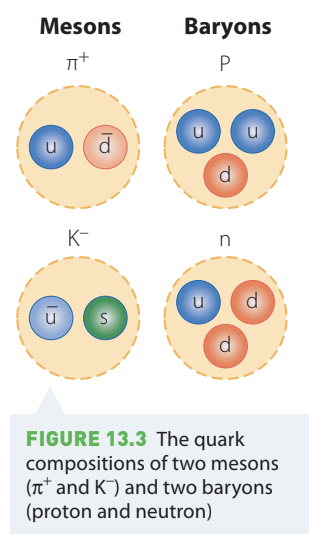
The diagram above shows how quarks combine to form different particles:
- The pion () meson contains an up quark and an anti-down quark
- The kaon () meson contains a down quark and an anti-strange quark
- The proton contains two up quarks and one down quark
- The neutron contains one up quark and two down quarks
Field particles
Field particles are special particles that carry forces between other particles through exchange mechanisms. For example, when charged particles interact electromagnetically, they exchange photons.
The four fundamental forces and their mediating particles are:
- Electromagnetic force - mediated by photons
- Weak force - mediated by W and Z bosons
- Gravitational force - mediated by gravitons (not yet detected experimentally)
- Strong force - mediated by gluons and pions
Timeline of the Big Bang
The first microsecond
According to the BBT, the most dramatic changes occurred incredibly quickly after the Big Bang:
Note
Time: to seconds
Temperature: K down to K
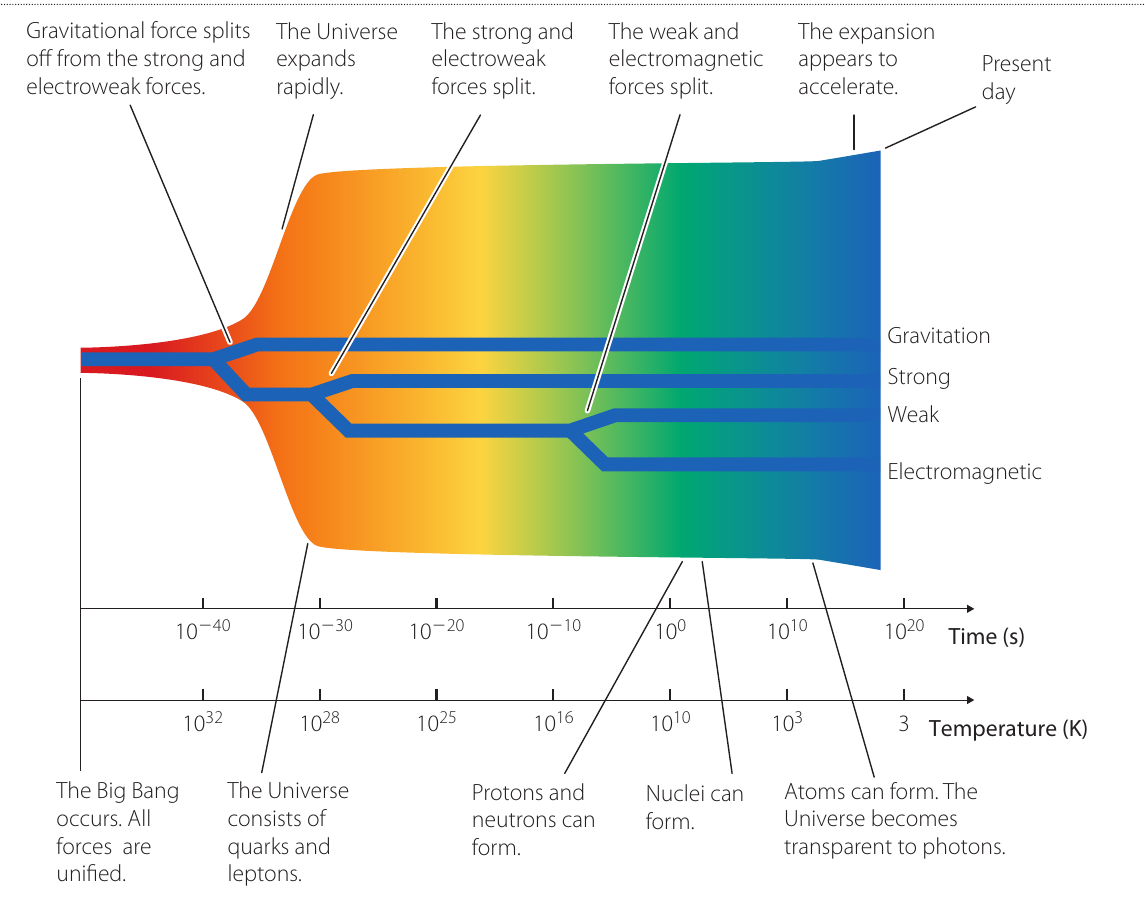
During this first microsecond, all four fundamental forces separated from their initially unified state. Quarks and leptons came into existence as the temperature dropped from K to K.
Formation of hadrons
As temperatures continued to fall, hadrons such as protons and neutrons were able to form from quarks. These particles became stable enough to persist rather than being immediately destroyed.
Note
Time: Within 3 minutes
This rapid stabilization of hadrons was crucial for the development of matter in the Universe.
Nuclear era
During this extended period, atomic nuclei began to form, primarily hydrogen, helium, and some lithium. However, these were charged ions rather than neutral atoms, as conditions were still too energetic for electrons to remain bound to nuclei.
Note
Time: Next 380,000 years
Temperature: Dropping to 3000 K
Throughout this era, collisions between matter and antimatter produced radiation. This radiation was strongly scattered by the charged ions, making the Universe opaque - similar to how water droplets scatter light to create fog.
The Universe becomes transparent
This marked a crucial transition when conditions finally allowed neutral hydrogen atoms to form. Because neutral atoms don't scatter radiation like charged ions do, radiation could now travel freely through space. The Universe became transparent to radiation for the first time.
Important
Time: Around 380,000 years after the Big Bang
Following this transition, neutral matter began to clump together under gravity's influence. Gas clouds formed, and eventually stars and galaxies developed. This moment represents one of the most significant phase transitions in cosmic history.
Evidence for the Big Bang Theory
Cosmic microwave background radiation
The strongest evidence supporting the BBT comes from detecting residual radiation that hasn't formed into matter. This cosmic microwave background radiation (CMBR) has a characteristic wavelength that matches BBT predictions precisely.
Important
The BBT predicted that residual gamma radiation from the Big Bang should be detectable from all directions across the sky. However, due to the enormous expansion of the Universe, these wavelengths would be dramatically stretched. Instead of gamma rays, we should observe microwaves corresponding to a temperature of approximately 3 K.
Discovery and measurement
In 1965, Robert Wilson and Arno Penzias made the first measurement of this predicted radiation, providing crucial evidence for the BBT.
Since then, sophisticated satellite missions have measured the CMBR with extraordinary precision:
- COBE (NASA, 1989-1993)
- WMAP (NASA, 2001-2011)
- Planck (European Space Agency, 2009-2013)
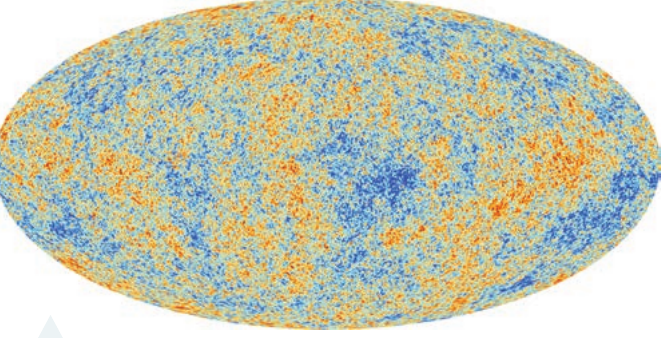
Note
The image above shows a computer-enhanced map of the cosmic microwave background radiation. The remnant radiation from the Big Bang has been stretched by universal expansion and now appears in the microwave region of the electromagnetic spectrum. This observation provides the strongest evidence supporting the Big Bang Theory.
Universe expansion and evolution
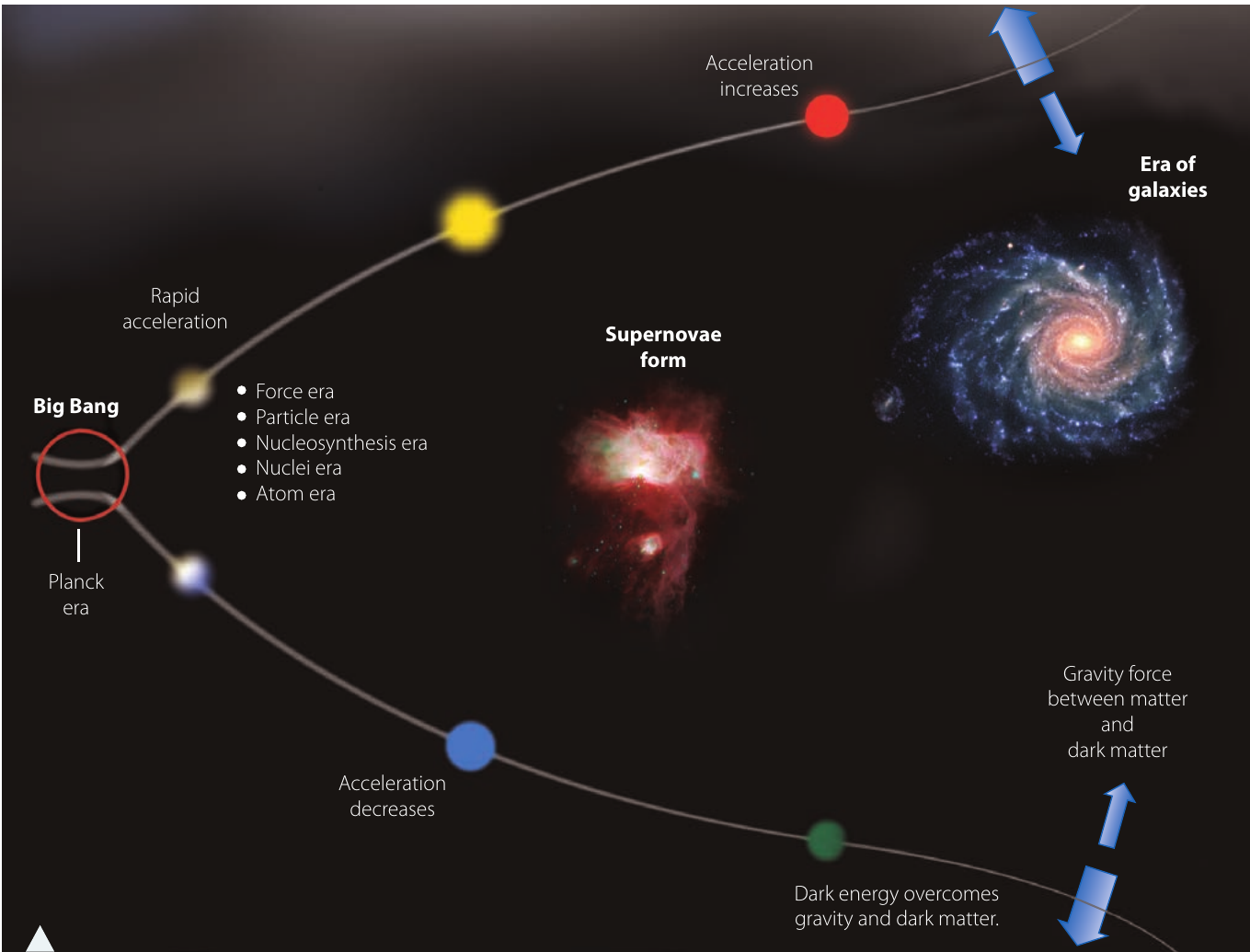
The diagram illustrates how the Universe has expanded from the Big Bang through various eras to the present day. Notice the accelerating expansion in recent cosmic history, discovered through work by researchers including Australian Nobel Laureate Brian Schmidt and colleagues at the Australian National University. This acceleration appears to be driven by dark energy overcoming the gravitational attraction between matter and dark matter.
Summary timeline of cosmic history
| Time since Big Bang | Era | Temperature (K) |
|---|---|---|
| s | Planck | |
| - s | Inflation | |
| s | Force separation | |
| s (1 ms) | Particles | |
| 3-20 min | Nuclear fusion / Nucleosynthesis | |
| Up to 380,000 years | Atoms | Falls to 3000 |
| 380,000 to 200 million years | Dark ages | Falls to 100 |
| 200 million to 380 million years | First stars | Falls below 100 |
| 400 million years to present | Galaxies | Falls to 2.7 |
Major events in each era
Planck era: Space and time were established. Temperatures were incredibly high.
Inflation era: Fundamental particles formed and unformed repeatedly. The strong force became distinct, and cosmic inflation occurred.
Force separation: Fundamental particles lasted long enough to interact. An explosion of photons resulted as matter and antimatter collided. The strong force, weak force, and electromagnetism separated.
Particle era: Fundamental particles stabilised. Protons, neutrons, electrons, and neutrinos became stable enough to persist.
Nuclear fusion era: Fusion processes began and then ceased. The primordial ratios of elements were established. A plasma of hydrogen, helium, and electrons filled the Universe.
Atom era: Photons that had been trapped were freed when atoms formed. The Universe became transparent, though no stars yet existed to produce light - only a faint hydrogen glow.
Dark ages: The Universe was transparent but dark, with cosmic background radiation travelling unimpeded.
First stars: Light from the first stars (50-500 solar masses) began to re-ionise surrounding gas clouds.
Galaxy era: Galaxies appeared and evolved. The Universe developed into its current state.
Summary
Key Points to Remember:
-
Energy transformation: According to the Big Bang Theory, all matter in the Universe formed from pure energy that spread out from a singularity approximately 13.8 billion years ago.
-
Elementary particles: Quarks and leptons are the fundamental building blocks of matter. Quarks combine to form larger particles like protons and neutrons, while leptons (including electrons) interact through gravity, electromagnetic, and weak forces.
-
Timeline of formation: The Universe progressed through distinct eras:
- Within the first microsecond: quarks and leptons formed
- Within 3 minutes: protons and neutrons appeared
- After 380,000 years: neutral atoms formed and the Universe became transparent
-
Cosmic microwave background radiation: The strongest evidence for the Big Bang Theory is the CMBR, discovered in 1965 and measured precisely by satellite missions. This radiation corresponds to a temperature of approximately 2.7-3 K and comes from all directions in space.
-
Matter-antimatter: Each particle has an antiparticle. When they meet, they annihilate and convert back to pure energy. Slightly more matter than antimatter formed in the early Universe, which is why we observe mainly matter today.