Properties of the Nucleus (HSC SSCE Physics): Revision Notes
📚Revision Notes
Energy from the Nucleus
Nuclear reactions release extraordinary amounts of energy compared to chemical reactions. The energy released in fission and fusion is typically 1-10 billion times greater than even the most explosive chemical reactions. Understanding how this energy is produced and controlled is fundamental to nuclear physics.
What are fission and fusion?
Nuclear processes can release energy in two main ways:
Nuclear fission occurs when a heavy nucleus breaks apart into smaller fragments. During this process, neutrons are released along with substantial amounts of energy that was previously stored as binding energy within the nucleus.
Nuclear fusion is the opposite process, where smaller nuclei combine to form a larger nucleus with a greater atomic number. The resulting nucleus is typically more stable than the original nuclei.
Note
The reason nuclear reactions release so much more energy than chemical reactions is that nuclear binding forces are much stronger than electromagnetic forces between atoms. While chemical reactions rearrange electrons, nuclear reactions involve changes to the nucleus itself, where far greater energies are involved.
Binding energy
Nuclear binding energy is the amount of energy required to completely separate all the nucleons (protons and neutrons) in a nucleus. This energy holds the nucleus together against the repulsive electromagnetic forces between protons.
Understanding binding energy per nucleon
The binding energy per nucleon is calculated by dividing the total binding energy by the number of nucleons in the nucleus. This value tells us how stable a nucleus is.
Nuclei with higher binding energy per nucleon are more difficult to split apart, making them more stable. The strong nuclear force acts most effectively between nearby nucleons, which explains why binding energy varies across different elements.
For example, helium-4 has a total binding energy of MeV and contains four nucleons:
The most stable nucleus
Important
Iron-56 is the most stable of all nuclides, with the highest binding energy per nucleon at 8.79 MeV per nucleon. This is why Iron-56 appears at the peak of the binding energy curve.
This special position of Iron-56 determines whether fusion or fission will release energy for any given nucleus.
The table below shows binding energies for various isotopes:
| Element | Binding Energy (MeV) | Binding Energy per Nucleon (MeV) |
|---|---|---|
| Deuterium (Hydrogen-2) | 2.23 | 1.12 |
| Helium-4 | 28.29 | 7.07 |
| Lithium-7 | 40.15 | 5.74 |
| Beryllium-9 | 58.13 | 6.46 |
| Iron-56 | 492.24 | 8.79 |
| Silver-107 | 915.23 | 8.55 |
| Iodine-127 | 1072.53 | 8.45 |
| Lead-206 | 1622.27 | 7.88 |
| Polonium-210 | 1645.16 | 7.83 |
| Uranium-235 | 1783.80 | 7.59 |
| Uranium-238 | 1801.63 | 7.57 |
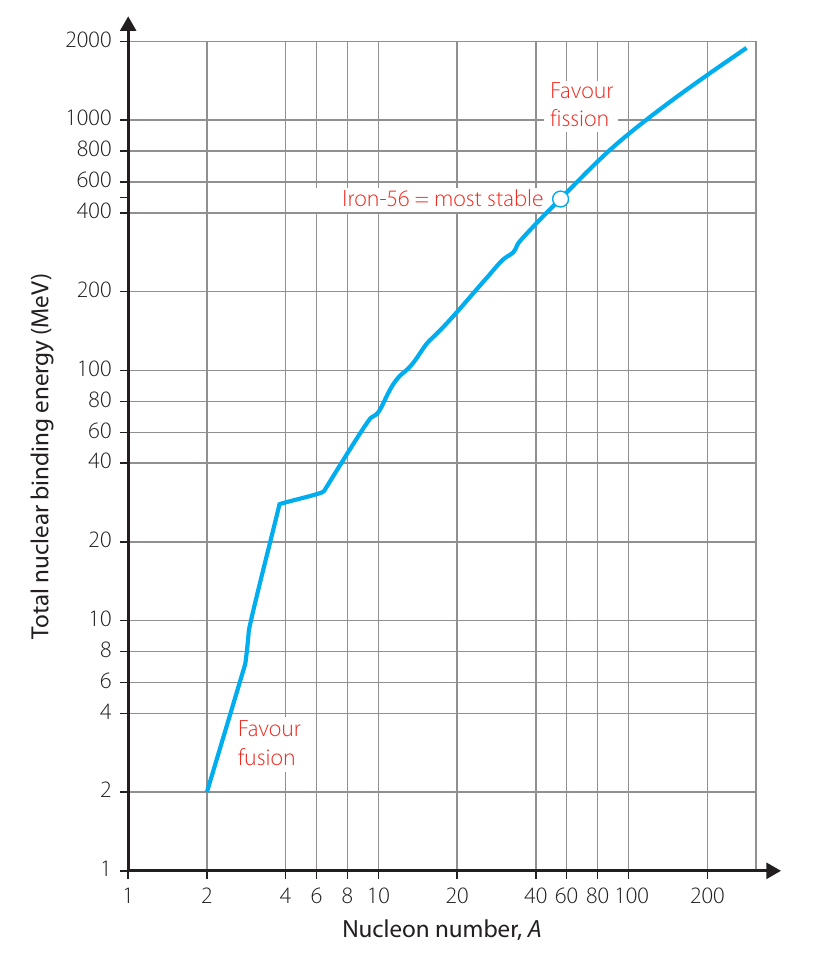
The graph above shows how total nuclear binding energy varies with nucleon number on a logarithmic scale. Notice that:
- Light nuclei (left side of Iron-56) have lower binding energy per nucleon and favour fusion
- Heavy nuclei (right side of Iron-56) have decreasing binding energy per nucleon and favour fission
Note
Fusion is more likely to occur for nuclides with atomic number , as the resulting composite nucleus will be more stable with greater binding energy per nucleon. This explains why fusion powers the Sun, where hydrogen nuclei combine to form heavier elements, releasing tremendous energy in the process.
Nuclear fission
Nuclear fission is the process by which a heavy nucleus (with ) splits into two fragments. The fragments produced are rarely the same size, so it's incorrect to say the atom "splits in half." During fission, neutrons are released and the binding energy stored in the nucleus is converted to kinetic energy and radiation.
How fission occurs
Fission is triggered when a nucleus absorbs a thermal neutron (a slow-moving neutron with about 5-10 keV of energy). When the neutron is absorbed, it forms an unstable nucleus that then splits apart.
A typical example is the fission of uranium-235:
In this reaction:
- One thermal neutron is absorbed by U-235
- The nucleus splits into krypton-92 and barium-141
- Three neutrons are released
- Approximately 200 MeV of energy is released
Note
The fission fragments are not always the same. Uranium-235 can split in many different ways, producing various combinations of lighter elements. However, the total number of nucleons (236) is always conserved, and the energy released is always around 200 MeV per fission.
Historical context
The discovery of nuclear fission involved many scientists. Irène Joliot-Curie (daughter of Marie and Pierre Curie) first identified the products of nuclear fission. The process was suggested by Hungarian chemist Ida Noddack to Otto Hahn. Lise Meitner developed a theoretical model to explain fission, which was written up by her nephew Otto Frisch, who coined the term "fission." Despite Meitner's crucial contributions, only Hahn and Fritz Strassmann received the Nobel Prize in 1944 for this work.
Enrico Fermi achieved the first controlled nuclear fission on 2 December 1942, when the first self-sustaining nuclear reactor began operation at the University of Chicago.
Fission chain reactions
When U-235 absorbs a thermal neutron, the resulting fission produces two or three new neutrons. If these neutrons go on to trigger additional fission events, a chain reaction occurs.
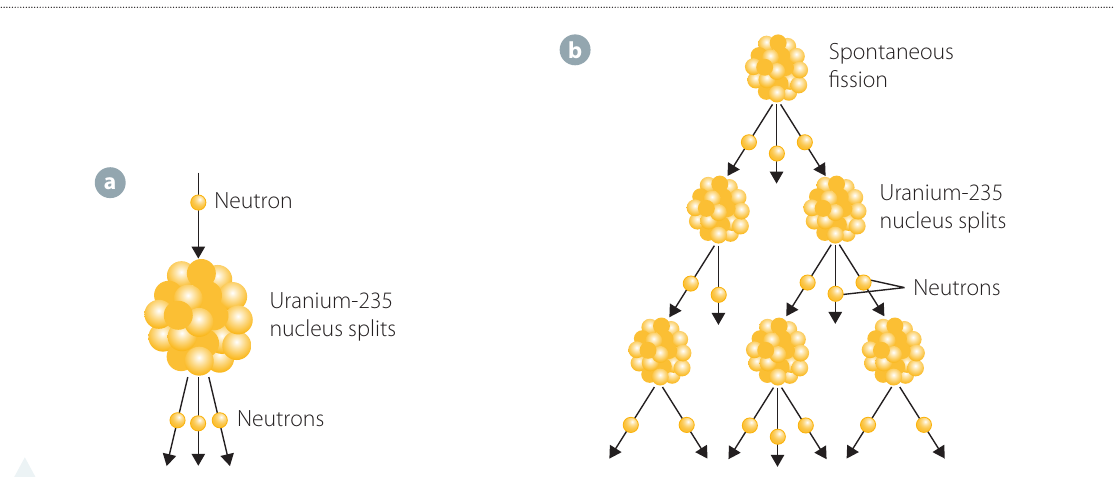
In the diagram above:
- Panel (a) shows a single fission event where one neutron causes U-235 to split, releasing three fast neutrons
- Panel (b) illustrates how this can develop into a chain reaction, with each fission producing neutrons that cause further fissions
Important
This process multiplies rapidly. If uncontrolled, it leads to a runaway explosion as the number of fission events grows exponentially. This is the principle behind nuclear weapons.
However, the neutrons released from fission are fast neutrons and don't easily cause further fission in U-235. In nature, this process rarely amounts to anything substantial because:
- Fast neutrons are more likely to be absorbed by U-238 than cause fission in U-235
- Other materials may absorb the neutrons without causing fission (these are called neutron poisons)
- Some neutrons escape from the sample entirely
Controlled fission chain reaction
For nuclear power generation, the chain reaction must be carefully controlled. In a controlled reaction, on average, exactly one neutron from each fission event goes on to cause another fission. This maintains a steady rate of energy production.
If more than one neutron per fission causes further fission, the reaction accelerates (runaway reaction). If fewer than one neutron causes fission, the reaction dies away.
Requirements for sustained controlled fission
Establishing and maintaining a controlled chain reaction is technically challenging. Natural uranium ore contains only 0.65% uranium-235, with 99.3% uranium-238 and a negligible amount () of uranium-234. U-238 acts almost exclusively as a neutron poison, absorbing neutrons without producing fission.
Four key requirements enable controlled fission:
1. Enrichment
The proportion of U-235 in the fuel must be increased through enrichment. This complex and expensive process separates U-235 from natural uranium ore and adds it back to increase the concentration.
- For controlled reactions (nuclear power): 1-4% enrichment is sufficient
- For uncontrolled reactions (nuclear weapons): enrichment may reach 97% U-235
Note
The enrichment process is technically difficult because U-235 and U-238 are chemically identical—they only differ in mass. Separation must be done using physical methods like gas centrifugation, which exploits the tiny mass difference between the isotopes.
2. Moderator
Fast neutrons produced by fission must be slowed down to become thermal neutrons that can trigger further fission in U-235. A moderator achieves this by providing light nuclei for the neutrons to collide with.
Common moderators include:
- Hydrogen ()
- Deuterium ()
- Tritium ()
- Graphite (carbon)
- Water
Through multiple collisions with these light nuclei, neutrons rapidly lose energy. This increases the probability that they will be absorbed by U-235 nuclei and cause fission.
3. Reactor vessel
The reactor vessel must be designed to minimize neutron loss. Fission occurs only when a neutron collides head-on with a nucleus, so neutrons that escape from the fuel are lost. The vessel is designed with the right surface area-to-volume ratio and made of high atomic number material to reflect escaping neutrons back into the fuel.
4. Control rods
To maintain exactly one fission-producing neutron per fission event, control rods containing neutron-absorbing materials are used. These rods can be moved in and out of the reactor core:
- When the reaction threatens to accelerate, control rods are inserted to absorb excess neutrons
- When the reaction starts producing too few neutrons, control rods are withdrawn
- Common control rod materials include boron-10 and cadmium
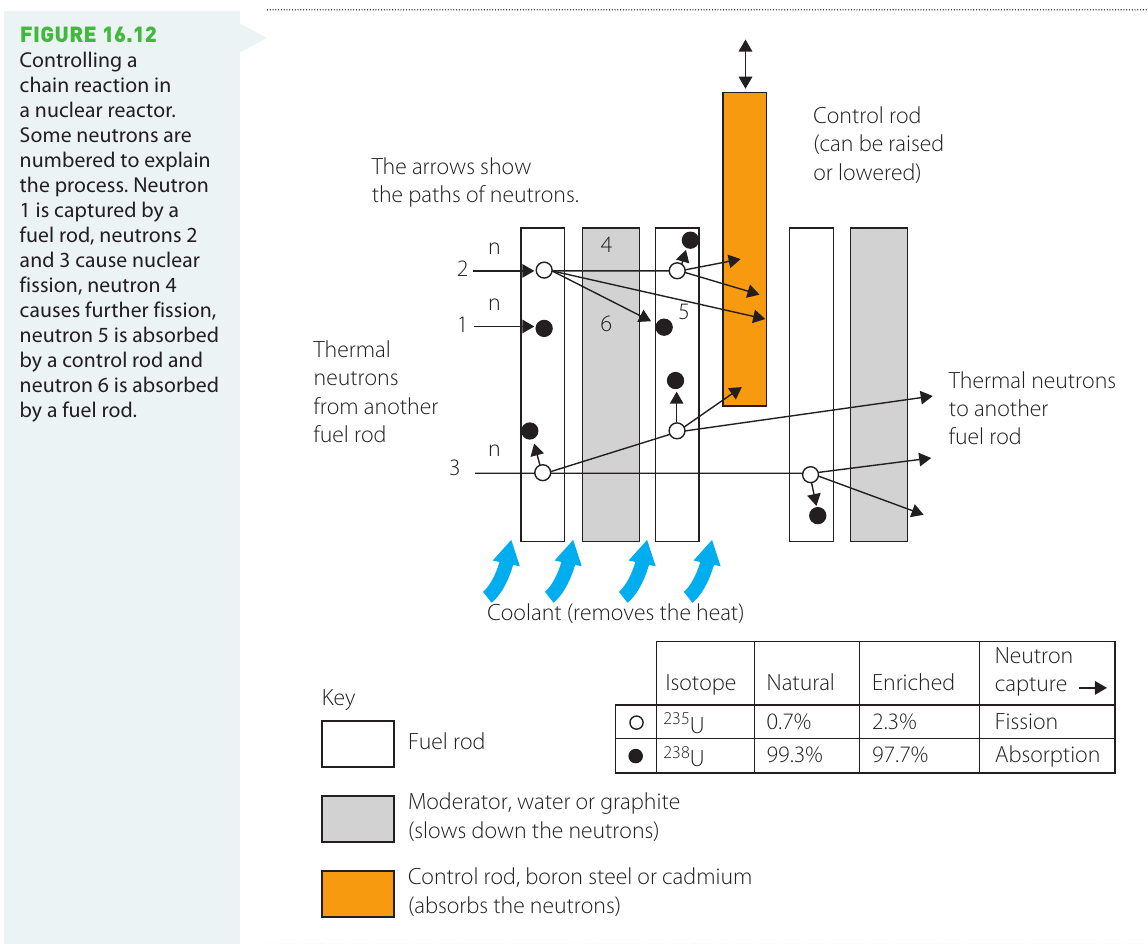
The diagram above shows the main components of a nuclear reactor:
- Fuel rods: Contain enriched uranium ( U-235)
- Moderator: Water or graphite that slows down neutrons
- Control rods: Boron steel or cadmium that can be raised or lowered to absorb neutrons
- Coolant: Removes heat generated by the chain reaction (shown by blue arrows at the base)
The numbered neutron paths show:
- Neutron 1 is captured by a fuel rod
- Neutrons 2 and 3 cause nuclear fission
- Neutron 4 causes further fission
- Neutron 5 is absorbed by a control rod
- Neutron 6 is absorbed by a fuel rod
The table in the diagram shows the isotope composition:
| Isotope | Natural | Enriched | Neutron capture |
|---|---|---|---|
| 0.7% | 2.3% | Fission | |
| 99.3% | 97.7% | Absorption |
Mass defect and energy release
In nuclear fission, the total mass after the reaction is less than the total mass before. This mass difference, called the mass defect, is converted into energy according to Einstein's famous equation.
Understanding mass defect
When uranium-235 undergoes fission, there are 236 nucleons before and after the reaction (one neutron plus 235 nucleons in U-235 equals 236 total). However, the actual mass of the products is less than the mass of the reactants.
For calculations involving nuclear reactions, we use unified atomic mass units (u) rather than kilograms:
Note
One unified atomic mass unit is defined as of the mass of a neutral carbon-12 atom. This is approximately equal to the mass of one nucleon, making it convenient for nuclear calculations.
Calculating energy release
Let's examine the fission reaction:
The masses of particles involved are:
| Particle | ||||
|---|---|---|---|---|
| Mass (in u) | 1.009 | 235.044 | 91.926 | 140.914 |
Example
Calculating Energy Released from Mass Defect
Step 1: Calculate initial mass
Step 2: Calculate final mass
Step 3: Find mass defect
Step 4: Convert to kilograms
Step 5: Calculate energy released using Einstein's equation
While J seems tiny, consider that 250 g of pure uranium contains more than atoms. If all underwent fission:
Important
This demonstrates the enormous energy potential of nuclear fission. For comparison, 2.78 terajoules is roughly equivalent to the energy released by exploding 665 tonnes of TNT, or enough to power a typical home for about 20 years—all from just 250 grams of uranium!
Worked example: fission energy calculation
Example
Worked Example: Calculating Fission Products and Energy
Problem: A thermal neutron (mass 1.01 u) causes fission of uranium-235 (235.04 u). The fission fragments are rubidium-93 (92.92 u) and caesium-141 (140.92 u).
a) How many fast neutrons are released? b) Write the nuclear fission equation c) Calculate the mass defect in (i) unified mass units and (ii) kilograms d) How much energy is released in joules?
Solution:
a) Number of neutrons released
Nucleon number must be conserved in nuclear reactions.
Total nucleons before fission:
Total nucleons after fission:
Solving for :
Two neutrons are released.
b) Nuclear equation
c) Mass defect
(i) In unified mass units:
Initial mass:
Final mass:
Mass defect:
(ii) In kilograms:
d) Energy released
Using Einstein's mass-energy equation:
Remember!
Summary
Key Points to Remember:
-
Binding energy is the energy required to hold a nucleus together. Iron-56 has the highest binding energy per nucleon and is the most stable nucleus.
-
Nuclear fission occurs when a heavy nucleus () splits into two smaller fragments after absorbing a thermal neutron. Each fission releases 2-3 neutrons and approximately 200 MeV of energy.
-
A chain reaction happens when neutrons from one fission event trigger additional fissions. Without control, this leads to exponential growth and explosive energy release.
-
Controlled fission requires four key components: enrichment ( U-235), moderator (to slow neutrons), reactor vessel (to contain neutrons), and control rods (to absorb excess neutrons).
-
The mass defect is the difference between the total mass before and after fission. This "missing" mass is converted to energy using Einstein's equation: , where .