Nuclear Fission (HSC SSCE Physics): Revision Notes
📚Revision Notes
Nuclear Fission
Nuclear fission is a nuclear process where heavy atomic nuclei split into lighter fragments, releasing energy in the process. While the provided material primarily focuses on nuclear fusion, it contains important comparative information about fission that helps us understand this process.
Understanding fission through binding energy
The binding energy curve (Figure 16.13) shows how nuclear stability varies across different elements. This curve is crucial for understanding why fission occurs in heavy elements.
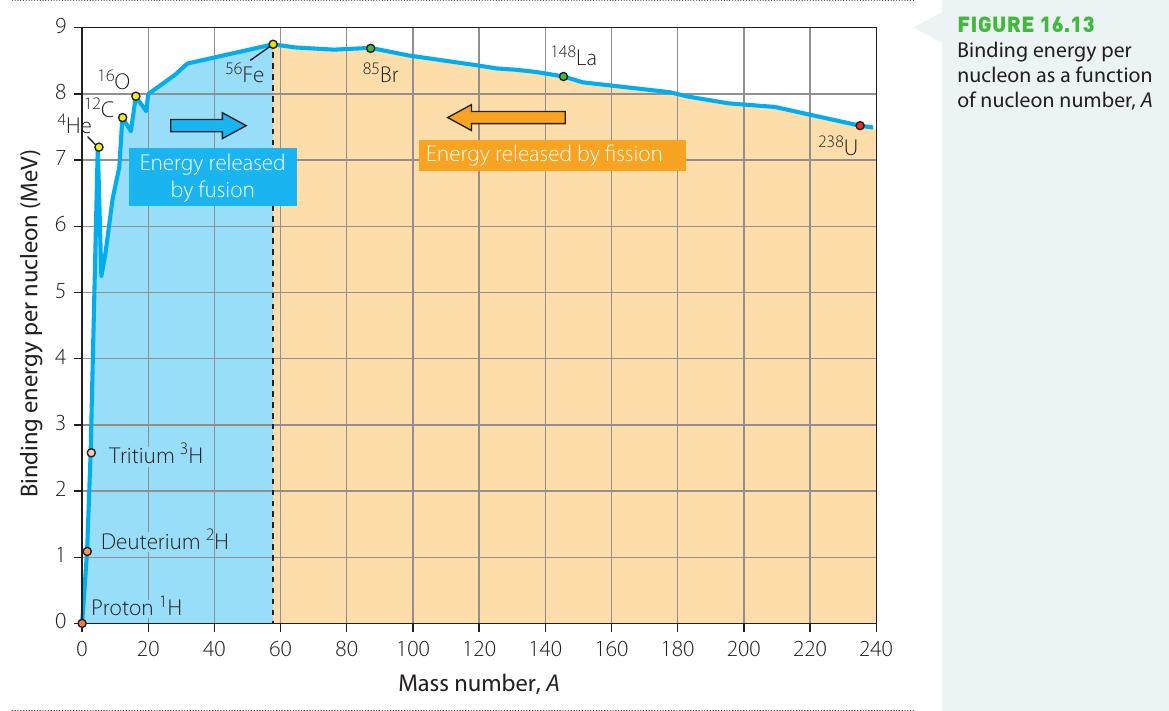
For heavy elements at the right end of the binding energy curve, nuclear fission is the favoured process. The graph shows that uranium and other heavy elements have lower binding energy per nucleon compared to medium-mass elements, making them less stable.
Note
The binding energy curve is fundamental to understanding nuclear processes. Elements to the right of iron-56 (heavy elements) can release energy through fission, while elements to the left (light elements) release energy through fusion. This is why uranium naturally undergoes fission rather than fusion.
Energy release in fission
When uranium-235 undergoes fission, there is a measurable increase in binding energy per nucleon:
- Uranium-235: approximately 7.6 MeV per nucleon
- Common fission fragments: approximately 8.6 MeV per nucleon
- Energy difference: approximately 2.0 MeV per nucleon
This means that fission releases about 26% of the original binding energy per nucleon. When you account for both fission fragments produced, this represents a significant energy release per fission event.
Important
The released energy comes from the mass defect - the difference between the mass of the original uranium nucleus and the total mass of the fission products. This mass difference is converted to energy according to Einstein's famous equation:
where:
- is the energy released (in joules)
- is the mass defect (in kilograms)
- is the speed of light ( m/s)
This mass-energy equivalence is the fundamental principle behind all nuclear energy release.
Comparing fission and fusion
While both fission and fusion release energy, they differ significantly in their energy yield:
Nuclear fission (heavy elements):
- Occurs in elements heavier than iron-56
- Releases approximately 26% of the original binding energy per nucleon
- Splits heavy nuclei into lighter fragments
Nuclear fusion (light elements):
- Occurs in elements lighter than iron-56
- Releases approximately 62% of the original binding energy per nucleon
- Combines light nuclei into heavier ones
Note
This comparison shows that fusion reactions release a greater proportion of the available mass-energy than fission reactions. However, both processes are important sources of energy, with fission being more easily controllable for current power generation technology.
Key concepts to remember
When studying nuclear fission, ensure you understand:
- What nuclear fission is and how it occurs: The process where heavy nuclei split into lighter fragments
- Why fission occurs for uranium: Heavy elements like uranium have lower binding energy per nucleon than their potential fission fragments
- What fission fragments are: The lighter nuclei produced when a heavy nucleus undergoes fission
- Mass defect in fission: The difference in mass between reactants and products, which is converted to energy
- Why fission is useful despite low energy per event: Chain reactions allow many fission events to occur, multiplying the energy output
- Binding energy per nucleon: A measure of nuclear stability - higher values indicate more stable nuclei
Summary
Key Points to Remember:
- Nuclear fission splits heavy atomic nuclei into lighter fragments, releasing energy
- Fission occurs in elements heavier than iron-56, where the binding energy curve shows lower stability
- The energy released in fission (about 26% of original binding energy per nucleon) comes from the mass defect through
- While individual fission events release relatively small amounts of energy, chain reactions make nuclear fission practical for power generation
- Binding energy per nucleon increases when uranium-235 undergoes fission, from approximately 7.6 MeV to 8.6 MeV, explaining why energy is released