Properties of Alpha, Beta, and Gamma Radiation (HSC SSCE Physics): Revision Notes
📚Revision Notes
Properties of Alpha, Beta, and Gamma Radiation
Alpha, beta and gamma radiation interact with matter in different ways based on their physical properties. Understanding these interactions is essential for radiation safety and applications in medicine, industry and research.
Ionising power
Ionisation occurs when atoms gain or lose electrons. When an atom loses electrons, it becomes a positive ion. When an atom gains electrons, it becomes a negative ion.
Alpha particles (α)
Alpha particles are positively charged (+2) and relatively slow-moving. As they travel through matter, they strongly attract electrons from nearby atoms. This interaction causes the atoms to lose electrons and become ionised.
Each time an alpha particle ionises an atom, it transfers energy and slows down. Because alpha particles ionise so frequently, they lose their energy quickly and cannot travel far through matter. Alpha particles have the strongest ionising ability of the three radiation types.
Beta particles (β⁻ and β⁺)
Beta-minus (β⁻) particles are high-speed electrons with a negative charge. As they move through matter, they are repelled by electrons in atoms. This causes the beta particles to bounce between atoms in a zigzag path. During these collisions, some electrons may be knocked out of atoms, causing ionisation. However, these collisions transfer less energy than alpha particle interactions.
Beta-plus (β⁺) particles, also called positrons, are positively charged. They interact with electrons in atoms as they pass through matter. These interactions cause ionisation, but again transfer less energy than alpha particle interactions.
Beta particles have moderate ionising ability - stronger than gamma rays but weaker than alpha particles.
Gamma rays (γ)
Gamma rays are high-energy photons with no charge. The ionising effect of a gamma ray depends on its energy level.
High-energy gamma rays can ionise atoms by colliding with them and transferring energy to their electrons. If an electron gains enough energy, it can escape from the atom, leaving behind a positive ion. The freed electron may later attach to another atom to form a negative ion.
Low-energy gamma rays are more likely to heat a material than cause ionisation.
Overall, gamma rays have the weakest ionising ability of the three radiation types.
Note
Neutrinos and antineutrinos are weakly interacting particles that do not ionise atoms at all. These particles can pass through vast amounts of matter with virtually no interaction.
Relationship between ionising and penetrating power
Important
Inverse Relationship:
The ionising power is inversely proportional to the penetrating power. This makes physical sense: as radiation ionises atoms, it transfers energy and slows down.
Radiation that ionises strongly (like alpha particles) loses energy quickly and therefore cannot penetrate far. Radiation that ionises weakly (like gamma rays) retains its energy and can penetrate much further through matter.
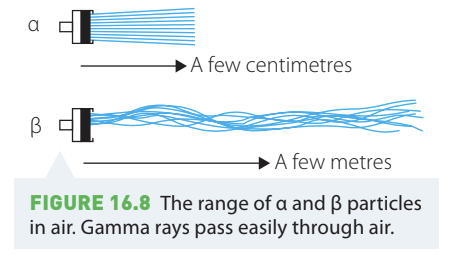
The range of alpha particles in air is much less than that of either beta particles or gamma rays.
Penetrating power
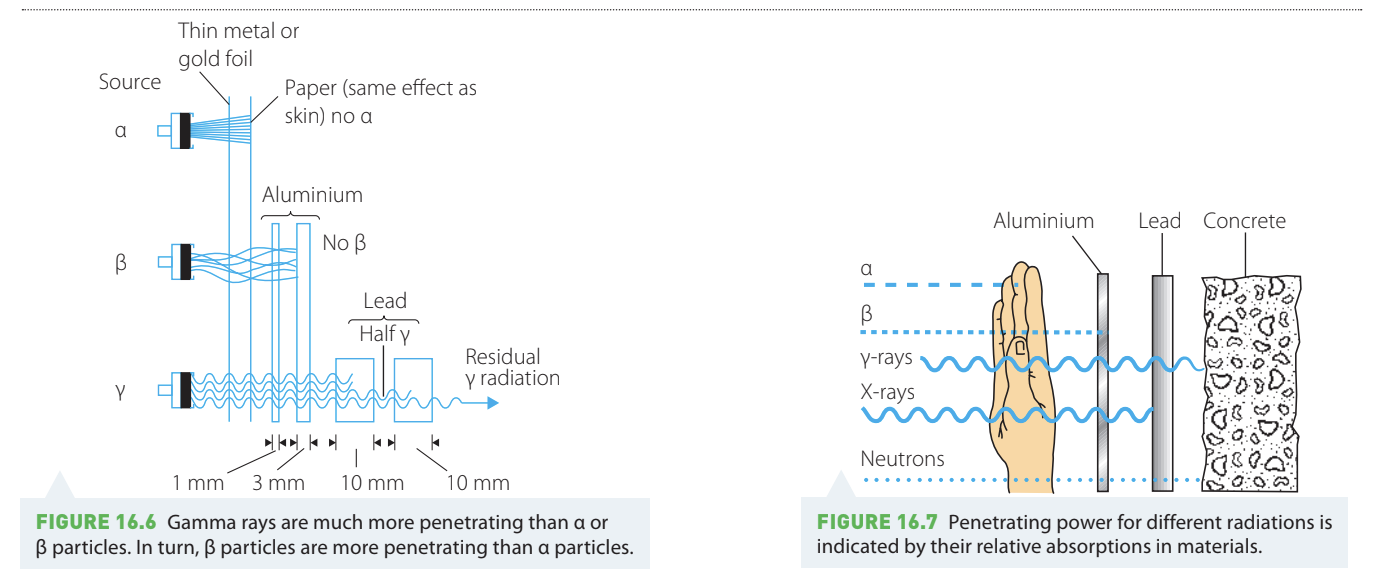
Penetrating power describes how far radiation can travel through different materials before being absorbed.
Alpha particles
Alpha particles are the most easily absorbed and therefore the least penetrating radiation. They can be stopped by:
- A thin sheet of paper
- The outer layer of human skin
- A few centimetres of air
Beta particles
Beta particles have moderate penetrating ability. They can be stopped by:
- A few millimetres of aluminium
- Several metres of air
Gamma rays
Gamma rays are the most penetrating radiation. They can:
- Travel through up to 30 cm of steel
- Travel hundreds of metres through air
- Require substantial lead shielding (a 1 cm thick sheet of lead reduces gamma ray intensity to about half)
Note
Memory Aid:
- Alpha is Absorbed - strong ionising, weak penetrating, stopped by paper
- Beta is Between - medium properties
- Gamma Goes - weak ionising, strong penetrating, passes through most materials
Neutrons
Although not one of the three main types of nuclear radiation, neutrons are worth mentioning. They are highly penetrating in air and most materials. However, they interact strongly with materials containing hydrogen atoms. Water and concrete are therefore good neutron absorbers and are used as shielding at nuclear reactors. For example, the core of the Open Pool Australian Lightwater reactor (OPAL) at Lucas Heights in Sydney is contained in a large pool of water.
Range in air
The range of radiation in air depends on how quickly it becomes neutralised or absorbed.
Alpha particles
Air contains many ions and charged particles. Because alpha particles have a strong positive charge (+2), they readily pick up electrons and other charged particles from the air, quickly becoming neutral. For this reason, alpha particles only travel a few centimetres in air before stopping.
Beta particles
The range of beta particles is more difficult to determine precisely because individual beta particles can have widely different energies when emitted. However, beta particles can typically travel a few metres in air before stopping.
Gamma rays
Gamma radiation is so energetic that it can penetrate hundreds of metres through air. Fortunately for life on Earth, most gamma radiation from space is absorbed by the atmosphere before reaching the surface.
Note
Comparing Ranges in Air:
- Alpha particles: ~few centimetres
- Beta particles: ~few metres
- Gamma rays: ~hundreds of metres
Notice the dramatic differences - gamma rays can travel roughly 100,000 times further than alpha particles in air!
Investigation: The penetrating power of radiation
Aim
To observe the penetrating power of alpha, beta and gamma radiation.
Students should write their own inquiry question for this investigation based on the aim.
Materials
- Approved samples of alpha, beta and gamma emitters
- Sheets of paper, cardboard, aluminium and lead
- Gloves
- Ruler
- Stopwatch
- Geiger-Muller tube and counter
Risk assessment
Important
Critical Safety Requirements:
Radioactive samples must only be handled by the teacher. Australian guidelines for the use of radioactive samples in schools must be strictly followed.
Before the investigation:
- Samples should be checked for damage before use
- Ensure all safety equipment is available
During the investigation:
- Maintain a safe distance from samples
- Wear gloves when handling samples
- Use samples quickly and efficiently
After the investigation:
- Store samples in lead-wrapped metal boxes away from the laboratory
- Wash hands thoroughly after the investigation
Method
- Place the Geiger-Muller tube 1 cm from each radioactive sample in turn. Record the radiation count over a 15 second interval for each sample.
- Repeat step 1 with a sheet of paper placed over the face of the Geiger-Muller tube.
- Repeat step 2 separately with cardboard, aluminium and lead sheets.
- Record results in a suitable table.
- For each radioactive sample, record the radiation counts over 15 seconds at distances of 1 cm, 2 cm, 3 cm, 4 cm, 5 cm and 10 cm from the source.
Results
Display the results from step 5 in a graph showing radiation count versus distance.
Discussion
- Relate the results to the nature of the three types of radiation tested.
- Provide an answer to the inquiry question.
Conclusion
Write a conclusion based on the aim, referring to the data obtained and its analysis.
Effects of electric and magnetic fields on radiation
Charged particles can be deflected by electric and magnetic fields. This property allows us to distinguish between different types of radiation. Gamma rays, having no charge or mass, are not affected by these fields.
Behaviour in electric fields
When charged particles enter an electric field, they experience a force that curves their path.
Alpha particles (α) and beta-plus particles (β⁺) are positively charged. They will be deflected towards the negative plate (in the direction of the electric field).
Beta-minus particles (β⁻) are negatively charged. They will be deflected towards the positive plate (opposite to the electric field direction).
Note
Understanding Deflection Magnitude:
The magnitude of deflection depends on both the force and the mass of the particle. Although an alpha particle experiences twice the force of a beta particle (because it has twice the charge), its path curves much less.
This is because the alpha particle has a mass about 7000 times greater than a beta particle. The greater mass means smaller acceleration and therefore less curvature.
Gamma rays have no charge and therefore pass through electric fields without any deflection.
Behaviour in magnetic fields
A magnetic field applies a force to any moving charged particle, causing it to follow a curved path.
The magnitude of the force depends on:
- The speed of the particle
- The magnitude of the charge
The direction of the force depends on:
- The sign of the charge
- The direction of motion relative to the magnetic field
Beta-plus (β⁺) and beta-minus (β⁻) particles moving at the same speed experience forces of equal magnitude but in opposite directions. Therefore, they curve in opposite directions.
An alpha particle (α) at the same speed as a beta particle curves in the same direction as a β⁺ particle (both are positive). However, the force on the alpha particle is twice as large (because it has twice the charge: +2 compared to +1).
Despite experiencing twice the force, an alpha particle is deflected much less than a beta particle because its mass is approximately 7000 times greater. The larger mass results in smaller acceleration and therefore less curvature of the path.
Gamma rays have no charge and are therefore not deflected by magnetic fields.
Note
Practical Application:
This behaviour allows scientists to identify unknown radiation by observing how it responds to electric and magnetic fields. By analyzing the direction and magnitude of deflection, researchers can determine the type, charge, and even the energy of the radiation.
Summary of properties
| Property | α particles | β particles | γ-rays |
|---|---|---|---|
| Composition | A helium nucleus (2 protons and 2 neutrons) | A fast-moving electron or positron | High-frequency electromagnetic radiation (a high-energy photon) |
| Charge | elementary charges | (electron) or (positron) elementary charge | Uncharged |
| Mass | atomic mass units ( kg) | u ( kg) | No mass |
| Ionising effect | Strong | Weak | Very weak |
| Penetrating power | Few centimetres in air | Few metres in air | Very weakly absorbed in air (most radiation absorbed by a few centimetres of lead) |
| Effect of electric and magnetic fields | Small deflection | Large deflection | No deflection |
| Typical emission velocity | of speed of light | of speed of light | Speed of light ( m s) |
Remember!
Summary
Key Points to Remember:
Inverse Relationship:
- Ionising power and penetrating power are inversely related. Strong ionisers (alpha) are weak penetrators. Weak ionisers (gamma) are strong penetrators.
Alpha Particles:
- Stopped by paper or skin
- Travel only a few centimetres in air
- Strongest ionising effect
Beta Particles:
- Stopped by a few millimetres of aluminium
- Travel a few metres in air
- Moderate ionising effect
Gamma Rays:
- Require several centimetres of lead to absorb significantly
- Travel hundreds of metres in air
- Weakest ionising effect
Field Effects:
- Charged particles (alpha and beta) are deflected by electric and magnetic fields
- Direction depends on the charge sign
- Magnitude of deflection depends on both charge and mass
- Gamma rays are not deflected because they have no charge
Safety:
- When conducting investigations with radioactive sources, always follow proper safety procedures including using approved samples, maintaining distance, wearing gloves, and thorough hand washing.