Spontaneous Decay of Unstable Nuclei (HSC SSCE Physics): Revision Notes
📚Revision Notes
Spontaneous Decay of Unstable Nuclei
What is spontaneous decay?
Spontaneous decay is a random, uncontrollable process where unstable atomic nuclei emit radiation to become more stable. This process was first discovered by Henri Becquerel in 1896 and opened up our understanding of the atom's internal structure. Since then, radioactivity has been used in many beneficial applications, including medical imaging and cancer treatment, as well as nuclear power generation.
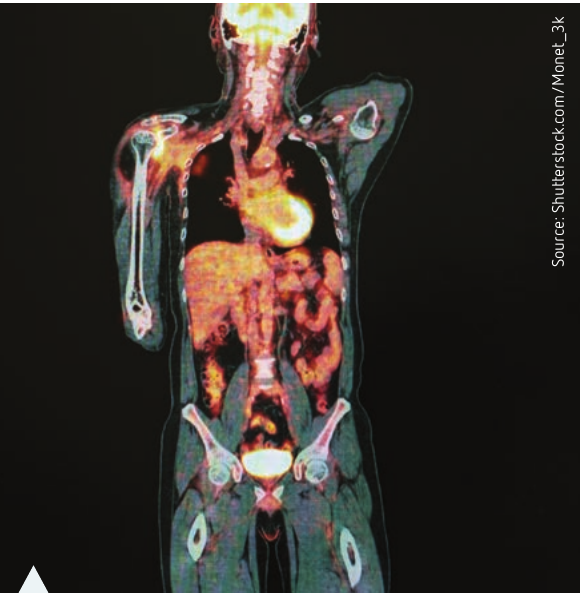
When nuclei decay, they can emit three main types of radiation:
- Alpha particles () - helium nuclei
- Beta particles () - electrons or positrons
- Gamma rays () - electromagnetic radiation
Important
Radioactive decay involves changes to the nucleus itself, not the electrons surrounding it. This makes nuclear reactions fundamentally different from chemical reactions. Nuclear processes release far more energy than chemical reactions.
Nuclear stability
Forces in the nucleus
All atomic nuclei except hydrogen-1 contain both protons and neutrons. Since protons are positively charged, they repel each other through the electrostatic force. So what holds the nucleus together?
The strong nuclear force is the answer. This force acts between all nucleons (protons and neutrons) and is much stronger than the electrostatic force, but it only works over very short distances - about the size of a nucleus. When the strong nuclear force is strong enough to overcome the electrostatic repulsion between protons, the nucleus is stable. When it isn't, the nucleus is unstable and will decay by emitting radiation.
Note
Neutrons play a crucial role in nuclear stability. They reduce the effect of electrostatic repulsion between protons by:
- Adding to the strong nuclear force without adding electrostatic repulsion (neutrons are uncharged)
- Increasing the distance between protons
The stability curve
Not all combinations of protons and neutrons create stable nuclei. The relationship between stability and nuclear composition is shown in the stability curve or line of stability.
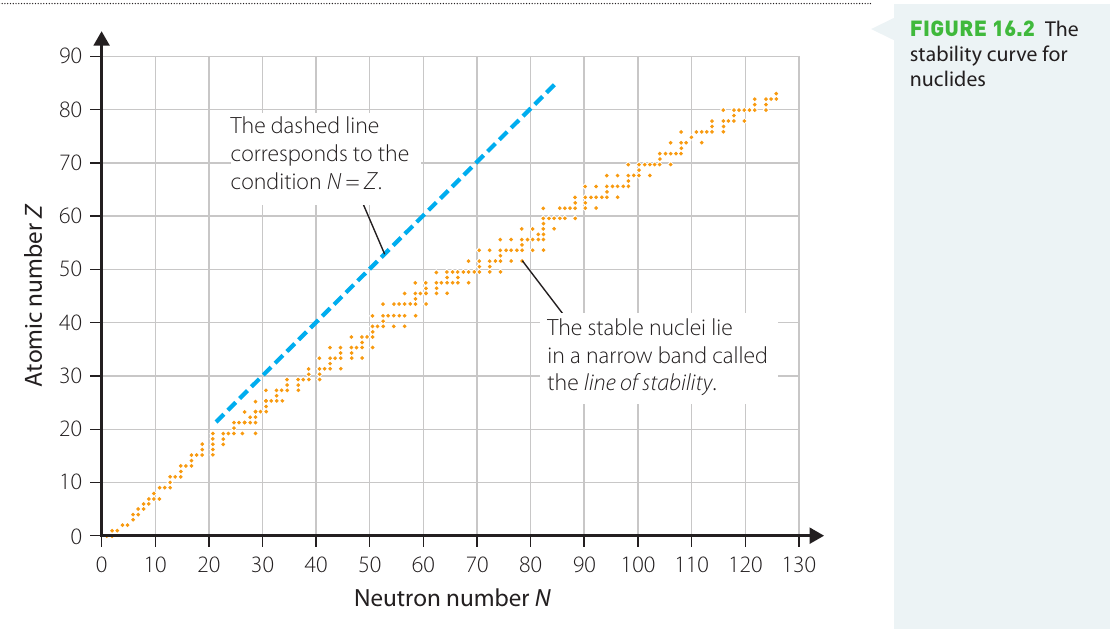
Key observations from the stability curve:
- Light nuclei (up to about 40 nucleons) are most stable when they have roughly equal numbers of protons and neutrons (following the line)
- Heavier nuclei require more neutrons than protons to remain stable
- Unstable nuclei below the line of stability typically undergo decay
- Unstable nuclei above the line typically undergo decay or alpha decay
Nuclear notation and features
Understanding nucleon symbols
To describe nuclei precisely, we use standardised notation that shows both the number of protons and the total number of nucleons.
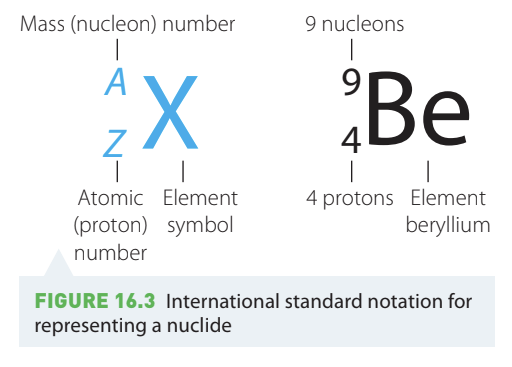
| Symbol | Name | Description |
|---|---|---|
| Mass number (nucleon number) | Total number of protons and neutrons in the nucleus | |
| Atomic number (proton number) | Number of protons in the nucleus | |
| Neutron number | Number of neutrons in the nucleus |
These quantities are related by the equation:
The standard notation for a nuclide is:
where X is the element symbol. For example, beryllium-9 is written as , showing 9 total nucleons (mass number) and 4 protons (atomic number).
Nuclides, elements and isotopes
Understanding the difference between these terms is important:
- A nuclide is a specific type of nucleus with a defined number of protons and neutrons. It is classified by its energy state as well.
- An element is a substance containing only atoms with the same number of protons. The number of protons determines the element's chemical identity.
- Isotopes are nuclides of the same element (same number of protons) but with different numbers of neutrons.
Note
For example, carbon-12 () and carbon-14 () are isotopes of carbon. Both have 6 protons but different numbers of neutrons (6 and 8 respectively).
Nuclear binding energy
Mass defect
When you measure the mass of a nucleus, you find something surprising - it's less than the sum of the masses of its individual protons and neutrons. This difference is called the mass defect ().
The mass defect exists because when nucleons bind together to form a nucleus, some of their mass is converted into binding energy. This is the energy that holds the nucleus together - the nuclear binding energy.
Mass-energy equivalence
Einstein's famous equation relates mass and energy:
where:
- is the binding energy
- is the mass defect
- is the speed of light ()
Note
This equation shows that mass and energy are interchangeable - they are different forms of the same thing. In this sense:
The binding energy is the energy that would be needed to completely disassemble a nucleus into its separate protons and neutrons. It also represents the energy released when a nucleus is formed from individual nucleons.
Types of radioactive decay
When an unstable nucleus decays, it emits particles or electromagnetic radiation to reach a more stable state. The original nucleus is called the parent nuclide, and the resulting nucleus is the daughter nuclide.
Conservation laws in nuclear reactions
Important
In all nuclear decay processes, two important quantities are conserved:
- The total number of nucleons (mass number must balance)
- The net charge (atomic numbers must balance)
These conservation laws allow us to predict the products of nuclear decay. Remember: "Top numbers add up, bottom numbers add up" - mass numbers must balance, and atomic numbers must balance.
Alpha decay ()
An alpha particle is a helium-4 nucleus containing 2 protons and 2 neutrons. When written in nuclear equations, it's shown as or simply .
The general equation for alpha decay is:
What happens during alpha decay:
- The mass number decreases by 4
- The atomic number decreases by 2
- The daughter nuclide is a different element, two places back in the periodic table
Example
Worked Example: Alpha Decay
Uranium-238 undergoes alpha decay:
Check the balance:
- Mass numbers: ✓
- Atomic numbers: ✓
Most of the energy released in alpha decay is carried away by the alpha particle.
Beta-minus decay ()
Beta-minus decay involves the emission of an electron from the nucleus. This might seem strange since electrons orbit the nucleus but aren't normally inside it. What actually happens is that a neutron converts into a proton, an electron, and an antineutrino ().
The neutron conversion can be written as:
or equivalently:
The electron is immediately ejected from the nucleus at very high speed (about two-thirds the speed of light) as a beta particle.
The general equation for beta-minus decay is:
What happens during beta-minus decay:
- The mass number remains unchanged
- The atomic number increases by 1
- The daughter nuclide is a different element, one place forward in the periodic table
Example
Worked Example: Beta-Minus Decay
Thorium-234 undergoes beta-minus decay:
Check the balance:
- Mass numbers: ✓
- Atomic numbers: ✓
Several beta-emitting isotopes are used in medicine, such as iridium-192 for prostate cancer treatment and iodine-131 for thyroid cancer.
Beta-plus decay (positron emission, )
Positron emission is similar to beta-minus decay, but a positron is emitted instead of an electron. A positron is the antimatter counterpart of an electron - it has the same mass but opposite charge.
In beta-plus decay, a proton converts into a neutron, a positron, and a neutrino ():
or equivalently:
The general equation for beta-plus decay is:
What happens during beta-plus decay:
- The mass number remains unchanged
- The atomic number decreases by 1
- The daughter nuclide is a different element, one place back in the periodic table
Example
Worked Example: Beta-Plus Decay
Thallium-195 undergoes beta-plus decay:
Check the balance:
- Mass numbers: ✓
- Atomic numbers: ✓
Note
Positron emitters are used in PET (Positron Emission Tomography) scans. When a positron meets an electron, they annihilate each other and produce gamma rays that can be detected to create medical images.
Gamma emission ()
Sometimes after alpha or beta decay, the daughter nucleus is left in an excited energy state. This is shown with an asterisk (*) after the symbol. The excited nucleus releases this extra energy by emitting a gamma ray - a high-energy photon of electromagnetic radiation.
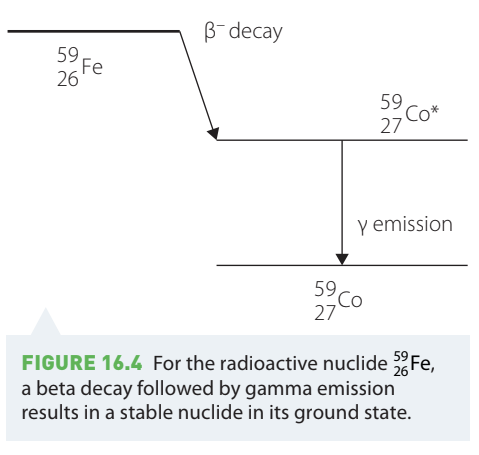
The general equation for gamma emission is:
What happens during gamma emission:
- The mass number remains unchanged
- The atomic number remains unchanged
- The nucleus transitions to a lower energy state
- No new element is formed
Example
Worked Example: Gamma Emission
Iron-59 undergoes beta decay to produce excited cobalt-59, which then emits a gamma ray:
Gamma rays have no mass and no charge, but they carry energy away from the nucleus.
Worked examples
Understanding nuclear decay equations requires practice in applying conservation laws and using correct notation.
Example
Worked Example 1: Alpha Decay
Neptunium-237 decays by emitting an alpha particle. What is the daughter nuclide?
Solution:
Write the general form:
Apply conservation of mass number:
Apply conservation of atomic number:
So the daughter nuclide is (protactinium-233).
Complete equation:
Example
Worked Example 2: Beta-Minus Decay
Carbon-14 undergoes beta-minus decay. What is the daughter nuclide?
Solution:
Write the general form:
Apply conservation of mass number:
Apply conservation of atomic number:
So the daughter nuclide is (nitrogen-14).
Complete equation:
Example
Worked Example 3: Positron Emission
Sodium-20 undergoes positron emission. What is the daughter nuclide?
Solution:
Write the general form:
Apply conservation of mass number:
Apply conservation of atomic number:
So the daughter nuclide is (neon-20).
Complete equation:
Example
Worked Example 4: Gamma Emission
Cerium-139 in an excited state emits a gamma ray. What is the daughter nuclide?
Solution:
Write the general form:
Apply conservation of mass number:
Apply conservation of atomic number:
So the daughter nuclide is (cerium-139 in ground state).
Complete equation:
Key points for examinations
Important
When solving nuclear decay problems:
- Always write the equation in standard form with mass numbers (top) and atomic numbers (bottom)
- Use conservation laws: top numbers must balance, bottom numbers must balance
- Remember that electrons and positrons have zero mass number but charge -1 and +1 respectively
- Gamma rays have zero mass number and zero charge
- Use the periodic table to identify elements from their atomic number
- Check your final answer by ensuring both sides balance
Remember!
Summary
Key Points to Remember:
-
Spontaneous decay is random and uncontrollable - it involves changes to the nucleus itself, releasing far more energy than chemical reactions.
-
Nuclear stability depends on the balance between the strong nuclear force and electrostatic repulsion - neutrons help stabilise nuclei by adding to the strong force without adding repulsion.
-
In alpha decay, the nucleus loses 4 nucleons and 2 protons - the daughter element moves two places back in the periodic table ().
-
In beta-minus decay, atomic number increases by 1 but mass number stays the same - a neutron converts to a proton, electron, and antineutrino ().
-
In beta-plus decay, atomic number decreases by 1 but mass number stays the same - a proton converts to a neutron, positron, and neutrino ().
-
Conservation laws are essential - in every nuclear reaction, the total number of nucleons and the net charge must be conserved.