Bohr’s Atomic Model (HSC SSCE Physics): Revision Notes
📚Revision Notes
Bohr's Atomic Model
Introduction
In the early 20th century, scientists were working to understand the structure of atoms. While Rutherford's nuclear model showed that atoms had a tiny, dense, positively charged nucleus surrounded by electrons, this model had serious problems.
Important
According to classical physics, electrons orbiting the nucleus should constantly emit radiation and spiral into the nucleus - but atoms are stable, so this clearly doesn't happen! This was a fundamental problem that Rutherford's model couldn't solve.
In 1913, Danish physicist Niels Bohr developed a revolutionary new atomic model that solved these problems. Bohr built upon Rutherford's work but incorporated a crucial new idea: quantised energy. He used Planck's quantum theory, which proposed that electromagnetic radiation comes in discrete packets of energy called quanta (now known as photons).
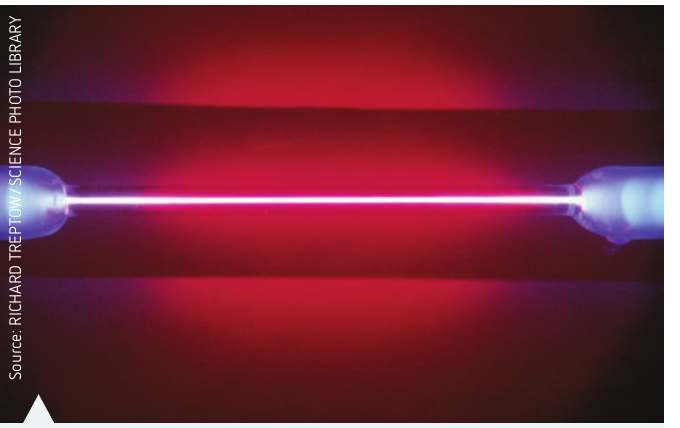
Bohr's model was specifically designed to explain the hydrogen emission spectrum - the characteristic pattern of coloured lines that appears when hydrogen gas is energised in a discharge tube.
Bohr's postulates
Bohr's atomic model is based on four fundamental principles, called postulates. These postulates describe how electrons behave in atoms and why atoms are stable.
Postulate 1: Circular orbits
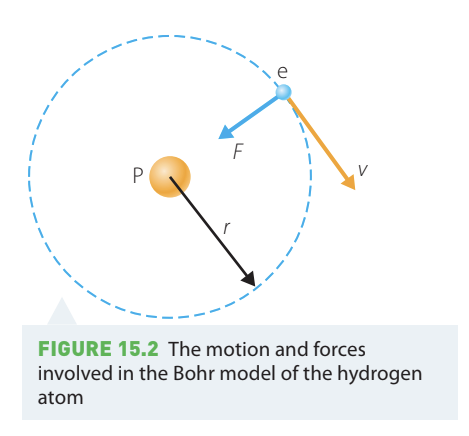
In Bohr's model, electrons travel in circular paths around the nucleus. The electron is held in its orbit by the electrostatic attraction between its negative charge and the positive charge of the nucleus.
Note
This is similar to how planets orbit the Sun due to gravitational attraction, which is why Bohr's model is sometimes called the "planetary model". However, unlike planets, electrons in atoms behave according to quantum rules rather than classical mechanics.
Postulate 2: Stable energy shells
This is the most revolutionary postulate. Electrons can only exist in certain specific, stable energy levels around the nucleus. These allowed energy levels are called energy shells.
Crucially, when electrons are in these stable shells, they do not lose energy and do not emit radiation. This solves the problem with Rutherford's model - electrons in stable shells don't spiral into the nucleus!
Important
Understanding Quantisation
This postulate introduces the concept of quantisation to atomic energy. An electron in an atom can only have certain allowed energy values - it cannot have an "in-between" energy.
Think of it like a staircase: you can stand on step 1 or step 2, but you cannot stand between the steps. Similarly, an electron can exist at energy level 1 or energy level 2, but not at any energy value between them.
Postulate 3: Energy transitions
Electrons can move between energy shells, but only by absorbing or emitting a specific quantum of energy in the form of electromagnetic radiation (a photon).
When an electron absorbs energy, it jumps up to a higher energy level with a larger orbital radius. When an electron falls down from a higher energy level to a lower one with a smaller radius, it emits energy as a photon.
The energy of the emitted or absorbed photon is given by:
where:
- is the energy in joules (J)
- is Planck's constant ( J s)
- is the frequency of the radiation in hertz (Hz)
When an electron transitions between two specific energy levels, the energy change is:
where is the initial energy level and is the final energy level.
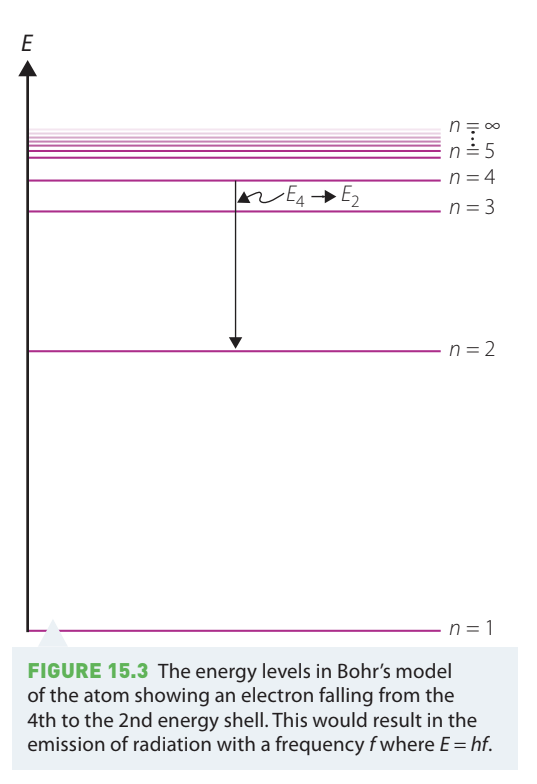
This diagram shows an electron falling from the fourth energy shell () to the second energy shell (). The energy difference () is released as a photon with frequency .
Note
Exam tip: Remember that energy is conserved. The energy lost by the electron exactly equals the energy of the emitted photon.
Postulate 4: Quantised angular momentum
The angular momentum of an electron in orbit around the nucleus can only have certain discrete values. Angular momentum () is a measure of rotational motion, given by , where is the electron's mass, is its velocity, and is the orbital radius.
Bohr proposed that angular momentum is quantised according to:
This can be rearranged to give the orbital radius:
where is the principal quantum number.
The principal quantum number determines which energy shell the electron occupies:
- The innermost shell closest to the nucleus has
- The next shell has
- The next shell has
- And so on...
Note
This postulate is called an empirical formula because Bohr derived it from observations of the hydrogen emission spectrum, rather than from fundamental physical principles. This means it was based on experimental data rather than theoretical derivation.
Important
Key point: The principal quantum number determines both the energy and the size of the electron's orbit. Higher values of mean higher energy and larger orbital radius.
Limitations of the Bohr model
Bohr's model was remarkably successful in some ways, but it also had significant limitations that showed it was not the complete picture.
Successes of the Bohr model
Bohr's model successfully:
- Explained both qualitatively (why) and quantitatively (exact numbers) the positions of spectral lines in the hydrogen emission spectrum
- Predicted the size of the hydrogen atom, which agreed closely with experimental measurements
- Introduced the crucial concept of quantised energy levels in atoms
What the Bohr model couldn't explain
Despite its successes with hydrogen, the Bohr model failed in several important ways:
Important
Major Limitations:
-
Multi-electron atoms: The model could not predict the spectra of atoms with more than one electron, even helium with just two electrons.
-
Line intensities: The model couldn't explain why some spectral lines are brighter than others.
-
Fine and hyperfine structure: Some spectral lines actually consist of multiple very closely spaced lines. Bohr's model couldn't explain this splitting.
-
The Zeeman effect: The model couldn't explain how spectral lines split when atoms are placed in a magnetic field (see next section).
-
Lack of explanatory power: While Bohr's model introduced quantised energy levels, it didn't explain why energy levels should be quantised. A successful scientific model should have both predictive power (making accurate predictions) and explanatory power (explaining why things happen). Bohr's model had limited predictive power and lacked explanatory power.
Note
Exam insight: Understanding the limitations of a scientific model is just as important as understanding what it explains. This shows how science progresses by building on and improving previous models.
The Zeeman effect
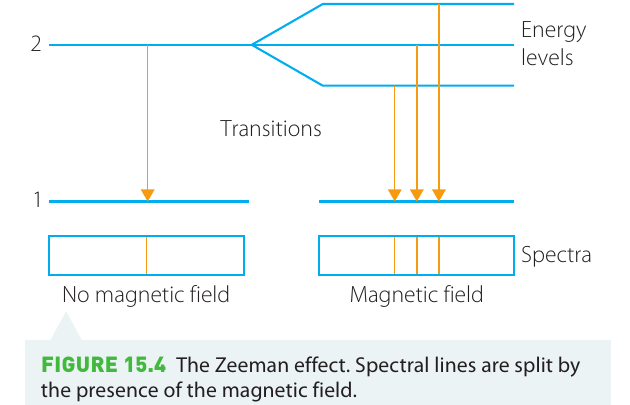
In 1896, Dutch physicist Pieter Zeeman made an important discovery while investigating how magnetic fields affect spectral lines. He observed that when atoms are placed in a strong magnetic field, individual spectral lines split into multiple closely spaced lines.
Note
Historical Note
Interestingly, Zeeman was supposed to be working on a different project and had been explicitly told by his supervisor not to use the laboratory equipment for his own research. When his supervisor discovered what he was doing, Zeeman was fired! However, his discovery was so important that he and Hendrik Lorentz were awarded the 1902 Nobel Prize in Physics for explaining it.
Zeeman and Lorentz showed that the line splitting occurs because electrons have two types of magnetic properties:
- An intrinsic magnetic field due to the electron's spin
- A magnetic field due to the electron's orbital motion
These magnetic properties interact with an applied external magnetic field, causing the energy levels to split slightly. This results in the spectral lines splitting into multiple components.
Important
Why is this important? The Zeeman effect demonstrated another limitation of Bohr's original model, which couldn't predict or explain this phenomenon. This showed that a more sophisticated quantum mechanical model was needed.
Remember!
Summary
Key Points to Remember:
-
Bohr's model (1913) built on Rutherford's nuclear model by incorporating quantum theory to explain the hydrogen emission spectrum.
-
The four postulates describe: (1) circular electron orbits, (2) stable energy shells where electrons don't radiate, (3) energy transitions involving photon absorption or emission (), and (4) quantised angular momentum ().
-
The principal quantum number () identifies which energy shell an electron occupies, with higher values meaning higher energy and larger orbital radius.
-
Bohr's model successfully explained the hydrogen spectrum and atomic size, but failed for multi-electron atoms and couldn't predict line intensities, fine structure, or the Zeeman effect.
-
The model's main weakness was that while it introduced quantised energy levels, it didn't explain why energy should be quantised - it lacked explanatory power and had limited predictive power beyond hydrogen.