Structure of the Atom (HSC SSCE Physics): Revision Notes
📚Revision Notes
Chadwick's Discovery of Neutrons
What are nucleons?
Following Rutherford's identification of the atomic nucleus, scientists discovered that the nucleus contains two types of particles called nucleons. These are:
- Protons - positively charged particles
- Neutrons - electrically neutral particles
Properties of nucleons
Both protons and neutrons exist inside the nucleus and have very similar masses, but they differ in their electrical charge.
Key properties:
- Location: Both nucleons are found inside the nucleus
- Mass: Protons have a mass of kg, whilst neutrons have a slightly larger mass of kg
- Charge: Protons carry a positive charge of C, whilst neutrons have zero charge
Note
The masses of protons and neutrons are remarkably similar - they differ by only about 0.1%. This tiny difference is significant because it means neutrons are slightly unstable when isolated and can decay into protons, electrons, and antineutrinos.
Historical understanding of the nucleus
When Rutherford first described the nucleus, it was understood simply as a concentrated region of positive charge. The internal structure and composition of the nucleus remained unknown. Understanding the nucleus required the work of many scientists over several decades.
Discovery of protons
Protons were the first nucleons to be discovered. Scientists measured the charge-to-mass ratio of protons using a discharge tube containing hydrogen ions. When a hydrogen atom loses its single electron, only a proton remains. This allowed the properties of protons to be measured in a similar way to how electrons were discovered.
Note
The method of using hydrogen ions to study protons was ingenious because hydrogen is the simplest atom - it contains only one proton and one electron. By removing the electron, scientists could study the proton in isolation.
Early theories about nuclear composition
After learning about the nucleus and protons, some scientists proposed that the nucleus contained:
- protons (where is the mass number)
- electrons (where is the atomic number)
Example
Worked Example: The Proton-Electron Hypothesis
For sodium atoms with and , this theory suggested the nucleus contained:
- 23 protons (to account for the mass)
- 12 electrons (to reduce the net charge)
The reasoning was:
- Total positive charge: +23 (from 23 protons)
- Total negative charge: -12 (from 12 electrons)
- Net charge: +23 - 12 = +11 (matching the atomic number)
This hypothesis appeared to work well for two reasons:
- It explained mass numbers: The theory accounted for why atoms had a mass number larger than the number of positive charges. In the sodium example, the 12 electrons in the nucleus would cancel the positive charges of 12 protons, leaving a net charge of +11 rather than +23.
- It explained beta decay: Scientists observed that electrons could be ejected from the nucleus during radioactive decay (beta particle emission). At the time, they believed this was only possible if electrons existed inside the nucleus.
Important
This theory was ultimately proven incorrect. Other scientists hypothesised that a different type of particle existed in the nucleus - one with a mass similar to the proton but with no electrical charge. These particles were eventually identified as neutrons. The electrons observed in beta decay are actually created during the decay process, not released from storage within the nucleus.
Bothe's observation (1930)
In 1930, German scientist Walther Bothe made an important observation whilst conducting experiments with alpha particles. He discovered that when beryllium metal was bombarded with alpha particles (which are helium nuclei), it produced a neutral but highly penetrative form of 'radiation'. However, Bothe could not identify the nature of this mysterious 'radiation'.
Chadwick's experiment (1932)
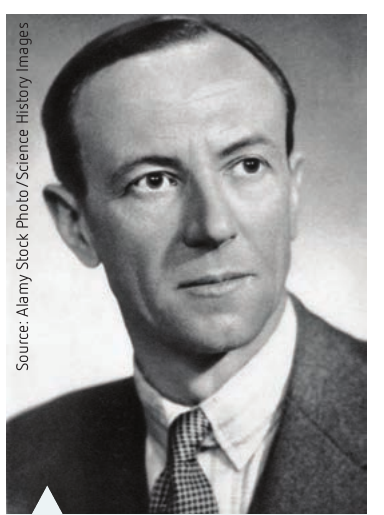
English physicist James Chadwick built upon Bothe's work to solve this mystery. In 1932, Chadwick demonstrated that the unknown 'radiation' from beryllium bombardment was not electromagnetic radiation at all, but rather consisted of particles - specifically, neutrons.
Experimental design
Chadwick's experimental setup consisted of several key components arranged in sequence:
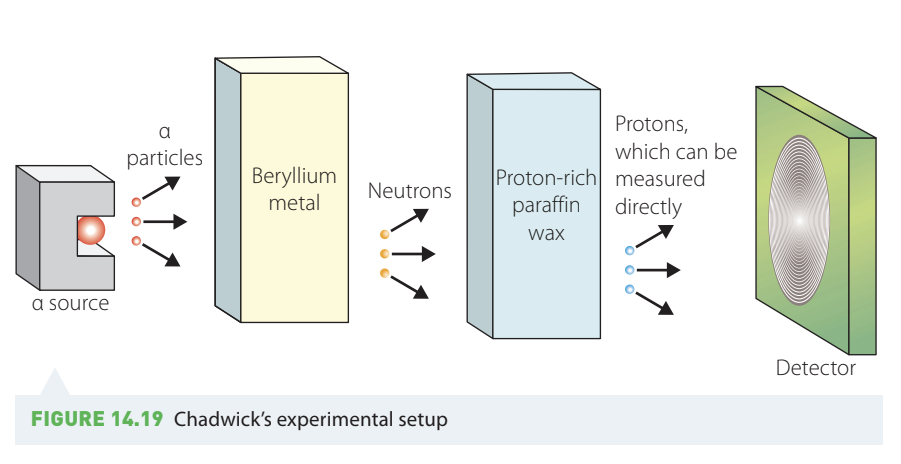
- Alpha particle source: Provided the bombarding particles
- Beryllium metal target: When struck by alpha particles, beryllium emitted neutrons
- Paraffin wax block: Rich in hydrogen atoms and therefore protons
- Detector: Measured the ejected protons
How the experiment worked
The clever design of Chadwick's experiment allowed him to detect neutrons indirectly:
Note
The Four-Step Detection Process
Step 1 - Demonstrating neutral charge: Chadwick first showed that this 'radiation' had no electrical charge because it was not deflected by electric or magnetic fields. This proved it was not the same as other known forms of radiation.
Step 2 - Using paraffin wax: Paraffin wax contains many hydrogen atoms, and therefore many protons. When the proposed neutrons were directed at the paraffin wax, they collided with these protons and knocked them out of the material.
Step 3 - Detecting protons: The ejected protons could be measured by the detector, which determined their energy and velocity. Because protons have an electrical charge, they are much easier to manipulate and detect than neutrons.
Step 4 - Calculating neutron mass: By applying the law of conservation of momentum and the law of conservation of energy, Chadwick worked backwards from the proton measurements to calculate the mass of the neutrons. His calculations showed that neutrons have approximately the same mass as protons.
Why neutrons are difficult to detect
Important
Neutrons are challenging to measure directly because they have no electrical charge. Without charge, they cannot be manipulated by electric or magnetic fields the way charged particles can. This is why Chadwick's indirect method was so ingenious - he converted the difficult-to-measure neutrons into easily measured protons. Since protons have charge, they can be manipulated just like electrons in cathode ray tubes.
The nuclear equation
The reaction that occurs in Chadwick's experiment can be represented by a nuclear equation:
In this equation:
- represents the alpha particle (helium nucleus)
- represents beryllium
- represents carbon (the product nucleus)
- represents the neutron
Example
Worked Example: Balancing Nuclear Equations
In nuclear equations, both the mass number and atomic number must be conserved.
Checking mass numbers (top numbers):
- Left side:
- Right side: ✓
Checking atomic numbers (bottom numbers):
- Left side:
- Right side: ✓
Both values balance, confirming the equation is correctly written.
Significance of the discovery
Chadwick's work was groundbreaking because he proved the existence of neutrons without directly observing them. Instead, he demonstrated their existence by observing their properties and effects on other particles. This indirect detection method was a brilliant solution to the problem of measuring uncharged particles.
Note
Chadwick's discovery of the neutron in 1932 was so significant that he was awarded the Nobel Prize in Physics in 1935. The neutron's existence explained the discrepancy between atomic mass and atomic number, and opened up new understanding of nuclear structure and nuclear reactions.
Modelling Chadwick's experiment
To understand the principle of momentum transfer in Chadwick's experiment, you can create a simple model using everyday objects.
The model
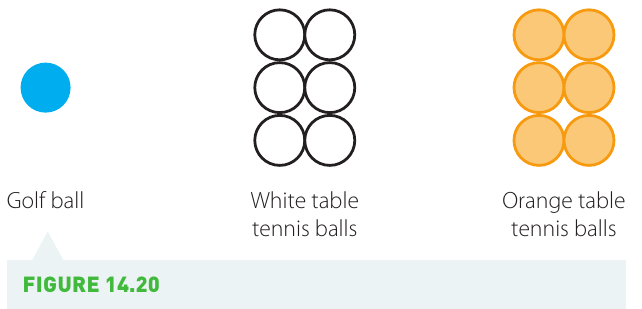
The investigation uses:
- A golf ball (representing neutrons - heavier and harder to detect)
- White table tennis balls (representing protons in paraffin wax)
- Orange table tennis balls (representing a second set of protons)
When the golf ball is rolled towards the white table tennis balls, it transfers momentum to them through collision. The white balls then collide with the orange balls, transferring momentum again. This models how neutrons transfer momentum to protons in the paraffin wax, which can then be detected.
Why this model works
- The golf ball has greater mass than the table tennis balls, similar to how incoming particles have significant momentum
- The table tennis balls are easy to observe, just as protons are easy to detect
- The momentum transfer through collisions demonstrates the same principle Chadwick used
Safety considerations
Note
When performing this investigation, ensure that all balls are accounted for and prevented from rolling onto the floor, as they could create a slipping hazard.
Remember!
Summary
Key Points to Remember:
- Nucleons are the particles found in the atomic nucleus: protons (positively charged) and neutrons (electrically neutral)
- Walther Bothe first observed the mysterious 'radiation' from beryllium bombardment in 1930 but couldn't identify what it was
- James Chadwick proved in 1932 that this 'radiation' consisted of neutral particles called neutrons with mass approximately equal to protons
- Chadwick's experiment used alpha particles to bombard beryllium, producing neutrons that knocked protons out of paraffin wax
- Neutrons are difficult to detect directly because they have no electrical charge, so Chadwick measured them indirectly by detecting the ejected protons
- Chadwick applied the laws of conservation of momentum and energy to calculate the neutron's mass from the properties of the ejected protons