Electromagnetic Spectrum (HSC SSCE Physics): Revision Notes
📚Revision Notes
Determining the Speed of Light
Introduction
For centuries, scientists believed that light travelled instantaneously across any distance. This assumption went unchallenged until the 17th century, when researchers began developing methods to measure what would become one of the most important constants in physics: the speed of light.
Note
The challenge in measuring light's speed lies in its extraordinary velocity. Unlike sound or other observable phenomena, light moves so quickly that early measurement attempts were limited by the technology and timing devices available.
Early attempts to measure the speed of light
Galileo's method (1638)
The first recorded attempt to measure the speed of light came from Galileo Galilei while working in Florence. His approach was remarkably simple but ultimately proved the limitations of direct measurement.
The method:
- Galileo and an assistant positioned themselves on separate hilltops at a known distance apart
- Each person had a covered lantern
- Galileo uncovered his lantern first
- When his assistant saw the light, he immediately uncovered his own lantern
- Galileo measured the time delay using a water clock
Results and limitations:
Galileo concluded that light travelled at least ten times faster than sound, but he recognised significant problems with his method:
- The time interval was too small to measure accurately
- Human reaction time introduced errors
- The equipment lacked sufficient precision
Important
His most important conclusion was that light speed was too fast to be measured using this direct timing method. This realisation was crucial because it showed that new approaches would be needed.
Rømer's astronomical method (1676)
Danish astronomer Ole Rømer made the first breakthrough by using astronomical observations rather than laboratory experiments. His method arose from attempts to solve a practical problem: determining longitude for ocean navigation.
The astronomical context:
Galileo had proposed using the eclipses of Jupiter's moon Io (as it passed into Jupiter's shadow) as a natural clock for navigation. However, the timing of these eclipses proved less predictable than expected.
Rømer's observation:
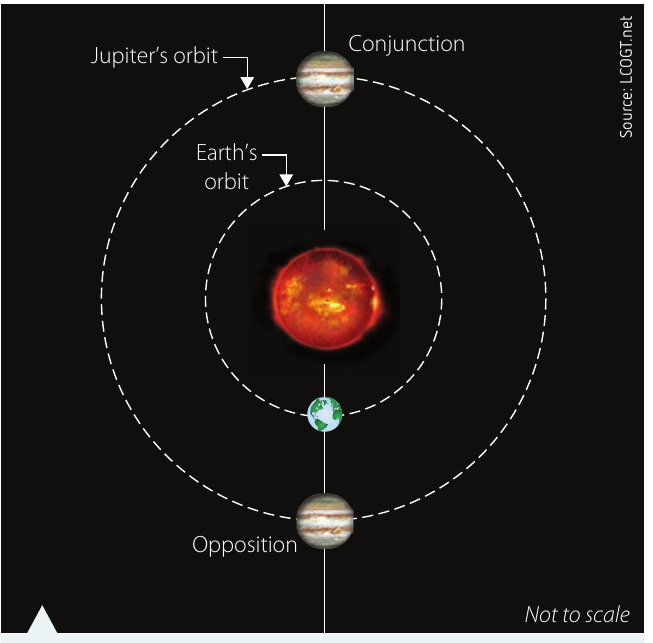
Rømer noticed that the timing of Io's eclipses varied by up to 16.6 minutes throughout the year. Crucially, these variations correlated with Earth's position in its orbit around the Sun.
The explanation:
The time variations occurred because:
- When Earth was closer to Jupiter (opposition), light had a shorter distance to travel
- When Earth was further from Jupiter (conjunction), light had to travel across the full diameter of Earth's orbit
- The maximum time difference represented the extra time for light to cross this distance
Results:
Rømer estimated that light took approximately 11 minutes to travel from the Sun to Earth, giving a speed of about 214,000 km s.
Important
Significance:
While his numerical result was inaccurate (due to poor knowledge of Earth's orbital diameter at the time), Rømer's work was revolutionary. As physicist Christiaan Huygens wrote: "I have seen recently, with much pleasure, the beautiful discovery of Mr. Rømer, to demonstrate that light takes time in propagating, and even to measure this time."
Rømer proved that light has a finite speed, fundamentally changing scientific understanding.
Bradley's aberration method (1728)
English astronomer and priest James Bradley, working with Samuel Molyneux, made an important discovery while attempting to measure stellar parallax (which would reveal the distance to stars).
The unexpected discovery:
While they failed to detect parallax (showing stars were much further away than previously thought), they discovered an unexplained circular motion in the apparent position of the star Gamma Draconis.
Note
Understanding aberration of light:
Bradley realised that this apparent motion resulted from Earth's movement around the Sun combined with light's finite speed.
The principle:
- As Earth moves through space, we observe starlight that was emitted some time earlier
- During the time light travels to Earth, our planet has moved to a new position
- This makes the star appear slightly ahead of its actual position
- The angular shift depends on the ratio of Earth's velocity to light's velocity ()
Calculation:
Knowing Earth's orbital velocity and carefully measuring the aberration angle, Bradley calculated the speed of light as 301,000 km s – a significant improvement over Rømer's estimate.
Terrestrial laboratory methods
Fizeau's toothed wheel method (1848-49)
French physicist Armand Hippolyte Louis Fizeau developed a method conceptually similar to Galileo's attempt, but with vastly superior technology that made precision measurement possible.
The apparatus:
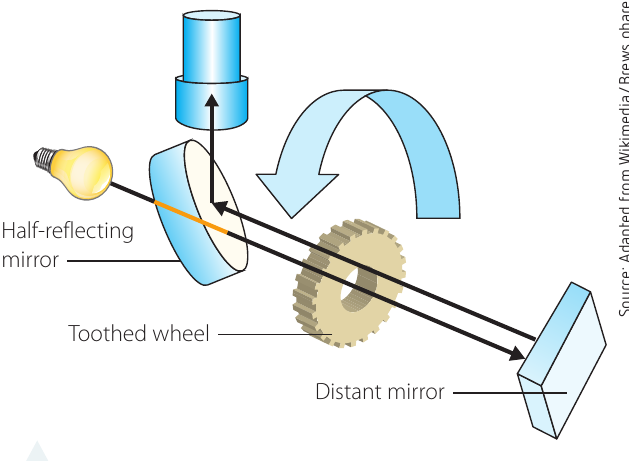
Fizeau's equipment consisted of:
- A light source
- A rapidly rotating wheel with 720 evenly-spaced teeth around its rim
- The gaps between teeth were the same width as the teeth themselves
- A distant mirror positioned approximately 19 km away
- Lenses to focus the light beam
How it worked:
- Light passed through a gap between the wheel's teeth
- The light travelled to the distant mirror and reflected back
- The wheel's rotation speed was adjusted until the returning light was blocked by a tooth
- At this critical speed, the wheel had rotated exactly enough during the light's round trip for a tooth to move into the position previously occupied by a gap
- Knowing the wheel's angular speed and the spacing between teeth, Fizeau could calculate the time for the light's journey
Results:
Using this method, Fizeau determined the speed of light to be approximately 315,000 km s.
Foucault's rotating mirror method (1862)
Léon Foucault, who had previously collaborated with Fizeau, developed an improved apparatus that replaced the toothed wheel with a rotating mirror.
The apparatus:
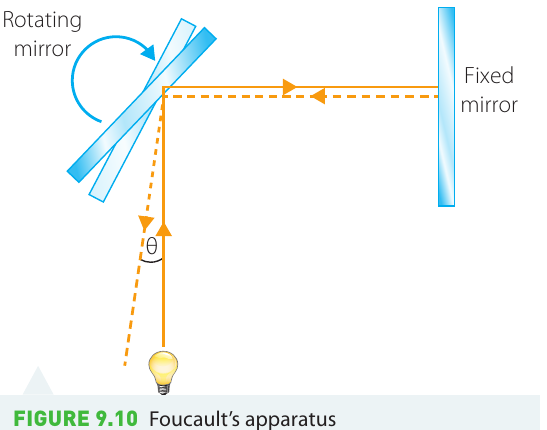
The key components were:
- A light source
- A rapidly rotating mirror
- A fixed (stationary) mirror at a known distance
- An angle measurement system
How it worked:
- Light from the source hit the rotating mirror
- The rotating mirror reflected light onto the fixed mirror
- The fixed mirror reflected the light back to the rotating mirror
- During the light's round trip, the rotating mirror rotated through a small angle
- This angular shift could be precisely measured
- The speed of light could then be calculated
Mathematical derivation:
The time for light to travel from the rotating mirror to the fixed mirror and back is:
where is the speed of light.
If the mirror rotates at a constant angular velocity of radians per second, the angle it rotates through during time is:
Important
Rearranging this equation to solve for :
This is Foucault's formula for determining the speed of light.
Results:
In 1862, Foucault achieved a value of 298,000 km s.
Advantages:
Foucault's apparatus had an important additional capability: the space through which light travelled could be filled with different substances (such as water or glass), allowing measurement of light's speed through various media.
Example
Worked Example: Foucault's method
Question: A student duplicating Foucault's method uses mirrors separated by 10 m. The rotating mirror spins at 1000 revolutions per second (which equals degrees per second). What angle must the mirror rotate through to measure the speed of light as m s?
Solution:
| Step | Calculation |
|---|---|
| Identify data | m, degrees s, m s |
| Apply formula | |
| Rearrange for angle | |
| Substitute values | |
| Calculate |
The mirror must rotate through just 0.024 degrees – an incredibly small angle that demonstrates both the speed of light and the precision required for these measurements.
Further refinements
Marie Alfred Cornu (1872-1876):
Working at the Paris Observatory, Cornu refined Fizeau's toothed wheel method. His final experiment used a light path almost three times longer than Fizeau's, achieving a value of 300,400 km s – within 0.2% of today's accepted value.
Albert Michelson (1877-1931):
Michelson conducted multiple experiments over more than 50 years, each time improving upon Foucault's rotating mirror method:
- 1879: Achieved 299,944 ± 51 km s (within 0.05% of the modern value)
- 1926: Achieved 299,796 ± 4 km s (just 4 km s above today's accepted value)
Modern measurements and definitions
The 1983 redefinition
In 1983, the definition of the metre underwent a fundamental change. Rather than being based on a physical standard, it was redefined in terms of the speed of light.
Important
Current definition:
One metre is exactly times the distance that light travels in one second through a vacuum.
Consequence:
This means we now have an exact value for the speed of light:
Any future measurement techniques that achieve even higher precision will affect our definition of the metre's length, not the speed of light itself.
Resonant cavity method
Between 1946 and 1950, British physicists Louis Essen and AC Gordon-Smith developed a fundamentally different approach to measuring the speed of light. Instead of timing light's journey over a known distance, they independently measured frequency and wavelength, then used the wave equation .
What is a resonant cavity?
Note
A resonant cavity is a physical container that sustains standing waves at specific frequencies. The key requirement is that an exact number of half-wavelengths must fit between the cavity walls.
Standing waves and nodes:
When waves reflect from a solid wall, they undergo a 180° phase change. The incident and reflected waves interfere to create a standing wave pattern. Points where the wave amplitude is always zero are called nodes. For a resonant cavity, nodes must occur at each wall, similar to how a guitar string has nodes at the bridge and nut.
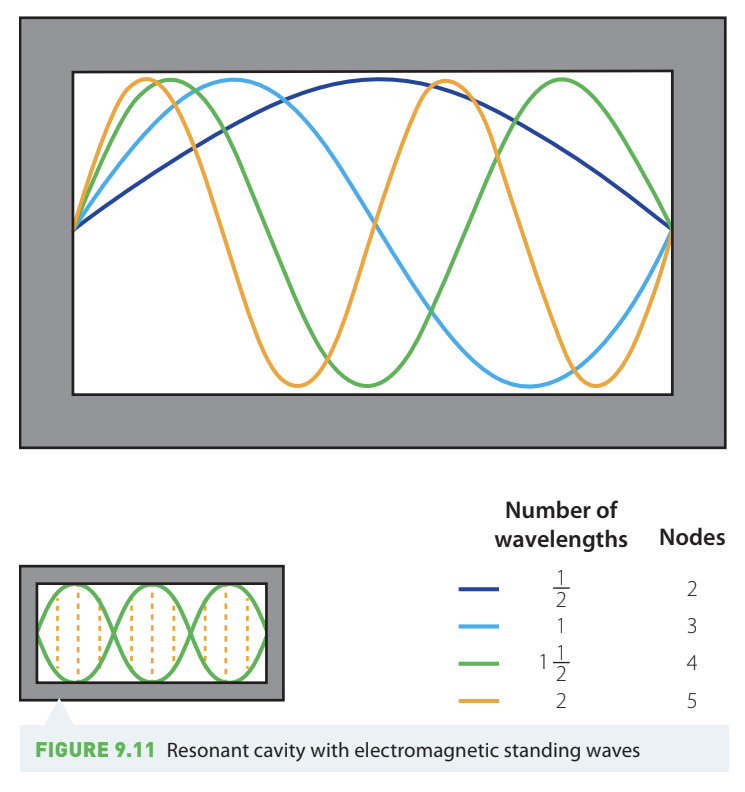
The diagram shows how different numbers of half-wavelengths fit in the cavity, with nodes (stationary points) marked by vertical dashed lines.
The Essen-Gordon-Smith method:
- They constructed a cavity with precisely measured dimensions
- The distance between opposite walls was determined using gauges calibrated by interferometry, achieving accuracy of ± 0.8 μm
- They generated electromagnetic waves at a known frequency using an oscillating electric circuit
- By knowing the cavity dimensions, they could determine the wavelength exactly
- Using , they calculated the speed of light
Interferometry
Interferometry uses the wave properties of light to make extremely precise measurements.
How an interferometer works:
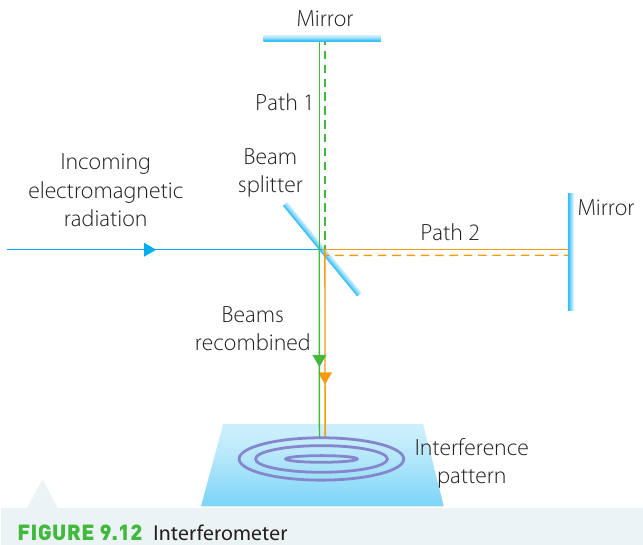
- A beam of electromagnetic radiation with known frequency enters the device
- A beam splitter divides the light into two separate beams
- The two beams travel along different paths
- Mirrors reflect the beams back to recombine them
- When recombined, the beams create an interference pattern
Reading the interference pattern:
Note
The interference pattern depends on the path difference between the two beams:
- When the beams recombine in phase (path difference is a whole number of wavelengths): constructive interference creates a bright spot
- When the beams are 180° out of phase (path difference is a half-wavelength plus whole wavelengths): destructive interference creates a dark spot
Determining wavelength:
By carefully adjusting one path length and measuring the distance moved while counting bright and dark fringes, the wavelength can be determined with extreme precision. The speed of light is then calculated using .
Evolution of precision:
- Early interferometry: Used coherent radio sources, but radio wavelengths are relatively long (shortest about 0.5 cm), limiting precision
- Laser interferometry: The development of lasers provided coherent light with wavelengths in the hundreds of nanometres, dramatically improving precision
- The United States National Bureau of Standards (now NIST) achieved a fractional uncertainty of just using advanced interferometric techniques
Example
Worked Example: calculating wavelength from frequency
Question: A radio station transmits at a frequency of 106.3 MHz. What is the wavelength of this electromagnetic wave?
Solution:
| Step | Calculation |
|---|---|
| Identify data | MHz |
| Apply wave equation | |
| Rearrange for wavelength | |
| Substitute values | |
| Convert units and calculate | m |
The wavelength is 2.82 metres.
Note: Remember to convert MHz to Hz by multiplying by before calculating.
Practical investigations
Investigation 9.1: Determining the speed of light with a resonant cavity
This investigation uses a microwave oven as a resonant cavity to measure the speed of light using the principle that standing waves form inside the oven.
Aim:
To determine the speed of light using a microwave resonant cavity.
Materials:
- Microwave oven of known frequency (written on the back panel)
- Either 1 kg block of chocolate or 500 g margarine
- Scissors
- Knife or spatula
- Baking paper
- Ruler
- Calculator
Safety considerations:
| Risk | Management Strategy |
|---|---|
| Microwaved substances can be hot | Take care when removing chocolate or margarine from the microwave oven |
| Possible slight microwave leakage | Stand away from the microwave door when in operation |
Method:
- Remove the turntable from the microwave oven (this is crucial – the turntable normally rotates to ensure even heating, but we want uneven heating to identify the standing wave pattern)
- Cut enough baking paper to completely cover the floor of the microwave oven
- Make a small hole in the baking paper to fit over the spindle that normally drives the turntable
- If using margarine: Cover the baking paper to a depth of about 4 mm with margarine, then insert into the microwaveIf using chocolate: Place baking paper in the microwave, then put chocolate face down (smooth side up) to cover the paper
- Close the door and run the 1000 W microwave at high power for approximately 35 seconds (time may vary depending on your microwave's power)
- Examine the margarine or chocolate for hot spots. These should be separated by several centimetres. Work quickly, as the hot spots will spread through thermal conduction, making it harder to identify their centres
- Measure the distance between the centres of adjacent hot spots
Analysis:
Note
The distance between hot spots represents half a wavelength () of the microwave radiation.
- Note the microwave oven's frequency (found on the back panel, typically around 2.45 GHz)
- Record the distances between hot spots (each measurement gives )
- Calculate the full wavelength:
- Calculate the speed of light using:
- Compare your result with the accepted value of 299,792,458 m s
Discussion points:
- How reliable and valid were your measurements?
- What percentage difference exists between your result and the accepted value?
- How could you improve the accuracy in future trials?
- What were the main sources of error?
Investigation 9.2: Determining the speed of sound using Rømer's method
While we cannot use Rømer's astronomical method to measure light speed in a school setting, we can apply the same principle to sound waves, which travel much more slowly.
Aim:
To determine the speed of sound using a method analogous to Rømer's.
Materials:
- Starter's pistol
- Ear muffs
- Stopwatch
Safety considerations:
| Risk | Management Strategy |
|---|---|
| Firing a starter's pistol can cause temporary hearing impairment | Person firing the pistol should wear ear muffs. Other people should stand well away when the pistol is fired |
Method:
- The person with the pistol goes to one end of the school oval or any large open space
- Observer(s) with stopwatch stand approximately halfway across the oval, watching the person with the pistol
- The pistol-bearer fires the pistol upwards
- Observers start the stopwatch when they see the flash, and stop it when they hear the report
- Observers note the time between flash and report
- Observers move to the opposite end of the oval, pacing (not measuring precisely) to estimate the distance (approximately 50 metres)
- The pistol-bearer fires again and observers record the new time between flash and report
Analysis:
- Calculate the difference in arrival times between the first and second observations
- This time difference represents how long sound took to travel the extra distance
- Using the approximate distance between the first and second positions, calculate:
Discussion points:
Note
How is this investigation similar to Rømer's method for measuring light speed?
- Both use timing of observable events at different distances
- Both rely on a visible signal (Jupiter's eclipse timing / pistol flash)
- Both measure time differences for different path lengths
How do the two investigations differ significantly?
- Rømer used astronomical distances and natural phenomena
- This uses terrestrial distances and controlled events
- Rømer observed naturally occurring eclipses; we create events on demand
Comment on the accuracy and reliability of this investigation:
- Human reaction time introduces errors
- Distance estimation is approximate
- Multiple trials would improve reliability
How do these accuracy concerns compare with Rømer's method?
- Rømer faced uncertainties in Earth's orbital diameter
- Eclipse timing had its own uncertainties
- Both methods pioneered measurement of "unmeasurable" speeds
Key formulas
Important
Wave equation
The fundamental relationship between speed, frequency and wavelength:
where:
- = speed of light (m s)
- = frequency (Hz)
- = wavelength (m)
Foucault's rotating mirror formula
For determining the speed of light using a rotating mirror:
where:
- = speed of light (m s)
- = distance between rotating and fixed mirrors (m)
- = angular velocity of rotating mirror (radians s)
- = angle through which mirror rotates during light's round trip (radians)
Derivation:
The time for light's round trip is
The angle rotated in this time is
Combining these:
Rearranging:
Summary
Key Points to Remember
-
Light's speed is finite: Rømer (1676) first proved light doesn't travel instantaneously, using variations in eclipse timings of Jupiter's moon Io
-
Historical progression of accuracy:
- Rømer: ~214,000 km s (astronomical method)
- Bradley: 301,000 km s (stellar aberration)
- Fizeau: 315,000 km s (toothed wheel)
- Foucault: 298,000 km s (rotating mirror)
- Modern value: 299,792,458 m s (exact, by definition)
-
Modern definition (1983): The metre is now defined as times the distance light travels in one second through a vacuum, making the speed of light an exact value
-
Two key modern methods:
- Resonant cavity: Independently measure frequency and wavelength, then use . Standing waves must have nodes at cavity walls
- Interferometry: Split light beam into two paths, recombine to create interference pattern that reveals wavelength with extreme precision
-
Essential formula: relates the speed of light to its frequency and wavelength – this applies to all electromagnetic radiation