The Production and Propagation of Electromagnetic Waves (HSC SSCE Physics): Revision Notes
📚Revision Notes
The Production and Propagation of Electromagnetic Waves
How electromagnetic waves are produced
Electromagnetic waves are created when electric charges move or accelerate. Understanding how these waves are produced requires examining the relationship between electric fields, magnetic fields, and moving charges. James Clerk Maxwell's equations provide the theoretical framework for understanding electromagnetic wave production and propagation.
Electric force and fields
Coulomb's Law
Every charged particle produces an electric field in the space around it. This is described by Gauss's Law for Electricity, which forms the basis of Maxwell's first equation. When multiple charges are present, they exert forces on each other according to Coulomb's Law:
Where:
- is the magnitude of the force between the charges
- and are the two charges
- is the separation distance between them
- is Coulomb's constant
Note
Coulomb's Law has a similar mathematical form to Newton's Universal Law of Gravitation, but describes the electrostatic force between charged particles. The key difference is that electric charges can be positive or negative, leading to both attractive and repulsive forces.
Permittivity of free space
Coulomb's constant is related to a fundamental property of space called the permittivity of free space ():
This constant appears in Maxwell's equations and is crucial for understanding how electromagnetic fields propagate through empty space. The permittivity of free space determines how easily electric fields can be established in a vacuum.
Charge acceleration
When charges experience an electric force, they accelerate according to Newton's second law (). If nothing restricts their movement, the charges will move in response to this force. This movement of charges is essential for producing electromagnetic radiation.
The production mechanism
Changing electric fields
Consider what happens at a fixed point in space when a charged particle moves past it. As the charge approaches, the electric field strength at that point increases. As the charge moves away, the field strength decreases. This creates a changing electric field at that point in space, even though the charge itself maintains a constant field around it as it moves.
Maxwell's equations and wave creation
The production of electromagnetic waves relies on two of Maxwell's equations working together:
Maxwell's fourth equation (the modified Ampère's circuital law) states that a changing electric field creates a changing magnetic field.
Maxwell's third equation (Faraday's Law of Induction) states that a changing magnetic field creates a changing electric field.
Important
The Self-Sustaining Cycle
This creates a self-sustaining cycle that is fundamental to electromagnetic wave propagation:
- The moving charge produces a changing electric field
- This changing electric field generates a changing magnetic field
- The changing magnetic field generates another changing electric field
- This process continues, with the fields propagating outward
Once started, this cycle continues indefinitely - the fields only need each other to keep the wave traveling through space.
Speed of propagation
According to Maxwell's fourth equation, these mutually creating fields propagate through space at the speed of light. This was one of Maxwell's great insights - that light itself is an electromagnetic wave, and the speed of electromagnetic wave propagation equals the speed of light.
Properties of electromagnetic waves
Perpendicular field orientations
In an electromagnetic wave, the electric field () and magnetic field () oscillate perpendicular to each other. Both fields are also perpendicular to the direction in which the wave travels. This creates a three-dimensional arrangement where all three directions (E field, B field, and wave motion) are mutually perpendicular.
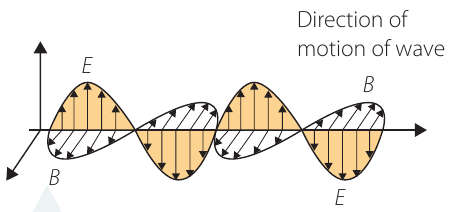
The diagram shows how the electric and magnetic fields oscillate at right angles to each other while the wave travels in the third perpendicular direction.
Note
The Three Perpendiculars
Remember that in an electromagnetic wave, there are three mutually perpendicular directions:
- The electric field oscillation direction
- The magnetic field oscillation direction
- The direction of wave propagation
This perpendicular arrangement is a defining characteristic of electromagnetic waves.
No medium required
Unlike sound waves or water waves, electromagnetic waves do not need a physical medium to travel through. The electric and magnetic fields only need each other to sustain the wave. This is why light can travel through the vacuum of space - the self-sustaining nature of the electric and magnetic fields is sufficient for propagation.
Important
Why No Medium is Needed
Mechanical waves like sound require a medium because they transfer energy by causing particles in the medium to vibrate. Electromagnetic waves are fundamentally different - they consist of changing electric and magnetic fields that create each other through Maxwell's equations. Since these fields exist in space itself, no material medium is required for their propagation.
Energy transfer
An electric field on its own can exert a force on a charged particle according to:
where is the electric field strength and is the charge. This means that electromagnetic radiation can transfer energy to charged particles at unlimited distances. The wave carries energy through space via the oscillating electric and magnetic fields, and this energy can be converted into kinetic energy when the wave interacts with charged particles.
Magnetic force on moving charges
Magnetic fields also exert forces on moving charged particles. This force is given by:
Where:
- is the force on the particle
- is the charge
- is the velocity of the charged particle
- is the magnetic field strength
- is the angle between the particle's velocity and the magnetic field direction
The force is greatest when the magnetic field is perpendicular to the particle's motion (when ). This magnetic force, combined with the electric force, allows electromagnetic waves to transfer energy to charged particles and accelerate them, even at great distances.
Key implications
Understanding electromagnetic wave production and propagation has profound implications for physics and technology:
Moving charges generate electromagnetic radiation: Any time a charge accelerates or changes direction, it produces electromagnetic waves. This principle underlies many technologies, from radio transmission to X-ray production.
Self-sustaining propagation: Once created, electromagnetic waves can travel indefinitely through empty space without losing their wave structure. The changing electric field continually recreates the changing magnetic field, and vice versa.
Universal speed: All electromagnetic waves travel at the same speed in a vacuum - the speed of light ( m/s) - regardless of their frequency or wavelength.
Summary
Key Points to Remember:
-
Changing fields create electromagnetic waves: A moving charge produces a changing electric field, which creates a changing magnetic field, which creates a changing electric field, and so on.
-
Maxwell's equations explain the mechanism: Maxwell's third equation (Faraday's Law) and fourth equation (modified Ampère's Law) show how electric and magnetic fields mutually create each other, enabling wave propagation.
-
Three perpendicular directions: The electric field, magnetic field, and direction of wave motion are all perpendicular to each other in an electromagnetic wave.
-
No medium needed: Electromagnetic waves are self-sustaining and can travel through a vacuum - they only need the electric and magnetic fields to support each other.
-
Energy transfer at any distance: Electromagnetic waves can carry energy across unlimited distances and transfer it to charged particles through the forces exerted by the electric and magnetic fields.