Einstein’s Theory of Special Relativity (HSC SSCE Physics): Revision Notes
📚Revision Notes
Einstein's Theory of Special Relativity
Introduction to Einstein's revolutionary theory
In 1905, Albert Einstein published a groundbreaking paper that fundamentally changed our understanding of space and time. This paper introduced the theory of special relativity, which challenged the most basic assumptions that scientists had taken for granted for centuries.
Einstein's approach was bold but effective - he questioned the fundamental nature of space and time itself. By doing this, he was able to resolve puzzling contradictions about how light behaves. His theory eliminated the need for the "aether" (a hypothetical medium through which light was thought to travel) and demonstrated that there is no absolute, privileged frame of reference in the universe.
Note
The theory of special relativity was built upon a foundation of simple thought experiments - what Einstein called "Gedanken experiments" in German. These imaginary scenarios, based on basic principles, allowed him to explore the consequences of his ideas without needing complicated equipment.
The two postulates of special relativity
Einstein's entire theory rests on two fundamental propositions. These postulates form the bedrock of special relativity, and all the strange effects we'll discuss flow logically from them.
Important
First postulate: The laws of physics are the same in all inertial frames of reference.
This means that if you're in a spaceship moving at constant velocity, you cannot perform any physics experiment that will tell you whether you're moving or stationary. All physical laws work exactly the same way regardless of your constant velocity. The first postulate effectively eliminated the aether, because the aether would have been a privileged reference frame - one "special" frame against which all motion could be measured.
Important
Second postulate: The speed of light has the same value, , in all inertial frames. It does not depend on the speed of either the source or the observer.
This is the truly revolutionary idea. In everyday experience, velocities add together. If you're on a train moving at and you throw a ball forward at , someone standing beside the tracks sees the ball moving at . But light doesn't work this way! No matter how fast you're moving, you always measure light travelling at exactly .
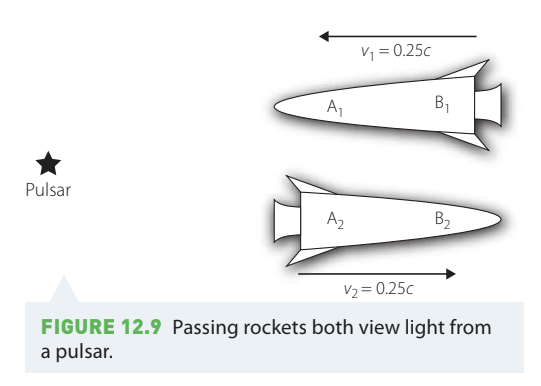
To understand why this is so strange, consider this example: imagine two rockets, one moving toward a distant pulsar (a type of star that emits pulses of light) and one moving away from it, each travelling at (one-quarter the speed of light).
Example
Demonstration: The Constancy of Light Speed
The pulsar emits a short pulse of light. Each rocket measures the speed of this pulse using light-sensitive detectors positioned on the outside of the spacecraft. According to Newton's laws (Galilean relativity), the rocket heading toward the pulsar should measure the light travelling at , while the rocket moving away should measure it at .
But this isn't what happens! Both rockets measure exactly .
This constancy of the speed of light was consistent with the results of the famous Michelson-Morley experiment. Einstein may or may not have known about this experiment when he developed his theory - he was primarily focused on Maxwell's equations of electromagnetism, which showed that light speed should be constant. Regardless, the Michelson-Morley results provided crucial experimental support for special relativity.
Time dilation
The theory of special relativity requires us to abandon our everyday intuitions about space and time. One of the most striking consequences is that time itself is not absolute - observers in different inertial frames will disagree about time measurements.
Understanding time dilation through a thought experiment
Let's imagine a train carriage moving at a high velocity relative to the ground. On the carriage are two mirrors ( and ) arranged so that light pulses can bounce back and forth between them. Fred stands on the train, while Pierre stands on the ground watching the train pass by.
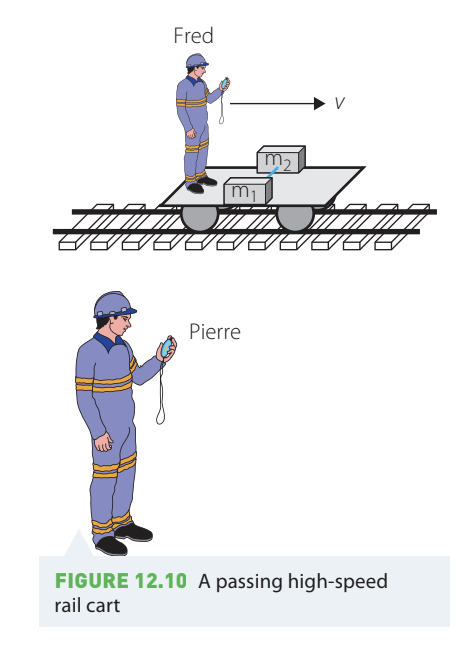
Fred measures the time () it takes for a pulse of light to travel from mirror to mirror and back again. Both Fred and Pierre agree that the perpendicular distance between the mirrors is . This perpendicular distance is the same in both reference frames because length contraction only occurs in the direction of motion.
From Fred's perspective on the train, the situation is straightforward. The light simply travels straight up and down between the two stationary mirrors.
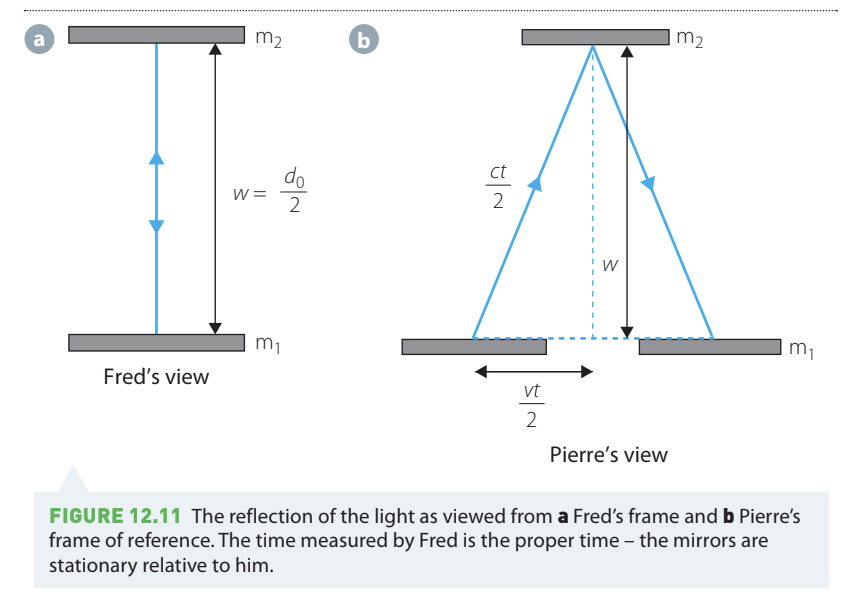
Fred observes the light travelling a total distance of , so the time he measures is:
However, Pierre sees something quite different. From his viewpoint on the ground, the mirrors are moving horizontally with velocity while the light pulse travels between them. This means the light doesn't travel straight up and down - instead, it follows a diagonal path, forming triangles.
For half the journey (from to ), the light pulse travels along the hypotenuse of a right-angled triangle. The three sides of this triangle have lengths:
- Vertical side: (the distance between mirrors)
- Horizontal side: (the distance the mirrors move during the transit)
- Hypotenuse: (the distance the light travels)
Using Pythagoras' theorem:
We can rearrange this equation:
Therefore:
This is the time dilation equation. The time measured by Pierre (who is moving relative to the mirrors) is longer than the time measured by Fred (who is at rest relative to the mirrors). In other words, Pierre sees Fred's clock running slow!
Proper time
Proper time is the time interval between two events occurring at the same place in an inertial frame, as measured by an observer in that inertial frame.
Note
In our example, Fred measures the proper time because he's travelling with the mirrors - from his perspective, the emission and detection of the light pulse happen at the same location. Pierre's measurement is not the proper time because he's not moving with the mirrors.
The crucial insight is that Pierre's measurement is dilated (stretched out) compared to Fred's. Time itself passes differently for observers in relative motion.
The Lorentz factor
The expression appears repeatedly in relativity calculations. It's given the special symbol (gamma) and is called the Lorentz factor:
We can also define (the velocity as a fraction of light speed), so:
The Lorentz factor tells us how significant relativistic effects will be. When is small compared to (as it is in everyday life), is very close to 1, and relativistic effects are negligible. But as approaches , increases dramatically.
Here's a table showing how varies with velocity:
| 0 | 1 |
| 0.0010 | 1.000 000 5 |
| 0.010 | 1.000 05 |
| 0.10 | 1.005 |
| 0.20 | 1.021 |
| 0.50 | 1.155 |
| 0.80 | 1.667 |
| 0.90 | 2.294 |
| 0.94 | 2.931 |
| 0.99 | 7.089 |
| 0.999 | 22.37 |
Notice how stays close to 1 until velocities reach a significant fraction of light speed, then increases rapidly. At , time is dilated by more than a factor of 22!
Important
Important note about calculations:
When gets very close to 1 (for example, 0.999999999), calculators and computers can produce unreliable results due to rounding errors. Be cautious with calculations at extreme velocities.
The reciprocal nature of time dilation
Here's a fascinating question: what would happen if we repeated the experiment with the mirrors on the ground and Fred on a moving train? From Fred's perspective, his train could be considered stationary and Pierre moving at velocity relative to him. In this case, Fred would find that Pierre's clock runs slow compared to his!
Note
How can both observers think the other's clock is slow? This seems like a contradiction, but it isn't. Time dilation is fundamentally about measurements made in different inertial frames - it's about what one observer sees when looking at another frame in relative motion. The effect must be reciprocal because there's no absolute frame of reference. Neither Fred nor Pierre has the "correct" time - both measurements are equally valid within their own reference frames.
The clocks themselves don't physically change. What changes is the measurement of time intervals between frames in relative motion. This is a profound shift from Newton's view, where time was considered absolute and universal.
Example
Worked Example: Time Dilation
Problem: A pilot in a rocket travelling at presses a button to flash a "Hello" sign for at a space station as the rocket passes. For how long is the flash seen by an observer on the space station?
Solution:
We need to use the time dilation equation:
Here, (the proper time measured on the rocket) and .
Substituting:
Explanation: The observer in the space station views the rocket travelling at relative to them. From this perspective, the clock on the rocket runs slow compared to the station's clock. Any observer regards a clock moving relative to their frame of reference as running slow. Therefore, what takes on the rocket takes according to the space station observer.
Time dilation only becomes significant when velocities approach the speed of light. At , the effect is relatively small (about difference), but it's still measurable.
Length contraction
If time measurements differ between inertial frames, it makes sense that measurements of length might also be affected. Indeed, special relativity predicts that objects in motion appear contracted (shortened) in the direction of motion.
Understanding length contraction through a thought experiment
Imagine a train travelling at velocity . On the train, there's a light source that emits a short pulse towards a mirror, and the light bounces back to the source.
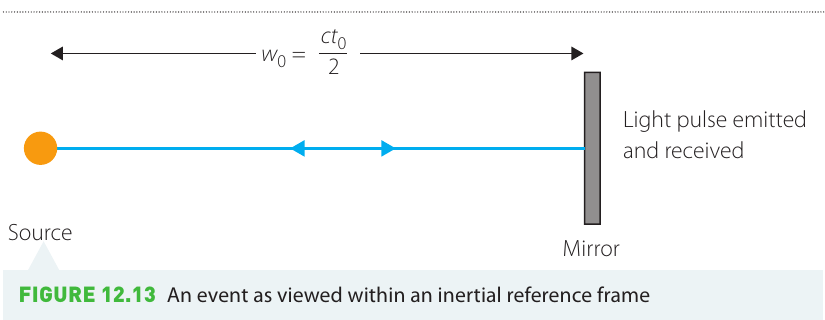
An observer on the train measures the distance from the source to the mirror as . This is the proper length because it's measured in the rest frame of the mirror. The time for the light to travel to the mirror and back is:
Now consider an observer on the ground, watching the train pass. This observer is stationary relative to the moving frame of the train.
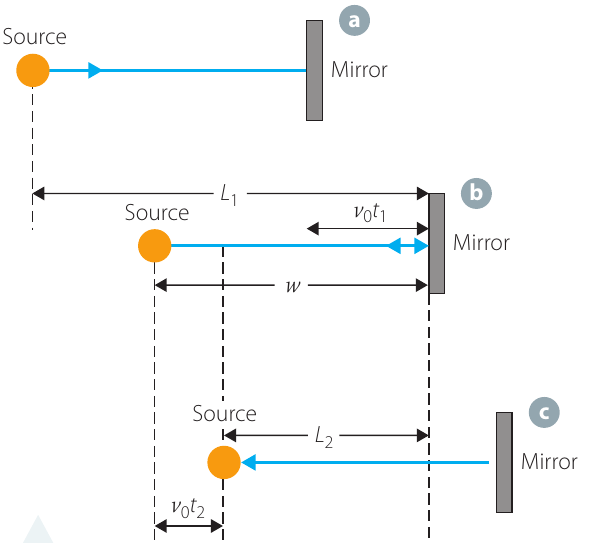
From the ground observer's perspective, during the time the light travels to the mirror, the mirror moves forward by a distance . The light must travel an extra distance to catch up with the moving mirror.
For the outward journey (source to mirror), the ground observer sees:
- The initial distance to the mirror:
- The mirror moves forward:
- The light travels:
Since the speed of light is constant in all frames:
Rearranging:
For the return journey (mirror back to source), the source is moving toward the returning light pulse:
Again, since the light speed is constant:
The total time for the round trip, as measured by the ground observer, is:
Now we can use the time dilation relationship. We know that:
Therefore:
Substituting :
Simplifying:
This is the length contraction equation! The distance measured by the ground observer is shorter than the proper length measured in the train's reference frame.
The length contraction formula
For any object moving with velocity relative to an observer:
where:
- is the proper length (length measured at rest in the object's frame)
- is the contracted length measured by an observer moving relative to the object
- is the relative velocity between the frames
The factor is always less than 1 (for any velocity less than ), which means . Objects moving relative to an observer always appear shortened in the direction of motion.
Important characteristics of length contraction
Important
Direction matters: Length contraction only occurs in the direction of relative motion. There's no contraction perpendicular to the motion. If a rectangular spacecraft travels lengthwise, it appears shorter but not narrower.
Note
Reciprocal effect: Just like time dilation, length contraction is reciprocal. If you measure a moving object as contracted, an observer moving with that object would measure you as contracted! Each observer sees the other as shortened. This must be the case because there's no absolute frame of reference.
Note
Only significant at high speeds: Like time dilation, length contraction is only observable when velocities approach the speed of light. At everyday speeds, the contraction factor is so close to 1 that the effect is immeasurable.
Example
Worked Example: Length Contraction and Space Travel
Problem 1: An observer on the Moon notices a spacecraft travelling past at . The spacecraft has a proper length of . What length will the observer on the Moon measure?
Solution:
Using the length contraction formula:
Given: and
The spacecraft appears about shorter to the Moon observer than its proper length.
Problem 2: A crewed mission is sent to an exoplanet light years away, travelling at .
Part a(i): According to the mission crew, how far away is the exoplanet?
Solution:
From the crew's perspective, Earth is moving away at , and the distance is contracted:
Part a(ii): According to the crew, how long will the journey take?
Solution:
Part b: According to mission command on Earth, how long will the journey take?
Solution:
From Earth's perspective, the distance is the proper length of light years:
Notice that both the distance and the journey time are different in the two reference frames! The crew experiences a shorter journey in both distance and time due to relativistic effects.
The Lorentz factor: historical context
Before Einstein developed special relativity, two scientists independently proposed an explanation for the null result of the Michelson-Morley experiment. George Fitzgerald from Ireland and Hendrik Lorentz from the Netherlands suggested that all objects physically contract in the direction of motion through the aether by a factor of .
Their motivation was to preserve Maxwell's equations when applied to moving charges. They saw this contraction as a real, physical change in the size of objects as they moved through the stationary aether.
Note
However, Einstein's interpretation was fundamentally different and more profound. Einstein argued that there was no physical change in the objects themselves. Instead, the properties of space and time themselves were relative - they depended on the observer's reference frame. Objects don't physically shrink; rather, measurements of length and time are frame-dependent.
Despite this crucial difference in interpretation, the mathematical factor is still sometimes called the Lorentz factor, and length contraction is sometimes called Lorentz-Fitzgerald contraction in recognition of their earlier work.
Remember!
Summary
Key Points to Remember:
-
The two postulates of special relativity form the foundation: (1) The laws of physics are the same in all inertial frames, and (2) the speed of light is constant in all frames regardless of the motion of source or observer.
-
Time dilation means moving clocks run slow: An observer sees a clock moving relative to them as running slower than their own clock. The proper time is measured in the frame where events occur at the same location. The dilated time is .
-
Length contraction shortens objects in the direction of motion: An observer measures a moving object as shorter in the direction of motion than its proper length. The contracted length is .
-
Both effects are reciprocal and only significant at high speeds: Each observer in relative motion sees the other as time-dilated and length-contracted. These effects are negligible at everyday speeds but become dramatic as velocities approach the speed of light.
-
The Lorentz factor quantifies relativistic effects: When , there are no relativistic effects. As velocity approaches , increases rapidly toward infinity, making time dilation and length contraction increasingly significant.