Experimental Evidence for Relativity (HSC SSCE Physics): Revision Notes
📚Revision Notes
Experimental Evidence for Relativity
The theory of special relativity makes predictions that seem counterintuitive, but a range of experiments and astronomical observations provide strong supporting evidence. This note explores three main sources of experimental evidence: cosmological observations, muon decay experiments, and atomic clock experiments.
Cosmological observations
Astronomical observations provide some of the most compelling evidence for Einstein's second postulate - that the speed of light is constant and independent of the source's motion.
Supernova evidence
When massive stars explode (called a supernova), fragments can fly outward at speeds exceeding 3% of the speed of light. If the speed of light depended on the speed of its source, light from fragments moving away from Earth should travel more slowly than light from fragments moving toward us. This would create observable effects in the light patterns astronomers detect.
Note
However, no such effects have been observed, confirming that light speed is independent of source motion. This provides direct observational evidence for one of the fundamental postulates of special relativity.
No faster-than-light particles
Throughout decades of particle physics experiments and cosmic ray observations, no particle has ever been reliably observed traveling faster than light. This universal speed limit is a fundamental prediction of special relativity.
Muon decay experiments
Muons are subatomic particles that provide excellent evidence for relativistic effects because they travel at speeds close to the speed of light and have measurable decay rates.
What are muons?
Muons are particles with a mass approximately 200 times greater than an electron. They occur naturally when cosmic rays bombard Earth's upper atmosphere. Muons have a mean lifetime of s (or μs) when measured in the laboratory. The mean lifetime relates to half-life by: .
Important
It's important to understand that mean lifetime is different from half-life - it's a measure of the average time a particle exists before decaying. This distinction is crucial for understanding muon decay experiments.
The Frisch and Smith experiment (1963)
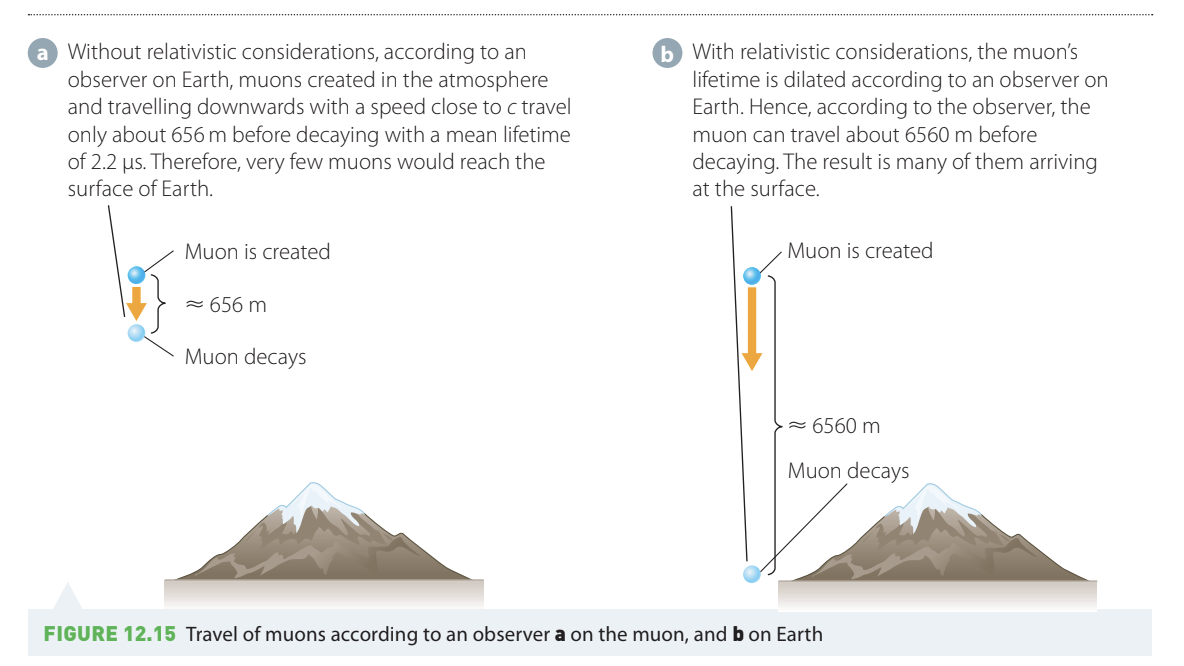
In 1963, physicists DH Frisch and JH Smith conducted a landmark experiment measuring muons at two different altitudes. They collected muons on a mountaintop at 1907 m above sea level and compared the count with measurements at sea level. The muons traveled at relative to Earth.
Prediction without relativity
Without considering relativistic effects, we can calculate how far muons should travel before decaying:
From an observer traveling with the muon (in the muon's rest frame), the time to reach sea level would be:
This represents mean lifetimes.
The number of muons decays exponentially, so the fraction surviving would be:
Note
This classical calculation predicts only about 5.5% of muons should reach sea level - a surprisingly small number that would be difficult to detect experimentally.
Prediction with relativity (Earth's frame)
However, the detectors measure time in Earth's rest frame, while the muon decays in its own rest frame. Time dilation affects what we observe.
The mean lifetime as measured in Earth's frame is:
At , the gamma factor is:
Therefore:
The trip now takes only:
The fraction reaching sea level becomes:
This predicts about 74.8% should reach sea level - a dramatically different result!
Experimental results
Frisch and Smith measured an average of 563 muons per hour at the mountaintop detector. At the sea level detector:
- Classical prediction: muons per hour
- Relativistic prediction: muons per hour
- Actual measurement: 412 muons per hour
Important
The experimental result closely matches the relativistic prediction, providing strong evidence for time dilation. The classical prediction is off by more than an order of magnitude, demonstrating that relativistic effects are essential for understanding muon decay.
The muon's perspective (length contraction)
From the perspective of an observer traveling with the muon, Earth appears to be moving at . In this frame, the distance between detectors appears shortened by a factor of due to length contraction:
Note
This shortened distance explains why so many muons reach the second detector from the muon's point of view. While Earth observers explain the result through time dilation, the muon's frame explains it through length contraction - both perspectives are valid and consistent!
Agreement and disagreement between frames
Both observers (one on Earth, one traveling with the muon) will agree about:
- The relative speed:
- The number of physical muon decays
- The number of elapsed mean lifetimes between detectors
They will disagree about:
- The mean lifetime of the muon
- The distance between detectors
Note
This shows how different frames of reference can have different measurements while still being consistent with the same physical reality. This is a fundamental principle of relativity - different observers can disagree on measurements but must agree on physical outcomes.
Atomic clock experiments
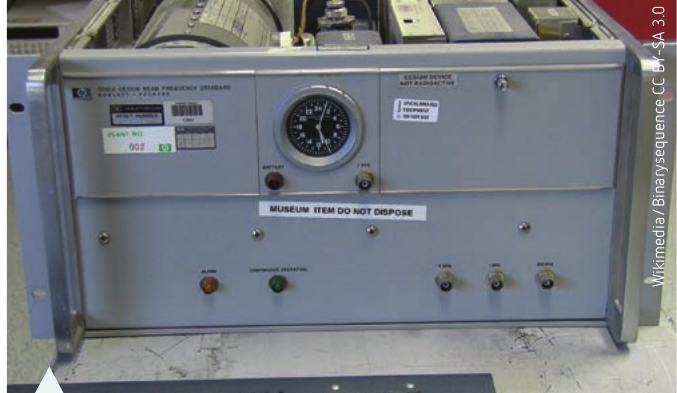
Atomic clocks are extraordinarily precise timepieces that can measure time accurately to within one second per hundred million years. This precision allows them to detect time dilation even at speeds much smaller than the speed of light.
The Hafele-Keating experiment (1971)
In October 1971, physicists Joseph Hafele and Richard Keating sent atomic clocks on commercial passenger jets flying around the world. Some clocks flew eastward, others westward. After the flights, these clocks were compared with a clock that remained stationary on the ground.
The flying clocks showed time differences consistent with the predictions of special relativity (and general relativity, which also affects the results due to gravity).
Calculating time dilation at low speeds
For a moving clock, time dilation gives:
However, when the speed of an aircraft is much smaller than (specifically when ), we can use an approximation:
This leads to:
The time difference between the moving and stationary clocks is:
Note
This approximation is extremely useful for everyday speeds where . Notice that the time difference depends on the square of the velocity ratio, making it very small for typical speeds but still measurable with precise instruments.
Worked example: time dilation on commercial aircraft
Example
Worked Example: Time Dilation on Commercial Aircraft
Problem: Find the time difference between a clock on the ground and one flown around Earth twice at km h. Earth's circumference is about km, so two circuits take approximately hours.
Solution:
Step 1: Convert the time to microseconds for easier calculation:
Step 2: Convert the speed to m s:
Step 3: Apply the approximation formula:
Step 4: Substitute the values:
Step 5: Calculate the result:
Conclusion: This 1 microsecond difference is measurable with atomic clock technology, confirming that time dilation occurs even at everyday speeds.
Summary
Key Experimental Evidence Summary
The theory of special relativity is supported by three major types of experimental evidence:
-
Cosmological observations: Light from supernovas behaves as expected if its speed is independent of the source. No particles travel faster than light, confirming the universal speed limit.
-
Muon decay experiments: Cosmic ray muons reach Earth's surface in numbers that match relativistic predictions but contradict classical physics. Time dilation (from Earth's perspective) and length contraction (from the muon's perspective) both explain the observations consistently.
-
Atomic clock experiments: Precise atomic clocks show time dilation effects even at aircraft speeds, which are tiny compared to the speed of light. This demonstrates that relativistic effects are real and measurable in everyday situations.
Summary
Remember!
-
Muon experiments provide clear evidence for time dilation. Far more muons reach sea level than classical physics predicts (74.8% vs 5.5%), matching relativistic calculations.
-
Different reference frames agree on relative speeds and physical events but disagree on measurements of time intervals and distances. This is a fundamental feature of special relativity.
-
Atomic clocks are precise enough to measure time dilation at speeds much less than , demonstrating that relativistic effects occur in everyday situations, not just at near-light speeds.
-
Cosmological observations confirm that light speed is independent of source motion and that nothing travels faster than light.
-
When speeds are much less than (specifically ), use the approximation: to calculate time dilation effects.