The Aether and Problems with Classical Relativity (HSC SSCE Physics): Revision Notes
📚Revision Notes
The Aether and Problems with Classical Relativity
The challenge to classical relativity
During the 18th and 19th centuries, physicists widely accepted the Galilean principle of relativity, also known as classical relativity. This principle states that there is no absolute frame of reference and that all velocities must be measured relative to something else. The laws of physics were thought to work the same way in all inertial frames of reference (frames that are either stationary or moving at constant velocity).
However, in the mid-19th century, James Clerk Maxwell developed his equations of electromagnetism, which created a significant problem for this classical view. Maxwell's equations showed that light behaves like an electromagnetic wave and predicted that light travels at a constant speed through a particular medium. This constant speed appeared to be independent of the motion of either the light source or the observer - a prediction that directly contradicted classical relativity.
Note
According to classical relativity, if you were moving toward a light source, you should measure the light approaching you faster than someone standing still. But Maxwell's equations suggested this wouldn't happen - the speed of light should always be the same, regardless of your motion. This fundamental contradiction would ultimately require a revolutionary new theory to resolve.
The concept of the aether
To resolve this apparent contradiction, physicists developed the theory of the aether (sometimes spelled "ether"). They reasoned that if light is a wave, it must need a medium to travel through, just as sound waves need air molecules to vibrate through.
Properties of the aether
The aether was imagined to have several special properties:
- It was thought to be a transparent, weightless substance that filled all of space
- It allowed electromagnetic waves (light) to vibrate through it
- It was believed to be fixed in space - not moving with the planets or stars
- All celestial bodies, including the Sun and planets, were thought to move through this stationary medium
Important
The concept of the aether was more than just a theoretical curiosity - it represented an attempt to reconcile wave theory with the observed behavior of light. If light was truly a wave (which many experiments suggested), physicists believed it absolutely required a medium to propagate through, just like all other known waves at that time.
The aether as an absolute frame of reference
The most significant implication of the aether theory was that it would provide an absolute frame of reference - a fixed framework against which all other motion could be measured. This idea contradicted the Galilean principle that all motion is relative.
If the speed of light was m·s when measured in the aether's frame of reference, then observers moving through the aether should measure different speeds. For example, if Earth was moving through the aether at velocity , then according to classical relativity:
- An observer on Earth moving in the same direction as a light beam should measure the light's speed as
- An observer moving toward the light should measure it as
This prediction could be tested experimentally, which led to one of the most important experiments in physics history.
The Michelson-Morley experiment
Purpose and design
In 1887, American physicists Albert Michelson and Edward Morley designed an experiment to detect Earth's motion through the aether. Their reasoning was straightforward: if the aether exists and is stationary, and if Earth is moving through it (as it orbits the Sun), then light traveling in different directions relative to Earth's motion should have different speeds.
The experimental apparatus
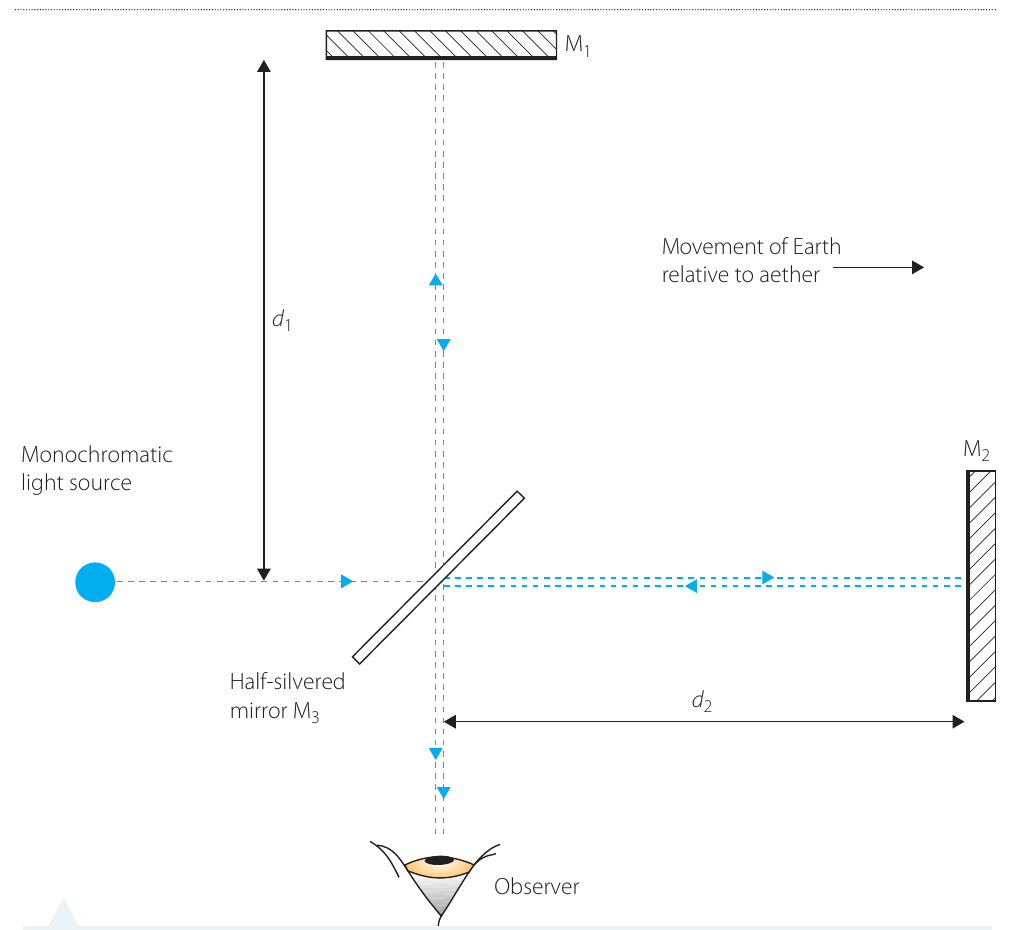
Michelson and Morley built a sensitive interferometer - a device that splits light into two beams, sends them along different paths, and then recombines them. Their apparatus had several key features:
- The entire instrument sat on a large stone block floating in a bath of mercury, allowing it to be rotated smoothly without vibrations
- A monochromatic light source (single wavelength) provided the light beam
- A half-silvered mirror () split the beam into two perpendicular paths
- Two additional mirrors ( and ) reflected the beams back
- The two path lengths ( and ) were made equal with very high precision
Note
How an interferometer works:
An interferometer exploits the wave nature of light. When two light waves overlap, they can constructively interfere (producing bright regions) or destructively interfere (producing dark regions), creating a pattern of bright and dark fringes. Any difference in the time taken for light to travel the two paths will shift this interference pattern, making interferometers extremely sensitive to even tiny differences in light speed or path length.
How the experiment worked
The operation of the interferometer relied on the wave properties of light:
- Light from the source hit the half-silvered mirror
- Part of the beam was transmitted through and traveled to mirror , where it reflected back
- The other part of the beam was reflected by and traveled to mirror , where it reflected back
- Both returning beams reached again - some of each beam was directed to the observer
- The two beams superimposed (overlapped) and created an interference pattern of bright and dark fringes
Expected results
Because the two light paths were perpendicular to each other, they couldn't both be parallel to Earth's motion through the aether at the same time. If the aether theory was correct and light speed was relative to the aether (not the observer), the speed of light should be different along the two paths.
As the apparatus was slowly rotated, first one path and then the other would become more aligned with Earth's motion through the aether. This changing alignment should cause the light to take different amounts of time to travel each path, which would shift the positions of the interference fringes as the apparatus rotated.
The actual results
The experiment produced a null result - Michelson and Morley detected no evidence whatsoever for the presence of the aether. The interference pattern remained unchanged as they rotated the apparatus, suggesting that light traveled at the same speed in both directions regardless of Earth's supposed motion through the aether.
Important
The significance of the null result:
This was not simply a negative result - it was a profound discovery that challenged the entire foundation of 19th-century physics. If the aether existed and was stationary, the experiment should have detected Earth's motion through it. The complete absence of any effect meant either:
- The aether doesn't exist, or
- Something was fundamentally wrong with how physicists understood space, time, and motion
The null result was so unexpected that many physicists initially refused to accept it, leading to decades of attempted explanations and refined experiments.
Refining the experiment
Over the following 50 years, Michelson and other scientists repeated and refined the experiment using various techniques to increase its sensitivity. Despite these improvements, no evidence for the aether was ever found.
Attempts to explain the null result
Some physicists attempted to save the aether theory by suggesting that perhaps Earth somehow dragged the aether along with it as it moved through space. This "aether drag" would explain why Michelson and Morley couldn't detect Earth's motion relative to the aether - if the aether moved with Earth, there would be no relative motion to detect.
However, later experimental work definitively showed this explanation to be incorrect. The aether theory had to be abandoned, but this created a new problem: how could light travel through empty space without a medium? The resolution to this puzzle would require a revolutionary new theory - Einstein's special relativity.
Summary
Key Points to Remember:
-
Classical relativity stated that all velocities are relative and there is no absolute frame of reference, but this created problems when combined with Maxwell's equations for light.
-
The aether was proposed as a transparent, weightless, stationary medium through which light waves could travel, providing an absolute frame of reference.
-
The Michelson-Morley experiment (1887) used an interferometer to detect Earth's motion through the aether by comparing light speeds in perpendicular directions.
-
The experiment produced a null result - no evidence for the aether was found, despite 50 years of increasingly sensitive measurements.
-
The failure of the aether theory set the stage for Einstein's revolutionary special theory of relativity, which would resolve the contradiction between classical relativity and Maxwell's equations.