Investigating the Photoelectric Effect (HSC SSCE Physics): Revision Notes
📚Revision Notes
Investigating the Photoelectric Effect
Introduction
In the early 20th century, the nature of light was hotly debated. Max Planck had introduced the radical idea of energy quantisation as a mathematical tool to explain the black body spectrum. However, this contradicted the well-established wave model of light. While scientists accepted that matter comes in discrete particles (atoms), the concept that energy itself might be quantised was revolutionary and controversial.
Note
The debate about light's nature was not merely academic—it challenged fundamental assumptions about how energy and radiation behaved. Planck himself initially viewed quantisation as just a mathematical trick rather than physical reality.
The photoelectric effect provided the crucial experimental evidence that confirmed energy quantisation was not just a mathematical convenience, but a fundamental property of nature.
Discovery of the photoelectric effect
The photoelectric effect was first observed by Heinrich Hertz in 1887. Hertz discovered that when light strikes a highly polished metal surface, electrons can be emitted from that surface. This was a surprising finding that demanded explanation.
Following Hertz's initial observation, his assistant Philipp Lenard conducted detailed investigations of the phenomenon. Lenard developed sophisticated equipment to make quantitative measurements of the intensity and energy of the emitted electron beams (then called 'cathode rays'). Robert Millikan and other physicists also performed careful experiments to understand the effect.
Important
Their combined experimental work revealed several puzzling features that the classical wave theory of light could not explain. These contradictions would ultimately lead to a revolution in physics.
The experimental apparatus
Scientists investigated the photoelectric effect using a specialized apparatus consisting of an evacuated glass tube with a quartz window. The setup includes:
- Metal plate X: A polished metal surface where photoelectrons are emitted when light strikes it
- Metal plate Y: A collecting electrode that attracts the emitted photoelectrons
- Quartz window: Allows ultraviolet light to pass through (ordinary glass would absorb it)
- Ammeter (A): Measures the photocurrent (flow of photoelectrons)
- Voltage divider: Allows adjustment of the potential difference between the plates
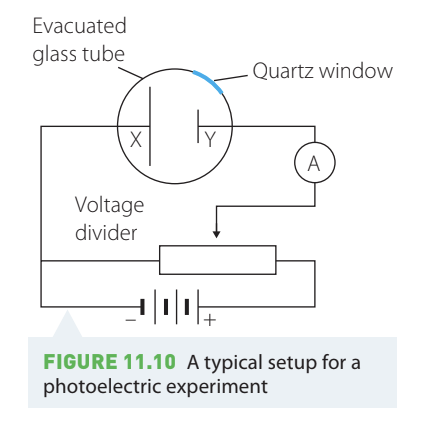
When light passes through the quartz window and strikes plate X, electrons are ejected from the surface. These photoelectrons are attracted to the positively charged plate Y, creating a measurable current called the photocurrent.
Note
The quartz window is essential because ordinary glass absorbs ultraviolet light. Many metals require UV light to exhibit the photoelectric effect, so using quartz ensures the full spectrum of incident light can reach the metal surface.
Key experimental observations
Careful experiments using this apparatus revealed several important findings that would challenge classical physics:
Cut-off frequency
A photocurrent is only produced when the frequency of incident light exceeds a minimum value called the cut-off frequency (). This implies a corresponding cut-off wavelength given by:
where is the speed of light.
Important
Above this wavelength, no photocurrent is produced, regardless of how bright the light is. This observation directly contradicted classical wave theory, which predicted that sufficiently intense light of any frequency should eventually cause electron emission.
Intensity and current relationship
The magnitude of the photocurrent (the number of photoelectrons emitted per second) depends on the intensity of the light but not on its frequency, provided the frequency exceeds . Brighter light produces more electrons, but changing the colour (frequency) of the light does not affect the number of electrons emitted.
Instantaneous emission
There is no time delay between light striking the metal surface and photoelectrons being emitted. This happens instantly, regardless of the light's intensity. Even very dim light that exceeds the cut-off frequency immediately produces photoelectrons.
Note
Classical wave theory predicted that dim light would need time to accumulate enough energy in an atom to eject an electron. The instantaneous emission observed in experiments was completely unexpected and contradicted this prediction.
Material-specific properties
Different metals have different characteristic cut-off frequencies. Each metal requires light of a specific minimum frequency before it will emit photoelectrons. This suggests that the energy required to remove an electron depends on the metal's properties.
Measuring maximum kinetic energy
Reverse bias voltage
The voltage divider can be adjusted to reverse the potential difference between plates X and Y, creating what is called a reverse bias voltage. In this configuration, plate Y becomes negative and repels the photoelectrons rather than attracting them.
When moving against this repelling force, electrons lose kinetic energy as they travel from plate X toward plate Y. The electrons move from a point of higher potential to one of lower potential, which for negatively charged particles means their electrical potential energy increases and their kinetic energy decreases.
Stopping voltage
As the reverse bias voltage is gradually increased, fewer and fewer photoelectrons have sufficient kinetic energy to reach plate Y. Eventually, when the voltage reaches a critical value called the stopping voltage (), even the most energetic photoelectrons are stopped before reaching plate Y, and the current drops to zero.
The stopping voltage is directly related to the maximum kinetic energy of the photoelectrons by:
where is the elementary charge ( C).
Note
This equation tells us that the maximum kinetic energy equals the stopping voltage multiplied by the electron's charge. By measuring the stopping voltage, we can determine the maximum kinetic energy of the emitted photoelectrons without directly measuring their velocities.
Experimental results and work function
When the maximum kinetic energy of photoelectrons is plotted against the frequency of incident light, a remarkable pattern emerges. The graph shows a linear relationship for each metal, but different metals produce parallel lines with different intercepts.
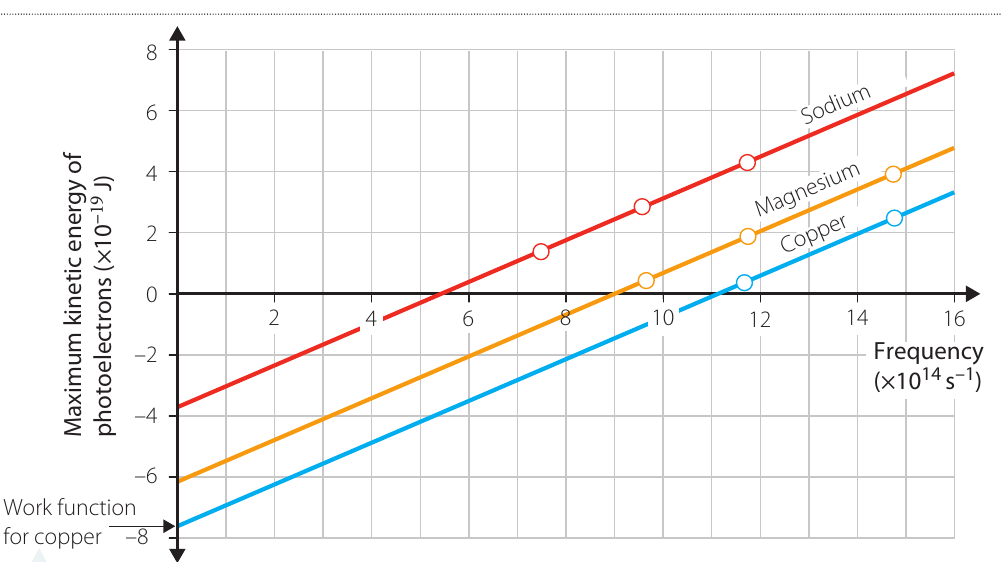
Several key features are evident from this graph:
- Linear relationship: For each metal, maximum kinetic energy increases linearly with frequency
- Parallel lines: All three metals show lines with the same slope, suggesting a universal constant
- Different intercepts: Each metal has a different y-intercept, indicating different energy requirements
- Threshold frequency: Extrapolating each line to zero kinetic energy reveals the cut-off frequency for that metal
The y-intercept (where the line crosses the vertical axis) represents the work function of the metal. This is the minimum energy required to remove an electron from the metal's surface. For an electron to just escape the metal with zero kinetic energy, it must receive energy equal to the work function.
Important
Different metals have different work functions because their atoms bind electrons with different strengths. Copper has a higher work function than sodium, meaning it takes more energy to liberate an electron from copper than from sodium. This material-specific property explains why each metal has a different cut-off frequency.
Comparison with classical electromagnetic theory
The experimental observations of the photoelectric effect fundamentally contradicted predictions made by classical electromagnetic wave theory. The following table compares what was actually observed with what classical theory predicted:
| Experimental observation | Prediction from classical electromagnetic wave model |
|---|---|
| Photocurrent only occurs for frequencies above , and is characteristic of the material. | Electrons should be emitted at any frequency, as long as the intensity is high enough. |
| The size of the current depends on intensity but not frequency. | The current should depend on both intensity and frequency. |
| There is no time delay between the absorption of light and emission of a photoelectron at any intensity. | At low intensities it takes time for enough energy to be absorbed by the atoms. Hence, there should be a delay between the light being turned on and electrons being emitted. The delay should be longer for lower intensities. |
| The maximum kinetic energy of the electrons depends on the frequency of light but not on the intensity. | The kinetic energy should only be related to the intensity, and not to the frequency. |
Important
These discrepancies between theory and experiment demonstrated that the classical wave model of light was incomplete. Light does not behave solely as a continuous wave when interacting with matter. Instead, it exhibits particle-like properties, with energy arriving in discrete packets called photons. This quantum behaviour was essential to explaining the photoelectric effect.
Worked example
Example
Worked Example: Calculating Photoelectron Energy and Velocity
Question: In a photoelectric effect experiment, the stopping voltage, , has a magnitude of 3.75 V.
(a) What is the kinetic energy of the fastest emitted electron?
(b) How fast is it going?
Solution
(a) Finding maximum kinetic energy:
We use the relationship between stopping voltage and maximum kinetic energy:
Substituting the values:
(b) Finding velocity:
We use the kinetic energy equation:
Rearranging to make the subject:
Substituting values (electron mass kg):
Answer: The fastest photoelectron has a kinetic energy of 6.0 × 10⁻¹⁹ J and travels at approximately 1.1 × 10⁶ m·s⁻¹ (about 0.4% of the speed of light).
Remember!
Summary
Key Points to Remember:
-
Photoelectric effect: When light strikes a metal surface, electrons can be emitted, but only if the light frequency exceeds a material-specific cut-off frequency ().
-
Cut-off frequency is crucial: No matter how bright the light, if the frequency is below , no photoelectrons are produced. This directly contradicts classical wave theory.
-
Stopping voltage measures maximum energy: The stopping voltage () relates to maximum photoelectron kinetic energy by .
-
Work function: The energy needed to just remove an electron from a metal surface varies between different metals, explaining why they have different cut-off frequencies.
-
Classical theory fails: The photoelectric effect cannot be explained by treating light as a continuous wave. It provided key evidence for the quantum nature of light and energy quantisation.